
Chicken pickle is ready to eat food which is made by cooking chicken pieces with several spices, stored with mustard oil for longer shelf life. Calcium testing of chicken pickle is a laboratory analysis conducted to determine the amount of calcium present in the product. Calcium is an essential mineral for bone health and metabolic functions, and its presence in food products like chicken pickle can influence the nutritional value and labeling of the product.
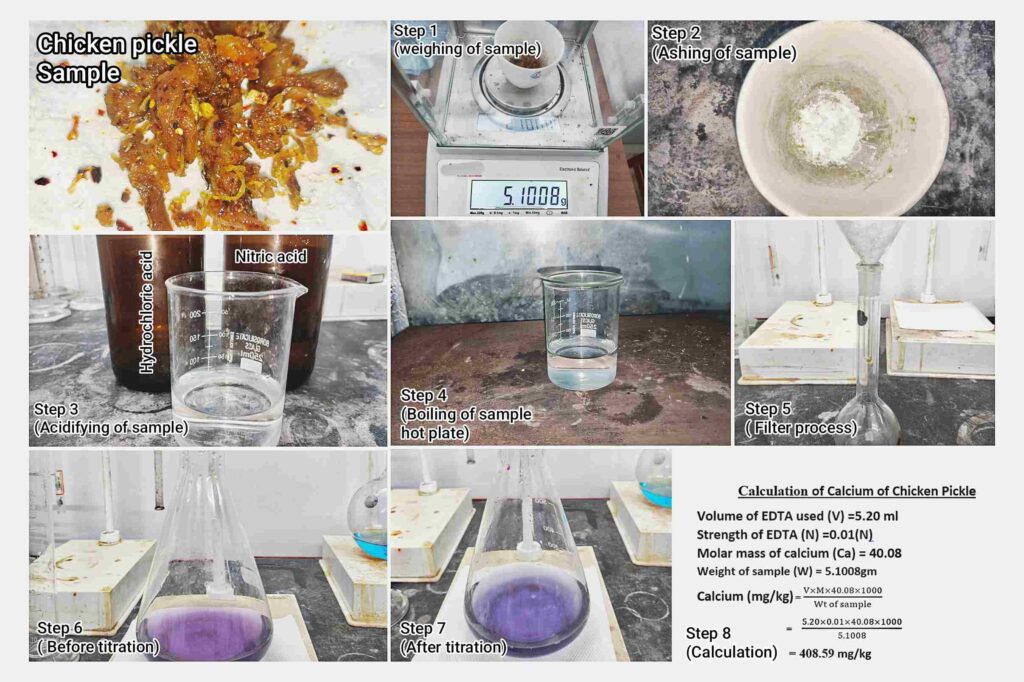
We determine calcium content by titrimetric with Ethylene Diamine Tetraacetic Acid (EDTA) method in our Pro Research & Testing Laboratory.
Instruments & Chemicals Used to Calcium Test of Chicken Pickle
- Silica crucible-Holds samples during ashing at high temperatures.
- Muffle furnace – Burns off organic matter to obtain ash for analysis.
- 4-digit analytical balance-Measures sample weight precisely.
- Hot plate – Heats solutions during sample preparation.
- Beaker(250ml) – Holds the ash mixed with acids while heating.
- Burette(50ml) – Dispenses precise volumes of titrant (EDTA).
- Volumetric flask(100ml) – Used for making accurate solution volumes.
- Funnel – Helps in transferring liquids and filtering.
- Filter paper – Separates solids from liquids during filtration.
- Conical flask (250ml)– Holds the sample during titration.
- Pipettes(5ml)- To add acids.
- pH meter – To check whether the pH of the sample is 12 after mixed with triethanolamine
Chemicals used
- Hydrochloric acid – Dissolves ash during sample preparation.HCl helps dissolve calcium salts into a clear solution, making calcium available for titration.
- Nitric acid- Helps in digestion and sample clarity.This acid effectively break down the food matrix and release bound minerals.
- 0.01N Ethylene Diamine Tetraacetic Acid (EDTA)-Titrant used to bind calcium ions during titration.EDTA binds with Ca²⁺ and Mg²⁺, breaking the indicator-metal complex.
- Triethanolamine –It helps to maintain alkaline pH (around 12) during titration, which is essential for selective and accurate complexation of calcium ions with EDTA.
- 1N sodium hydroxide solution-Adjusts pH for accurate titration. Dilute 4gm of NaOH in 100ml distilled water.
- Patton-Reeder indicator – Indicates the endpoint in calcium titration with EDTA.
- Distilled Water-To make the titrant.The conductivity of distilled water should be <5 μS/cm to prevent contamination
Method Of Calcium Testing of Chicken Pickle Sample
| Sample Preparation | Weigh 5 g of chicken pickle sample in silica crucible. Ash the sample(process previously described) in a muffle furnace. Dissolve the ash in a 5ml hydrochloric acid & 5ml nitric acid. Add 50 ml distilled water and boil for 5 minutes in a hot plate.Boiling ensures maximum recovery of total calcium. |
| Filtration | Filter the solution to remove any insoluble residue and make up the final volume in a volumetric flask (100 ml). |
| Reagents Required | Prepare 0.01N EDTA solution described previously. |
| Titration Steps | Take 100 ml of the prepared test solution in a conical flask. Add 5 mL of NaOH & triethanolamine to maintain correct pH (pH 12) for titration. Add a pinch of Patton-reeder indicator. The solution turns purple. Titrate with EDTA solution slowly from a burette until the color changes from purple to blue (end point) |
| Calculation | Note the titre value and calculate as per the formula |
Calculation for Calcium Test
Calcium( mg/kg)=( V×M×40.08×1000)/ Wt of sample
V = Volume of EDTA used (mL)
M = Molarity of EDTA
40.08 = Molar mass of calcium (Ca)
W = Weight of the sample (g)
Why it is important to test the Calcium of Chicken Pickle?
- Nutritional Assessment: To determine the calcium content for accurate nutritional labeling, which helps consumers make informed dietary choices.
- Quality Control: To monitor and maintain consistent calcium levels across batches, ensuring product uniformity.
- Shelf-life and Stability Analysis: Calcium levels may affect the texture and stability of the pickle over time; testing helps understand and control these factors.
- Compliance with Food Safety Regulations: Regulatory bodies may require calcium content disclosure mentioned clearly.
Handling Mistakes should be avoided during Calcium Test of Chicken Pickle
- Using the Wrong Indicator-Using an inappropriate or expired indicator can lead to undefined colour change which may affect to get exact titre value.
- Over/Under Titration-Adding EDTA too quickly or missing the endpoint leads to over- or under-titration
- Improper Standardization of EDTA Solution-Using EDTA without standardizing it against a calcium standard.If EDTA concentration is not correct, all subsequent results will be inaccurate.
- Not using masking agent- Use a masking agent (NaOH) to prevent magnesium interference.
- Contaminated Glassware-Using unclean or dirty burettes, pipettes, or flasks, causes contamination, affecting titration accuracy.Proper cleaning Process described previously.
- Incorrect Sample Digestion or Preparation-Incomplete ashing can leads to wrong result.
Conclusion of Test the Calcium in Chicken Achar
Calcium testing of chicken pickle is essential for accurate nutritional labeling, quality assurance, and regulatory compliance. By determining the calcium content, producers can ensure consistency, assess the nutritional value, and meet consumer health needs. Proper testing using validated methods like EDTA titration ensures reliable results, supporting food safety and product integrity in the food industry.To perform calcium test at a food manufacturing company or laboratory should ensure by following standard procedures mentioned above to accurately determine the Calcium testing and assess the quality of the chicken yormi with availability of the apparatus & chemicals and also the above real-time photo attachment will help to understand the testing process completely. In addition, if expert guidance is needed ,please reach out to Pro Research & Testing Laboratory.
FAQ related to Calcium Testing of Chicken Achar
1.Can this test detect calcium in all types of pickles?
Ans- Yes, with proper sample preparation, it can be used for any pickle containing calcium.
2.Why is ashing required before calcium testing?
Ans-Ashing removes organic matter, leaving minerals (like calcium) for accurate titration.
3.What happens if pH is not controlled during titration?
Ans- Inaccurate results may occur because EDTA may not bind calcium correctly at the wrong pH.
4.What is the role of sodium hydroxide (NaOH) in calcium titration?
Ans- It adjusts the pH to around 12, necessary for calcium- titration with Patton-Reeder indicator.
5.What if magnesium is present in the sample?
Ans- Use pH control and masking agents(NaOH) to avoid interference from magnesium during calcium titration.
6.How to handle if the solution does not change color clearly during titration?
Ans- Check pH, freshness of indicator, and proper dissolution of the ash.
7.How many titrations should be done for reliable results?
Ans-Perform at least three consistent titrations, and take the average reading for accuracy.
8.Why do some methods use both HCl and HNO₃ together?
Ans- Using both acids can ensure complete digestion of complex residues, especially in tough or oily samples like chicken pickle.
9.Why boiling of acid containing ash is important?
Ans-Boiling ensures maximum recovery of total calcium, making the test result reliable and reproducible.
10.Why triethanolamine is used?
Ans-In chicken pickle, the matrix is complex due to presence of fats, proteins, spices, and acids. TEA ensures a stable pH environment which allows precise detection of calcium, especially when other interfering ions are present.
How We Verified This Testing/Research Procedure :
This testing procedure is done under qualified analyst .Continually monitored by expertise.Repeatedly testing is always done to get accurate result.

Written by
Riya Ghosh (M.Sc. Food Technology, MAKAUT)
Designation – Chemist
Reviewed by
Anwesha Das (M.Sc Microbiology,BU)
Designation – Microbiologist
Verified By
Dr. Jyotirmoy Kumar Dey (Phd,Chemistry)
Designation – Senior/Chief Chemist
Experience – 25 Years +