
Ovaltine powder or Malt Milk is a popular malted drink mix that made from barley malt extract, milk solids, and cocoa. People commonly consume it as a health beverage, and producers fortify it with vitamins like A, C, D, B-complex,protein and minerals such as iron and calcium, making it a nutritious supplement, especially for children and the elderly.
Crude fibre in Malt Milk represents the indigestible portion of plant-based ingredients. It primarily includes cellulose and lignin, which aid in digestive health by promoting bowel regularity and supporting gut function.
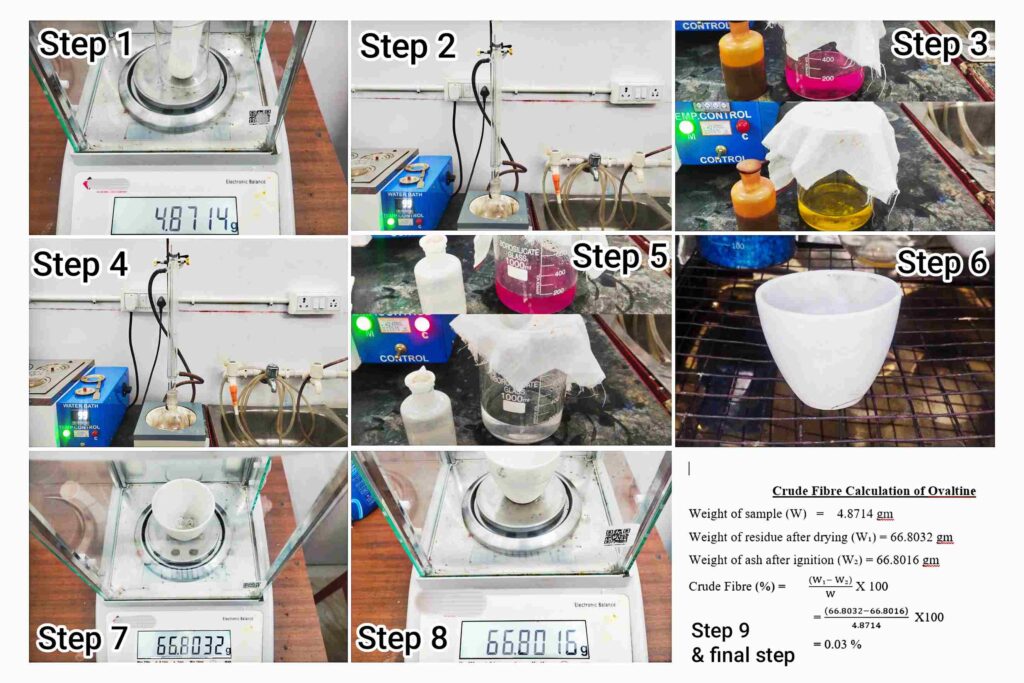
Here,we describe the details procedure of crude fibre testing followed in our lab Pro Research Testing & Laboratory
Crude Fibre Testing for Ovaltine or Malt Products :
To determine the amount of crude fiber in ovaltine powder, the sample is successively digested using diluted acid and alkali to eliminate digestible materials.The remaining residue is ashed after it is dried and weighed.The amount of crude fiber is determined by the weight loss during ashing.
Following equipments are required during this test-
Instruments Used during this Test:
- Heating mantle – Provides heat(95°C- 100°C) for digestion of the sample.
- Hot Air Oven -To dry the residue at 105°C before ignition.In hot air oven sample does not absorb moisture from air which helps to get accurate result.
- Muffle furnace – Burns organic matter at high temperature (600°C) to determine ash content.
- Dessicator – Use for cool the sample to avoid absorb the moisture.
- 4 digit Analytical balance – Measures precise weight of sample, residue, and ash.
- Water Tap – To provide constant water supply during the reflux process to maintain the temperature of condenser.If water flow discontinued then condenser become heated & sample will well out from the condenser.
Glassware Used during this Test:
- Measuring cylinders (250 ml)– For accurate measurement of reagents.
- Flat Bottom Flask (500 ml) – For sample digestion with acid and alkali.
- Pipette (2 ml) : To measure Sulphuric acid while preparing 1.25% Sulphuric acid.
- Condenser – It is used during both alkali & acid digestion to prevent loss of volatile components.
- Silica Crucibles (30 ml capacity) – To hold the sample.
- Muslin Cloth (Fine linen 18 threads) & Beaker ( 1000 ml ) – For filtering & during washing steps..
Chemicals used during the Test :
- Dilute Sulfuric Acid (1.25%): Breaks down acid-soluble substances such as starch, proteins, and sugars.It helps remove digestible organic matter.To make 1.25% add 1.25 ml sulphuric acid in 100 ml distilled water.
- Dilute Sodium Hydroxide (1.25%) : Removes alkali-soluble substances like residual proteins.It ensures the final residue consists of crude fibre (mainly cellulose and lignin).To make 1.25% NaOH solution add 1.25gm NaOH to 100 ml distilled water.
- Distilled water : For washing and preparing reagents.For reagent preparation the conductivity of the distilled water should be <5 µS/cm.
- Phenolphthalein & Methyl red Indicator : It is used to know the residue is proper washed & acid-alkali free. Phenolphthalein for alkali & methyl red for acid indicator. (To make methyl red indicator add 2-3 gm methyl red powder into 100 ml distilled water & to prepare phenolphthalein indicator take 0.1 gm phenolphthalein powder add in 100 ml ethyl alcohol).
Procedure To Follow While Doing Crude Fibre for Ovaltine or Malt Products:
| Step | Details |
| 1. Sample preparation | Weigh 2–5 g of Ovaltine powder or malt milk powder. Remove fat of the sample by Soxhlet Method (previously described). |
| 2. Acid digestion | Take sample from cellulose thimble & boil with 200 mL of 1.25% H₂SO₄ for 30 minutes using a reflux condenser.Stir occasionally to suppress the foam.If stirring is not done sample may be spill out from the condenser which can lead to sample loss. |
| 3. Filtration and washing | Transfer the residual sample into cloth & filter using a muslin cloth.Wash residue with distilled water until acid-free.Use methyl red indicator.Colour changes from pink to yellow when it become acid free. |
| 4. Alkali digestion | Transfer residue to clean flask, boil with 200 mL of 1.25% NaOH for 30 minutes. Stir occasionally to suppress the foam. |
| 5. Filtration and washing | Filter again and wash thoroughly with distilled water.Use phenolphthalein indicator.Colour changes from pink to colourless when it become alkali free. |
| 6. Drying | Transfer the residue by spatula (if all the residue can not be transfer wash the cloth with little distilled water & dry it in heating mantle) into crucible.Dry the residue in an oven at 105°C until constant weight is achieved. Record the value. |
| 7. Ashing | Ignite the dried residue in a muffle furnace at 600°C for 3–4 hours. Cool in desiccator and weigh.Finally calculate the result using formula. |
Calculation of Crude Fibre Testing in Ovaltine :
Crude Fibre (%) = (W₁- W₂)/W × 100 W= Weight of Sample, W₁ = Weight of residue after drying W₂ = Weight of ash after ignition
Purpose of Crude Fibre Testing in Ovaltine or Malt Products :
Crude fibre testing ensures Ovaltine’s quality, nutritional accuracy, and consumer safety. Besides this,
- To determine fibre content – Helps assess the nutritional value related to digestive health.
- To ensure quality control – Verifies that the product meets label and regulatory fibre specifications.
- To support product development – Helps create health-oriented or fiber-rich options.
- To meet food safety standards – Required for nutritional labeling and compliance with food regulations.
Handling Mistakes to Avoid During Crude Fibre Test of Ovaltine or Malt Products :
Proper technique and consistency are crucial to obtaining reliable crude fibre values.
- Incomplete defatting – Defatting prevents interference in digestion and improves accuracy of the crude fibre result.
- Over- or under-boiling – Improper digestion time can cause loss or incomplete breakdown of sample.
- Insufficient washing – Inadequate washing may leave acid/alkali traces, affecting final weight.
- Loss of residue during transfer – Spillage while filtering or transferring can cause errors in weight.
- Improper drying – Not drying to constant weight may lead to inaccurate residue mass.
- Contaminated crucibles or glassware – Residual ash or moisture can skew weight measurements.
- Inaccurate weighing – Use a calibrated analytical balance; even small errors affect percentage calculation.
- Ashing temperature too high or low – May lead to incomplete combustion or loss of residue.
- Not cooling in desiccator – Hot crucibles absorb moisture from air, altering final weight.
Conclusion of Crude Fibre Testing in Ovaltine or Malt Products:
Crude fibre estimation in Ovaltine powder or malt products is an essential analytical procedure to evaluate its indigestible plant-based content, mainly cellulose and lignin. This test helps determine the product’s nutritional quality, especially its contribution to digestive health. Accurate results depend on proper sample preparation, precise digestion, and weighing.By using standardized methods, this test helps with quality control, research & development purpose,following regulations, and nutritional labels for food packaging. By using the method mentioned above, you can easily check the crude fiber in any lab or factory that has the right equipments and chemicals.This testing process gives you accurate results, which are really important for quality control in many areas. Plus, if you find the procedure confusing, you can look at the real-time photo included with this text, which shows you each step and makes it easier to understand. Also, if you want professional help or need more advanced testing, you can contact Pro Research & Testing Laboratory for your testing needs.
FAQs of Crude Fibre Testing in Ovaltine or Malt Products
Q1. What is crude fibre in Ovaltine powder?
A: Crude fibre is the indigestible part of plant material, mainly cellulose and lignin, present in Ovaltine from ingredients like barley.
Q2. What are the others name of Ovaltine powder?
A: Ovaltine powder is also known as Malt Milk powder, Dehydrated Malt.
Q3. Why is crude fibre testing important?
A: It helps assess the nutritional value, supports digestive health evaluation, and ensures product quality.It is also important for nutritional labeling for food business operators.
Q4. Is defatting necessary before crude fibre estimation?
A: Yes, defatting prevents interference in digestion and improves accuracy of the crude fibre result.If defatting is not done the sample may be contaminated which may give high value or unnecessary result of crude fibre.
Q5. What causes low crude fibre values?
A: Incomplete digestion, improper washing, or loss of residue during filtration can result in lower fibre readings.
Q6. Why is ashing done in the test?
A: Ashing removes organic matter, allowing accurate measurement of fibre by subtracting ash weight from dried residue.
Q7. Why 1.25% sulphuric acid and NaOH is used not more stronger than that?
A: These dilute concentrations are strong enough to hydrolyze and remove most proteins, starches, and other digestible components. Strong acid or alkali may digest necessary fibre in sample also which can give error result.
Q8.Can I do this test in any laboratory or manufacturing units?
A:Yes, by following the above-mentioned method, you can easily test the crude fibre at any laboratory or manufacturing industry with the availability of the equipment and chemicals. Furthermore, if you can’t understand the procedure, you can check our real-time photo attached with this writing. Alternatively, you can also reach out to Pro Research & Testing Laboratory for testing purposes.
How We Verified This Testing/Research Procedure :
This testing is done under qualified analysts in our lab.Continually monitored by expertise.Repeatedly testing is always done to get accurate result.

Written by
Anwesha Das (M.Sc Microbiology,BU)
Designation – Microbiologist
Reviewed by
Riya Ghosh (M.Sc. Food Technology, MAKAUT)
Designation – Chemist
Verified By
Dr. Jyotirmoy Kumar Dey (Phd,Chemistry)
Designation – Senior/Chief Chemist
Experience – 25 Years +