
Dissolved Oxygen (DO) is one of the most important parameters in assessing the quality of Wastewater/Sewage water/Effluent water. It represents the amount of oxygen available in water for aquatic life and for biological processes such as the degradation of organic matter. Adequate oxygen levels are essential for aerobic microorganisms to break down pollutants, while low level indicates pollution, organic overload, or anaerobic conditions that can produce foul odors and harmful by-products.
Here we take waste water to test Dissolve Oxygen.
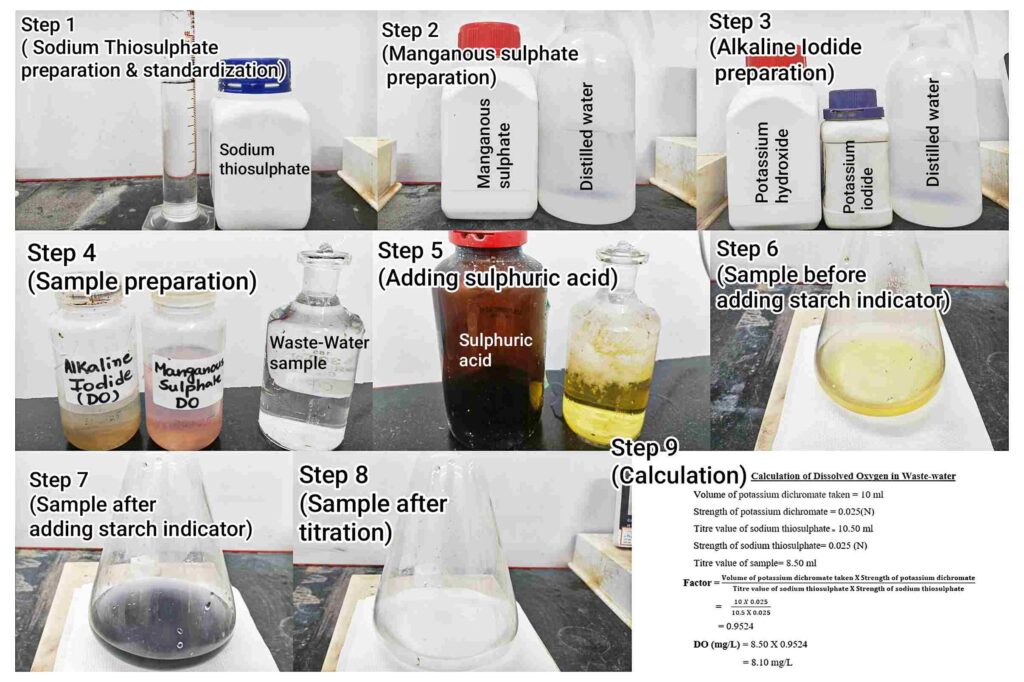
Measuring DO in wastewater is therefore crucial for monitoring treatment efficiency, ensuring regulatory compliance, and protecting receiving water bodies. The most common method used is Winkler’s iodometric titration method to determine Dissolved Oxygen in Pro Research & Testing Laboratory.
Glasswares,Apparatus & Chemicals used to test Dissolved Oxygen in Wastewater
- BOD bottles(300ml)-Collect water samples without air bubbles to avoid oxygen contamination.
- Pipettes(2ml)-Used to add precise volumes of reagents & acid.
- Conical flask(500ml)- To hold the sample solution during titration.
- Measuring Cylinder(250ml)-Measures sample solution accurately.
- Volumetric flask(1000ml)-Preparation of standard solutions like sodium thiosulphate.
- Analytical Balance(4-digit)-Weighs chemicals for standard solution & reagent preparation.
- Heating Mantle– To make starch indicator.
- Distilled Water-To prepare Standard Solution & reagent.The conductivity of distilled water should be <5 μS/cm to prevent contamination.
- Manganous Sulphate solution-It reacts with oxygen to form manganese hydroxide precipitate.To prepare manganous sulphate solution dissolve 364 g of Manganese Sulphate (MnSO4.H2O ) in 1000 ml distilled water.
- Alkaline iodide solution-Provides alkaline medium and iodide ions for iodine liberation.To prepare alkaline iodide solution dissolve 700 gm potassium hydroxide(KOH) and 150 g of potassium iodide(KI) in 1 litre distilled water.
- Sulphuric Acid(H2So4)-Acidified solution to release iodine equivalent to dissolved oxygen. Here we have used the Sulphuric Acid of Nice company. You can use the same company or any other companies.
- Starch Indicator-Forms a blue complex with iodine, showing titration endpoint.Dissolve 2 g of starch and 0.2 g of salicylic acid in 100 ml of hot distilled water.
- Sodium Thiosulphate solution(0.025N)-To prepare 0.025 N sodium thiosulphate solution dissolve 25 g of sodium thiosulphate in boiled distilled water & make up to 1000 ml. From there take 250 ml solution and volume make up to 1000 ml with distilled water.
Procedure To Test Dissolved Oxygen in Wastewater
| Standardization of 0.025 (N) Sodium Thiosulphate | Prepare stock solution of potassium dichromate by dissolving 12.259 g potassium dichromate in 120 mg sulphamic acid & 1000 ml distilled water. To make 0.025 N potassium dichromate solution take 100 ml from the stock solution and volume make up to 1 litre. Take 10 ml 0.025 (N) potassium dichromate,add 2 ml sulphuric acid. Titrate against 0.025(N) sodium thiosulphate solution using starch indicator. Factor=(Volume of potassium dichromate taken X Strength of potassium dichromate )/(Titre value of sodium thiosulphate X Strength of sodium thiosulphate) |
| Sample preparation | Take a 300ml BOD bottle.Fill the bottle with wastewater sample. Add 2 ml Manganous sulphate & Alkaline iodide solution each. Shake well. Add 2 ml Concentrated Sulphuric acid & shake well. |
| Titration | Take 200 ml of the sample solution,add 2-3 drops of starch indicator & titrate against 0.025N sodium thiosulphate solution. Colour changes from blue to colourless. |
| Calculation | DO (mg/L)=Titre Value of sample X Factor |
Purpose of DO Testing To Test Dissolved Oxygen in Wastewater
- Assessment of Water Quality – To determine whether the wastewater contains sufficient oxygen to support aquatic life.
- Monitoring Treatment Efficiency – To evaluate the performance of wastewater treatment plants, especially in aeration tanks where oxygen is required for microbial activity.
- Pollution Control – To detect oxygen depletion caused by organic or chemical pollutants, which can lead to anaerobic conditions.
- Prevention of Environmental Hazards – To avoid fish death, foul odor generation, and harmful anaerobic by-products in receiving water bodies.
- Compliance with pollution control board- Dissolved Oxygen testing is an important parameter in compliance with pollution control as from the result the BOD value can be assumed.
Handling Mistakes To Test Dissolved Oxygen in Wastewater
- Delay in Sample Testing – If the wastewater sample is left open for too long before testing, oxygen may escape or dissolve, giving inaccurate results.
- Presence of Air Bubbles – Shaking the sample bottle or not filling it completely allows air bubbles, which artificially increases DO levels.
- Improper Fixation of Sample – In Winkler’s method, reagents must be added immediately after sample collection. Delay causes oxygen exchange with air.
- Contaminated Containers – Using dirty or detergent-rinsed bottles introduces chemicals that affect DO. Always use clean, DO-specific bottles.Proper cleaning Process described previously.
- Improper Mixing of Reagents – Incomplete or excessive mixing during chemical addition leads to faulty titration readings.
- Leaking/Storing Bottles Improperly – Poor sealing or long storage causes oxygen diffusion, leading to inaccurate low DO readings.
- Using Expired or Wrong Chemicals – Old titrants or wrongly prepared solutions affect endpoint accuracy.
Conclusion of Test Dissolved Oxygen in Wastewater
The Winkler’s method is a reliable technique for estimating dissolved oxygen in water. It helps assess water quality and suitability for aquatic life as well as pollution levels. This makes it essential in environmental and wastewater analysis.By following these method, you can easily test the Dissolved Oxygen content at environmental science laboratory or any laboratory & also manufacturing industry with availability of the equipments & chemicals. If you can’t understand the procedure you can check our real time photo attached with this writing or also you can reach to Pro Research & Testing Laboratory for the testing purposes.
FAQ of Test Dissolved Oxygen in Wastewater
1.What is Dissolved Oxygen (DO)?
Dissolved oxygen is the amount of oxygen gas present in water in dissolved condition, necessary for aquatic life and biological processes.
2.Why is DO important in water testing?
It indicates water quality, pollution levels, and the ability of water to support aquatic organisms.
3.What is the principle of DO testing (Winkler Method)?
The Winkler method is based on the chemical fixation of oxygen in water using manganous sulfate and alkaline iodide, forming iodine equivalent to the oxygen content, which is then titrated with sodium thiosulfate.
4.How is a water sample collected for DO testing?
Use clean, air-tight BOD bottles. Fill completely without trapping air bubbles. Avoid touching the inside of the bottle or cap to prevent contamination
5.Why is standardization of sodium thiosulfate important?
Accurate titration depends on knowing the exact concentration of sodium thiosulfate, ensuring reliable DO results.
How We Verified This Testing/Research Procedure :
This testing procedure is done under qualified analyst .Continually monitored by expertise.Repeatedly testing is always done to get accurate result.

Written by
Riya Ghosh (M.Sc. Food Technology, MAKAUT)
Designation – Chemist
Reviewed by
Anwesha Das (M.Sc Microbiology,BU)
Designation – Microbiologist
Verified By
Dr. Jyotirmoy Kumar Dey (Phd,Chemistry)
Designation – Senior/Chief Chemist
Experience – 25 Years +