
Fat testing in milk is a crucial analysis to determine the percentage of milk fat, which directly indicates its quality and value. It helps in standardization for dairy products like butter, cheese, and ghee.This testing ensures nutritional labeling, and quality control in dairy industries, while also helping to detect adulteration or dilution in milk samples.
The Rose–Gottlieb method is a gravimetric procedure for determining milk fat. Ammonia first breaks protein–fat binding, ethanol minimizes emulsions, and the fat is extracted with diethyl ether followed by petroleum ether. The combined solvent is evaporated, the residue is dried to constant mass, and the increase in weight is reported as fat percentage. It’s highly accurate and widely accepted for milk and many dairy products.

Here’s detailed procedure of fat testing in milk by the Rose–Gottlieb method is given,followed in our lab –
Instruments & Glasswares used to Test Fat content in Milk Sample
- Analytical balance (4 digit) : To measure the milk precisely for accurate fat percentage calculation.
- Heating Mantle: Maintains constant temperature to ensure uniform extraction and safe evaporation of solvents without degrading fat.
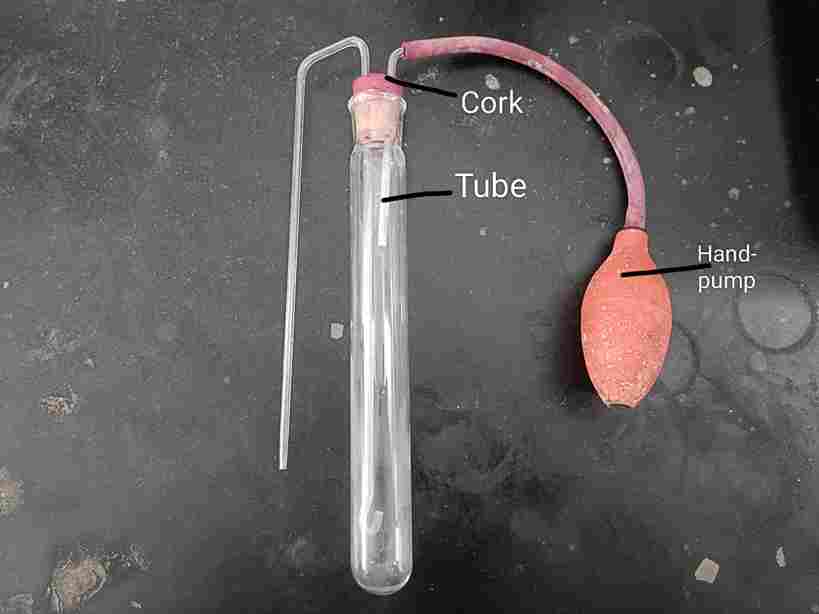
- Rose–Gottlieb tube with Cork or stopper & silicone rubber hand pump: For holding milk sample and solvents during fat extraction & allows separation of fat-solvent mixture from the aqueous layer.
- Condenser- It is attached on top of the extractor that condenses solvent vapour back into liquid through the sample.
- Splash Head Condenser – It operates between the flask and the condenser while recovering the ether.
- Recovery Funnel – It attached with the condenser while recovering the ether.
- Hot Air oven & desiccator: Removes moisture and ensures the fat residue reaches constant weight for accurate results.
- Beaker : For sample measurement.
- Measuring cylinders(1ml,10ml & 25 ml) : Used for measurement of solvents into samples.
- Flat Bottom Flask : Holds fat-solvent mixture for evaporation to leave pure fat residue for weighing.
- Water Supply : Provide constant water supply during extraction to maintain the temperature of condenser.If water flow discontinued then condenser become heated & break the condenser.
Chemicals used to Test Fat content in Milk Sample
- Ammonia solution : Breaks protein–fat bonds, releasing fat from milk proteins in alkaline medium
- Ethanol (95%) : Prevents formation of emulsions, aiding complete fat extraction.To prepare 95% ethanol add 95 ml ethanol in 5 ml distilled water.Down graded ethanol may take huge time to remove emulsion which remains in fat,affects in result.
- Diethyl ether : Dissolves almost all milk fats due to non-polar nature.
- Petroleum ether: It ensures complete extraction and reduces residue volatility.
- Distilled water & Acetone: Used for dilution and cleaning, preventing contamination and maintaining accuracy.
Procedure to Test Fat content in Milk Sample
| Sample preparation | Weigh 10 ml (in gm) milk sample. Add 1 ml ammonia,10 ml 95% ethanol,25 ml diethyl ether & 25 ml petroleum ether into it. Shake to mix the reagent with sample properly. Keep it standby until it seperate the layers. |
| Sample extraction | Dry the flask & take empty weight. Collect the upper layer in the dry flask by pumping. Evaporate the solvents to get the fat residue by recovery process. Dry the flask in hot air oven with fat residue until the constant weight. Repeat the procedure at least 5 times for accurate result. |
Calculation | Calculate with the below formula to determine fat content. Fat Content( %)=[ ( mass of the flask with the fat, after drying – mass of the empty dry flask)/ Sample taken for the test]×100 |
Purpose of fat testing in milk by the Rose–Gottlieb method
- Determine accurate fat content for quality evaluation and product standardization.
- Ensuring nutritional labeling, and quality control in dairy industries.
- Maintain nutritional quality, since fat is a key source of energy and essential fatty acids.
- High fat levels can lead to rancidity over time, especially in dehydrated milk products stored for long period.
- Detect adulteration or dilution, ensuring the milk meets regulatory standards and consumer safety.
Handling Precautions to Test Fat content in Milk Sample
Here are key handling precautions and common mistakes to avoid during fat testing of milk by the Rose–Gottlieb method
- If the process is started late fat may be decomposed which can affect in result accuracy.
- Ensure proper homogenization of the milk sample to avoid inaccurate fat distribution.
- Use completely dry glassware to prevent fat loss or solvent contamination.Proper cleaning Process described previously.
- Handle solvents like diethyl ether and petroleum ether in a well-ventilated area to avoid fire hazards.
- Prevent loss of solvent during evaporation, as this can lead to underestimation of fat content.
- Use an analytical balance carefully to avoid weighing errors.
- Avoid contact of fat residue with dust or moisture or emulsion, which can alter final weight readings.
- Incomplete mixing of chemicals leading to partial fat extraction.
- Overheating during evaporation, which may oxidize or decompose fat.
- Not drying the residue to constant weight, resulting in inaccurate fat percentage.
Conclusion to Test Fat content in Milk Sample
The Rose–Gottlieb method is a highly accurate and reliable reference procedure for determining fat content in milk. By using ammonia and ethanol to release bound fat and solvent extraction for separation, it ensures precise and reproducible results. This method supports quality control, nutrition labelling and regulatory compliance in the dairy industry.By following these method,you can easily test the fat content at any laboratory or manufacturing industry with availability of the equipments & chemicals.If you can’t understand the procedure you can check our real time photo attached with this writing or also you can reach to Pro Research & Testing Laboratory for the testing purposes.
FAQ of Test Fat content in Milk Sample
Q1. Why is the Rose–Gottlieb method preferred?
It is considered the reference method because of its high accuracy, reproducibility, and compliance with standards.
Q2. Can this method be used for products other than milk?
Yes. With slight modifications, it is used for curd, condensed milk, ice cream, and other dairy products.
Q3. Why are two solvents (diethyl ether and petroleum ether) used?
Using two solvents ensures complete fat extraction since some fats dissolve better in diethyl ether than petroleum ether alone.
Q4. What causes inaccurate results?
Common issues include late testing start, improper homogenization, wet glassware, solvent loss, or overheating during drying.
Q5. What is the minimum fat % should be present in mil?
As per FSSAI fat should present minimum for 3.0%- 4.0% in cow milk & for 5.0 % in buffalo milk.
Q6. Can I do this test in any laboratory or manufacturing units?
Yes,by following above mentioned method,you can easily test the fat content at any laboratory or manufacturing industry with availability of the equipments & chemicals.If you can’t understand the procedure you can check our real time photo attached with this writing or also you can reach to Pro Research & Testing Laboratory for the testing purposes.
How We Verified This Testing/Research Procedure :
This testing is done under qualified analysts in our lab.Continually monitored by expertise.Repeatedly testing is always done to get accurate result.

Written by
Anwesha Das (M.Sc Microbiology,BU)
Designation – Microbiologist
Reviewed by
Riya Ghosh (M.Sc. Food Technology, MAKAUT)
Designation – Chemist
Verified By
Dr. Jyotirmoy Kumar Dey (Phd,Chemistry)
Designation – Senior/Chief Chemist
Experience – 25 Years +