
Iron is a naturally occurring element in soil, rocks, and groundwater, and can enter drinking water through the dissolution of minerals, corrosion of iron pipes, or industrial discharges. While iron is not considered a health hazard at typical levels, excessive amounts can cause undesirable taste, staining of laundry and plumbing fixtures. Water which is free from iron is good for hair as well as skin as excessive iron can damage hair follicles which may cause hair loss.Regular testing of drinking water for iron is therefore important to ensure quality, consumer acceptance, and compliance with water quality guidelines.
Here we test the iron of Drinking Water Sample
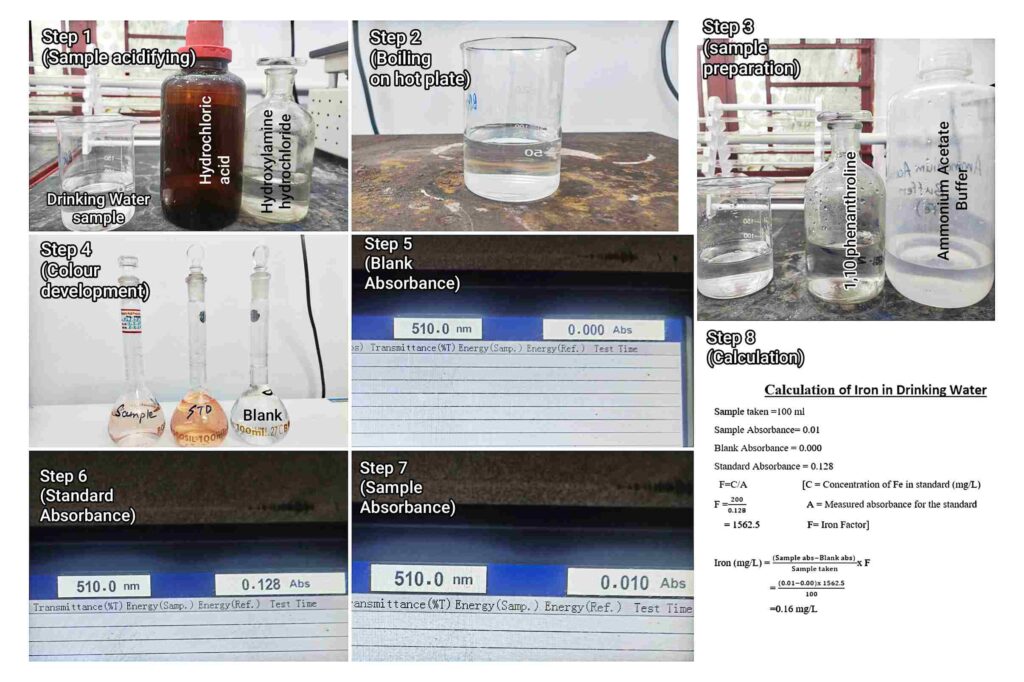
Among the various analytical methods,we Pro Research & Testing Laboratory detect iron concentration in drinking water by 1,10-phenanthroline method.
Instruments,Glasswares & Chemicals while performing the Iron test in Water-
- Spectrophotometer (510 nm) – Measures the absorbance of the iron–phenanthroline complex.
- Hot Plate – To boil the blank, sample & standard solution.
- 1 cm pathlength cuvettes – Hold the colored solution for optical measurement.
- Volumetric flasks (100 mL, 1000 mL) – Prepare and dilute reagents and standards to accurate volumes.
- Graduated pipettes (2 ml,5ml,10 ml) – Transfer precise volumes of reagents.
- Beakers (250 mL) – Mix and hold solutions during preparation.
- Measuring cylinders (100ml) – Measure water sample.
- Analytical balance (4 digit) – Weigh solid chemicals accurately for reagent preparation.
- Dropper- To add dropwise potassium permanganate solution.
Chemical used
- Hydrochloric Acid-Used to acidify the sample and prevent iron precipitation.
- Sulphuric Acid– To make stock iron solution.It is used to complete dissolve of iron compounds to make it stable form,preventing its oxidation & precipitation before analysis.
- Hydroxylamine solution-Reduces ferric iron (Fe³⁺) to ferrous iron (Fe²⁺) for complex formation,ensuring all the iron is in the same oxidation state.Dissolve 10 g of hydroxylamine hydrochloride in 100 ml distilled water.
- Ammonium Acetate Buffer Solution-Maintains pH around 4–5 for optimal color development. Dissolve 250 g ammonium acetate 150 ml distilled water. Add 700 ml glacial acetic acid.
- Ammonium iron(II) sulfate hexahydrate-Primary standard used to prepare iron stock solution.
- 1,10 Phenanthroline Solution-Forms a stable orange-red complex with Fe²⁺ for colorimetric measurement.Dissolve 100 mg 1,10 phenanthroline in 100 ml distilled water, by stirring and heating at 80°C.
- 0.1 N potassium permanganate solution-Standard oxidizing solution for preparing iron standard. 3.16g of potassium permanganate in 1 litre distilled water.
- Distilled water-To make the reagent.The conductivity of distilled water should be <5 μS/cm to prevent contamination.
Procedure of Iron testing in Water Sample
| Preparation of stock iron solution | Weigh 1.404 g of Ammonium iron(II) sulfate hexahydrate [Fe(NH₄)₂(SO₄)₂·6H₂O] and dissolve it completely in the acidified water(50 mL of distilled water in a 250 mL beaker & carefully add 20 mL of concentrated sulphuric acid with constant stirring and let it cool). Add 0.1 N potassium permanganate solution dropwise until a faint pink colour just persist.Transfer the solution to a 1000 mL volumetric flask, dilute to the mark with distilled water and mix well. |
| Preparation of standard iron solution | Pipette 10 mL of the iron stock solution into a 100 mL volumetric flask. Dilute with distilled water to mark. This solution contains 1 ml= 200 mg/L of iron . |
| Pre-boiling Preparation | Take 100ml drinking water sample & the working standard in separate beakers. Add 2 ml hydroxylamine solution and 2 ml conc HCL and boil ( at 100°C) till reduced to 50 ml. |
| Buffer Addition | Cool the solutions. Add 5ml 1,10 Phenanthroline Solution & 10 ml Ammonium Acetate Buffer Solution. Volume make up to 100 ml. Keep the solution to rest for 15 minutes for colour development. |
| Measuring the Absorbance | Measure the absorbance at 510 nm. Run a blank sample in the same way. Perform the test at least in 3 set to get accurate result. |
| Iron factor calculation | F=C/A C = Concentration of Fe in standard (mg/L) A = Measured absorbance for the standard F = Iron factor |
| Calculation of Iron | Iron(mg/L)= (Sample abs-Blank abs) x F/Sample taken |
Purpose of Testing for Iron Test in Water Sample
- Compliance with water quality standards – To verify that iron concentration is within regulatory or guideline limits (≤0.3 mg/L as per IS 10500) for safe and acceptable drinking water.
- Prevention of household issues – To avoid metallic taste, reddish-brown discoloration, and staining of clothes and utensils caused by excess iron.
- Protection of plumbing systems – To prevent internal corrosion, scaling, and clogging of pipes that can reduce water flow and damage infrastructure.
- Early detection of contamination sources – To identify and address issues like pipe corrosion, groundwater mineral leaching, or industrial discharge before they worsen.
Handling Mistakes while doing iron test in water sample
- Not acidifying the sample before adding buffer-Causes iron to precipitate, leading to low readings.
- Old or oxidized reagents-Reduces color development accuracy and sensitivity.
- Not adding reducer for Fe³⁺-Ferric iron won’t react with phenanthroline without being reduced to Fe²⁺,makes incomplete reaction which can impact the result.
- Dirty or scratched cuvettes / bubbles-Distorts light path, giving incorrect absorbance values which gives the false result.
- Wrong wavelength setting-Leads to wrong absorbance readings and inaccurate results.
- Forgetting dilution factors-Causes miscalculation of the final iron concentration.
- Using uncalibrated & dirty glasswares-Results in volume errors and inaccurate standard/sample preparation.Proper cleaning Process described previously.
Conclusion for Testing of Iron in Water
Testing iron in drinking water ensures the water meets safety and quality standards, prevents staining and taste issues, and protects public health. The 1,10-phenanthroline method is a reliable, sensitive, and easy technique to detect even low levels of iron. Accurate results depend on reagent preparation, elimination of interferences, and strict adherence to the procedure.Monitoring once in six month helps maintain water quality and ensures compliance with regulatory limits.To perform iron test at a water manufacturing company or laboratory should ensure by following standard procedures mentioned above to accurately determine the iron and assess the quality of the drinking water with availability of the apparatus & chemicals and also the above real-time photo attachment will help to understand the testing process completely. In addition, if expert guidance is needed ,please reach out to Pro Research & Testing Laboratory.
FAQ about the Test of Iron in Water Sample
1.Why is iron present in drinking water?
Ans-It can come from natural sources like soil and rocks, corrosion of iron pipes.
2.What problems does excess iron cause?
Ans-Unpleasant metallic taste, reddish-brown staining of laundry, clogging of pipes.
3.How often should drinking water be tested for iron?
Ans-At least once in six month, or whenever there are complaints of metallic taste, staining, or after changes in water source.
4.Does the 1,10-phenanthroline method measure total iron?
Ans-Yes, by reducing Fe³⁺ to Fe²⁺ (using hydroxylamine & HCl) before adding 1,10-phenanthroline.
5.What is the ideal range of iron in drinking water?
Ans- According to IS 10500,the maximum acceptable limit of iron is 0.30 mg/L. We recommend iron in drinking water should be <0.01 mg/L.
6.Why is acid added before testing?
Ans-To prevent precipitation of iron and keep it dissolved for accurate measurement.
7.What should be taken care while measuring in spectrophotometer?
Ans-While measuring in a spectrophotometer, ensure clean scratch-free cuvettes, no bubbles, correct wavelength, same cuvette orientation, consistent filling, and quick measurement after preparation.
8.How to remove excess iron contamination from water?
Ans-Remove excess iron from water by using an filter or a water softener.
For heavy iron, use aeration, chlorination, followed by filtration.Manually, you can fill a clean container with the water, let it sit for several hours so iron settles as rust, then pour off the clear water by straining using a clean cloth and discard the sediment.
How We Verified This Testing/Research Procedure :
This testing procedure is done under qualified analyst .Continually monitored by expertise.Repeatedly testing is always done to get accurate result.

Written by
Riya Ghosh (M.Sc. Food Technology, MAKAUT)
Designation – Chemist
Reviewed by
Anwesha Das (M.Sc Microbiology,BU)
Designation – Microbiologist
Verified By
Dr. Jyotirmoy Kumar Dey (Phd,Chemistry)
Designation – Senior/Chief Chemist
Experience – 25 Years +