
Zinc dross is a Poly-metallic non-ferrous concentrates,a by-product generated during the galvanizing process and other zinc-based metallurgical operations. It consists mainly of zinc oxide, metallic zinc, and impurities such as iron, aluminum, or lead. Depending on formation temperature, zinc dross is categorized as top dross (light, oxidized form) or bottom dross (heavier, iron-rich form). Though considered a waste by-product, zinc dross is valuable because it can be recycled to recover metallic zinc, making it an important secondary resource for the non-ferrous industry.
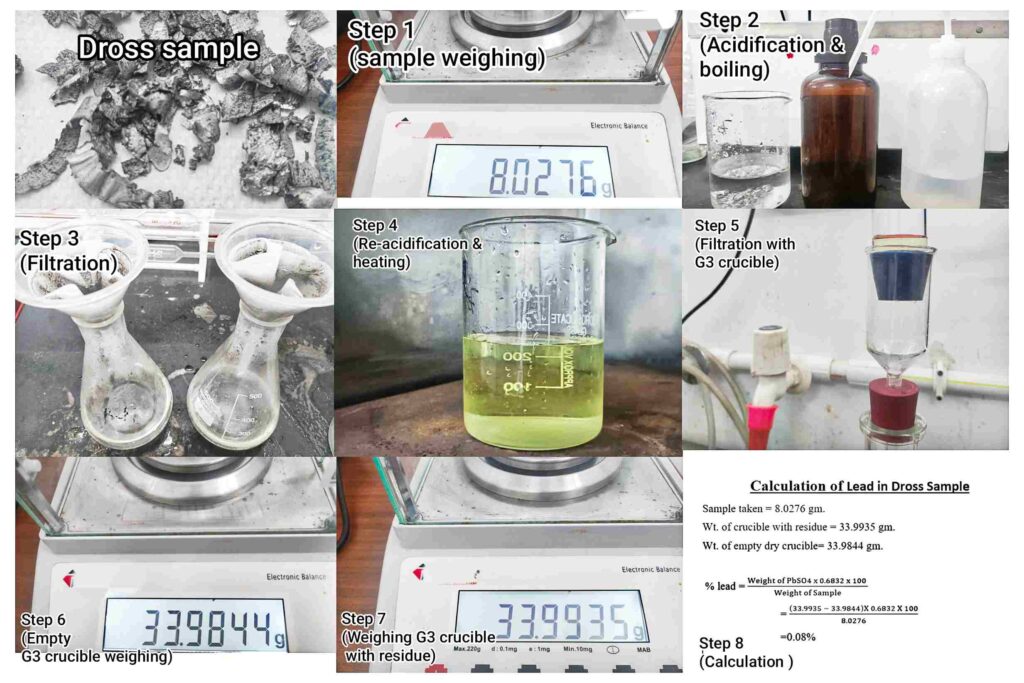
Zinc dross is a complex, metal-rich matrix. Accurately determining lead(Pb) requires complete digestion of the sample and a technique that copes with high Zn matrix levels.
Instruments,Glassware & Chemicals used in testing of Lead in Non-ferrous Metal Dross Sample
| Instruments | Weight balance (4 Digit) | Used for precisely weigh the sample. |
| Hot Air oven | Used for evaporation & drying at certain temperature(150°C). | |
| Desiccator | To cool hot crucibles after heating to prevent moisture absorption before weighing with the presence of desiccant i.e silica beads. | |
| Hot Plate | Used during digestion & boiling sample. | |
| Vacuum Pump | A vacuum pump generates a pressure differential that compels the liquid to flow through the crucible. | |
| Glasswares | Beaker (250 ml) | Mix and hold solutions during preparation. |
| G3 Crucible with Filtration Unit | To filter the sample after digestion process. | |
| Funnel with whatman 1 filter paper | To filter the sample during the process | |
| Chemicals | Nitric Acid | To digest the sample.Here we have used the Nitric Acid of Nice company. You can use the same company or any other companies. |
| Sulphuric Acid | Used for precipitation of Lead(Pb) as Lead Sulphate(PbSO4). Pb2+ + H2SO4 → PbSO4 ↓+ 2H+ [ after acidification] | |
| Distilled water | To mix the sample during digestion. The conductivity of distilled water should be <5 μS/cm to prevent contamination. |
Procedure to Test of Lead in Non-ferrous Metal Dross Sample
| Sample Preparation | Take 5-15 gm homogenized sample (mechanical mill) Digest the sample with 25 ml of distilled water & nitric acid. Digest till dissolution leaving behind the insoluble particle. |
| Filtration | Dilute the above with 50 ml distilled water. Warm & filter if particulates remain. |
| Boiling | To the filtrate add 20 ml- 25 ml of sulphuric acid & boil for 5 minutes & allow to settle till Lead(II) sulfate precipitation occurs. |
| Re-filter & drying | Dry a clean G3 gooch crucible & take the empty weight. Cool down the sample & filter with G3 gooch crucible. Dry the crucible with its contents until the constant weight. |
| Calculation | Note the value & calculate by using following formula % lead = Weight of PbSO4 x 0.6832 x 100 / Weight of Sample |
Why it is important to test the lead in Dross?
The main purpose of testing lead in zinc dross is to determine its concentration for quality control, environmental compliance, and resource recovery. Lead is an undesirable impurity in galvanizing and other zinc-based metallurgical operations, as high levels can affect product quality and processing efficiency. Accurate lead analysis helps in-
- Ensure product quality – Maintain required purity of zinc and prevent contamination of coatings.
- Optimize recovery – Identify whether secondary treatment or refining is needed to recover usable zinc and reduce lead content.
- Meet safety and environmental standards – Monitor hazardous lead levels to comply with regulations on waste handling, worker safety, and emissions.
- Support process control – Provide feedback for refining operations, enabling adjustments to reduce lead carry over into dross.
Handling Mistakes to Avoid during Testing of Lead in Dross Sample
- Improper Sampling – Taking a non-homogenize portion of dross can give inaccurate results, as lead distribution is uneven.
- Loss of Sample – Spillage, incomplete transfer, or residues in containers reduce actual test mass.
- Contamination – Using unclean glassware, reagents, or filters may introduce external lead, giving falsely high readings. Proper cleaning Process described previously.
- Incomplete Digestion – If the sample is not fully dissolved, lead trapped in undissolved particles will be missed.
- Poor Safety Practices – Mishandling acids, generating toxic fumes, or careless disposal of residues risks health and environmental safety.
Conclusion for Test the Lead in Non-ferrous Metal Dross Sample
Lead testing in zinc dross is an essential analytical step to ensure product quality, process efficiency and environmental compliance. Accurate determination of lead content helps industries monitor impurities, optimize zinc recovery, and maintain safe operating standards. By following proper sampling, digestion, and reliable results can be achieved, minimizing handling errors and supporting sustainable metallurgical practices.By using the method mentioned above, you can easily perform the lead determination test in any lab or factory or in other places that has the right equipments and chemicals.This testing process gives you accurate results, which are really important for quality control in many areas.Plus, if you find the procedure confusing, you can look at the real-time photo included with this text, which shows you each step and makes it easier to understand.Also, if you want professional help or need more advanced testing, you can contact Pro Research & Testing Laboratory for your testing needs.
FAQ about Lead Testing Process in Non-ferrous Metal Dross
Q1. Why is it important to test lead in zinc dross?
Testing ensures product purity, helps control process efficiency, and meets environmental and safety standards by monitoring toxic lead levels.
Q2. What are the main challenges in testing?
Incomplete digestion can leave undissolved lead, and contamination from reagents or glassware may give false results.
Q3. Can zinc dross with high lead content be reused?
Yes. It can be reprocessed to recover zinc, but additional refining may be required to lower lead content before reuse.
Q4. What safety measures should be taken during testing?
Always work in a fume hood, wear acid-resistant gloves, goggles, and lab coats, handle nitric acid carefully, and dispose of lead-containing waste as per hazardous waste guidelines.
Q5. How is lead concentration usually expressed in results?
Results are reported as mg of Pb per kg of zinc dross (mg/kg) or as a percentage (%) depending on industry requirements.
Q6. What mistakes commonly cause inaccurate results?
Improper sampling, incomplete digestion, poor calibration, and contamination during handling are the most common sources of error.
Q6. Which types of dross sample’s lead can determined by following this method?
By this method you can determined lead from Aluminium based Dross,Copper based Dross,Lead Dross,Tin based Dross etc or you can reach out to Pro Research & Testing Laboratory for testing purposes.
How We Verified This Testing/Research Procedure :
This testing is done under qualified analysts in our lab.Continually monitored by expertise.Repeatedly testing is always done to get accurate result.

Written by
Anwesha Das (M.Sc Microbiology,BU)
Designation – Microbiologist
Reviewed by
Riya Ghosh (M.Sc. Food Technology, MAKAUT)
Designation – Chemist
Verified By
Dr. Jyotirmoy Kumar Dey (Phd,Chemistry)
Designation – Senior/Chief Chemist
Experience – 25 Years +