
| Polenske value is an important analytical parameter used to evaluate the purity and quality of ghee. It specifically measures the amount of volatile, water-insoluble fatty acids present in ghee. Since these fatty acids are characteristic of milk fat, the Polenske value serves as a reliable test to detect adulteration with non-dairy fats or oils. A genuine ghee sample shows a defined range of Polenske values, while significant deviation indicates substitution or mixing with cheaper oils. Thus, Polenske value testing plays a vital role in ensuring the authenticity, nutritional quality, and consumer safety of ghee. |
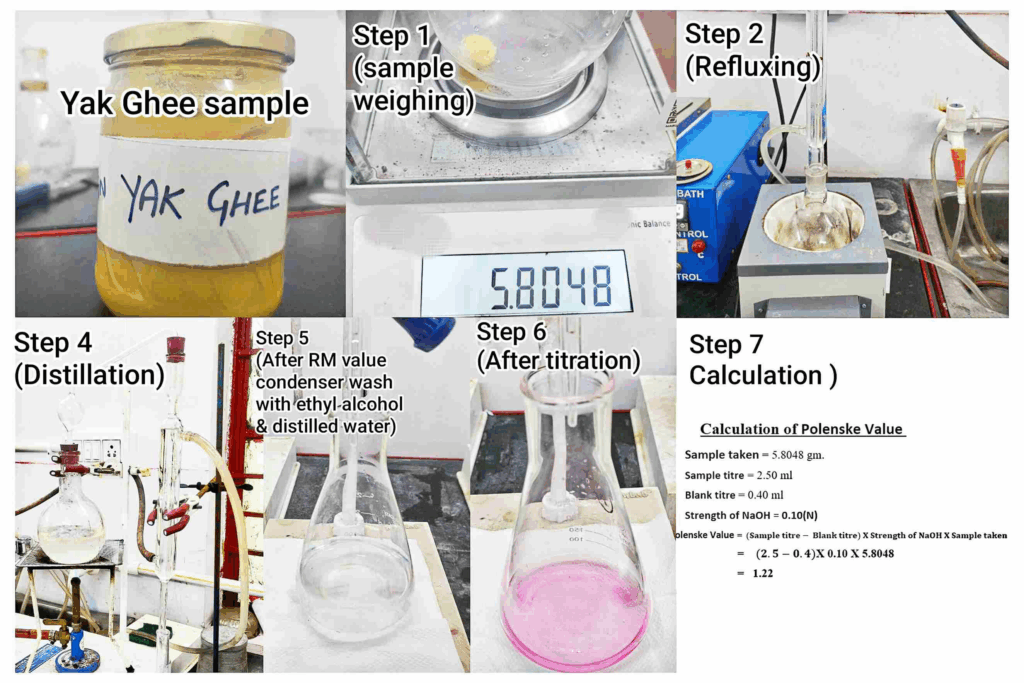
Yak ghee is made from Yak milk.To check the quality we test Polenske value in Pro Research & Testing Laboratory which is described as follows-
Instruments, Glasswares & Chemical used during the test
Instruments used
- 4 digit Analytical balance –to weigh ghee and reagents with high accuracy
- Heating Mantle -Provides uniform heating by electrical resistance to maintain controlled temperature during distillation
- Bunsen burner -to provide direct flame heating when required.
- Water Tap -Supplies continuous cold water to the condenser for efficient condensation of volatile fatty acids.
Glasswares used
- Measuring cylinders (50 ml) -Measures liquid volumes accurately.
- Volumetric Flask (110 ml)-Provides precise dilution up to the 110 ml mark for standard solutions.
- Pipette (2ml ) :Delivers an exact fixed volume of liquid (50% NaOH) by suction.
- Reflux condenser –Condenses volatile vapors back into liquid using water circulation.
- Flat bottom flask (500 mL) –Provides uniform heating surface for boiling ghee sample during distillation.
- Still Head – Directs vapors from boiling flask to condenser without loss.
- Burette (50 mL) –Measures and dispenses standard alkali solution accurately during titration.
- Conical flask (250 mL) –Serves as a receiver for distillate and mixing vessel during titration.
- Glass Beads -Prevent bumping and ensure smooth boiling.
Chemical used
- Glycerol (20 gm) – Use during saponification,ensures that all fats are broken down,freeing the volatile fatty acids that are needed for distillation & titration.,
- 50 % Sodium Hydroxide(NaOH)– Convert ghee into soap and glycerol so that the volatile fatty acids can be later separated and measured. Preparation Described previously.
- 0.1 (N) NaOH – It is used to titrate the distillate containing volatile fatty acids, quantify the amount of volatile fatty acids by neutralizing them. To prepare add 4 gm NaOH in 1000 ml distilled water. Here we have used the Loba company’s Sodium Hydroxide . You can use the same company or any other companies.
- Dilute(1:1) Sulphuric acid – Liberate volatile fatty acids by acidifying the soap solution, enabling their distillation and measurement in the RM value test. Add 25 ml Sulphuric acid in 25 ml of distilled water.
- Ethyl Alcohol -To run blank sample & to wash condenser.
- Phenolphthalein Indicator -Helps in detecting the end point (faint pink color) in titration.Preparation Described previously.
- Distilled Water – Used to prepare reagent.It is also used to dilute the saponified mixture before acidification.The conductivity of distilled water should be <5 μS/cm to prevent contamination.
Procedure
| RM value determination | Take 5 gm sample in a flat bottom flask and Run Reichert-Meissl value by following the process mentioned previously. |
| Condenser washing & Titration | After RM value take the 10 ml distillate left in the volumetric flask & wash the condenser with 45 ml of hot water with 10 ml of ethyl alcohol. Titrate against 0.1 N NaOH by using phenolphthalein indicator until it become colorless to pink which indicates the end point. Use blank value of RM value. |
| Calculation of Polenske Value | Polenske Value= (Sample titre- Blank titre) X Strength of NaOH X Sample taken |
Purpose of Polenske Value Testing
- Check Purity of Ghee – To confirm that the ghee is made from milk fat and not mixed with cheap oils or fats.
- Detect Adulteration – To identify substitution with non-dairy fats which lack volatile fatty acids.
- Quality Control – To maintain uniform standard of ghee in production and storage.
- Regulatory Compliance – To meet food safety standards and FSSAI specifications for ghee.
- Consumer Protection – To ensure authenticity and prevent fraud in the dairy market.
Handling Mistakes
- Wrong sample weight – Adding more or less ghee than required,can lead to wrong polenske value
- Not Washing condenser- Volatile fatty acid sticking to condenser wall will not recovered and it may give false result.
- Leaking apparatus – Volatile acids escape if joints are loose which give wrong result.
- Titration errors – While doing titration proper speed of should be maintained otherwise it may lead to over titration.
- Not standardizing NaOH– Not using freshly prepared & standardized reagents and using old or degraded reagents affect reaction efficiency.
Conclusion
Polenske value testing confirms the purity of ghee by measuring volatile fatty acids unique to milk fat. A standard value ensures authenticity, while deviations indicate adulteration with non-dairy fats.By following these method, you can easily test the Polenske Value of yak ghee or any other ghee at laboratory & also manufacturing industry with availability of the equipments & chemicals. If you can’t understand the procedure you can check our real time photo attached with this writing or also you can reach to Pro Research & Testing Laboratory for the advance testing.
FAQ
1.What is the Polenske value of ghee?
It is the number of milliliters of 0.1 N alkali required to neutralize the volatile water-insoluble fatty acids distilled from 5 g of ghee under specified conditions.
2.Why is Polenske value important in ghee testing?
It helps in detecting adulteration and characterizing ghee, since genuine milk fat has specific ranges of volatile fatty acids different from other fats and oils.
3.Why is Polenske value determined after RM value?
The distillate first contains water-soluble volatile acids (for RM value), which are titrated directly. After this, the insoluble acids are separated and titrated to give the Polenske value. Hence, the test sequence is RM value → Polenske value.
4.What is the normal range of Polenske value for pure ghee?
Typically the normal range of Polenske value for pure ghee is 1.0 – 2.0.
5.Can Polenske value alone confirm ghee purity?
No, it must be interpreted along with RM value to reliably detect adulteration.
6.What does a high Polenske value indicate?
A higher Polenske value suggests an abnormally high amount of insoluble volatile fatty acids, which can indicate adulteration with other oils.
7.Can you test Polenske value of other ghee by this method?
Yes, you can test the Polenske value of any ghee like cow ghee,gawa ghee,desi ghee,buffalo ghee etc by this procedure or you can reach out to Pro Research & Testing Laboratory for further details.
How We Verified This Testing/Research Procedure :
This testing is done under qualified analysts in our lab.Continually monitored by expertise.Repeatedly testing is always done to get accurate result.

Written by
Riya Ghosh (M.Sc. Food Technology, MAKAUT)
Designation – Chemist
Reviewed by
Anwesha Das (M.Sc Microbiology,BU)
Designation – Microbiologist
Verified By
Dr. Jyotirmoy Kumar Dey (Phd,Chemistry)
Designation – Senior/Chief Chemist
Experience – 25 Years +