
The Polymer Content Test is performed to determine the percentage of polymer present in a High-Density Polyethylene (HDPE) sample. It helps assess the quality and purity of the material by identifying the amount of polymer and the presence in polymeric substances. This test ensures that the HDPE material meets the specified quality requirements and is suitable for its intended application.
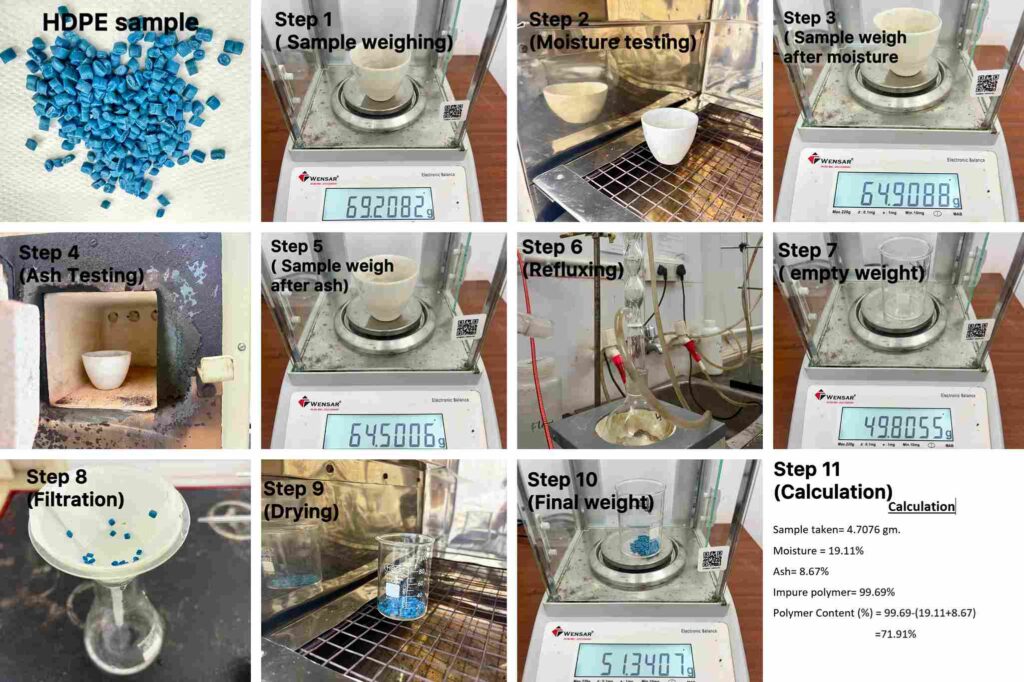
Chemicals, Equipmetns & Instruments Used in Polymer Content in HDPE Sample
| Chemical used | How it works |
| Chloroform | Used as a solvent allowing separation from insoluble fillers and contaminants. |
| Ethyl Alcohol | Used for washing and removing residual impurities or solvent from the polymer. |
| Toluene | Acts as an organic solvent to dissolve certain additives, waxes, or organic contaminants present in the sample. |
| Petroleum Ether | Used for degreasing and removing oils, grease, and other non-polar impurities from the sample. |
| Distilled Water | Used for rinsing glassware to remove impurities without introducing contaminants.The conductivity of distilled water should be <5 μS/cm to prevent contamination. |
| Equipments used | |
| Silica Crucible(50ml) | To hold the sample during moisture & ash testing. |
| Flat Bottom Flask(250 ml) | Holds solvent mixture for evaporation to leave pure residue that release the binders. |
| Condenser | It is attached on top of the extractor that condenses solvent vapour back into liquid through the sample. |
| Whatman Filter Paper With Funnel | To collect the residue by filtering the sample. |
| Water Supply | Provide constant water supply during extraction to maintain the temperature of condenser.If water flow discontinued then condenser become heated & break the condenser. |
| Instruments Used | |
| Analytical balance(4-digit) | Accurately weighs the sample used in the test. |
| Heating Mantle | This instrument provides constant heat to boil the solvent. |
| Muffle Furnace | Used to ash, leaving behind inorganic residue for analysis. |
| Hot-Air-Oven | Typically set at 85°C to remove moisture before and after the filtration. |
| Desiccator | It allows to cool the sample without interference of moisture. |
Analysing Method Followed to detect Polymer Content in HDPE Sample
Weigh approximately 5 g of the sample using a 4-digit digital balance.
│
▼
At first remove the moisture of the sample by the Moisture determination process & then it make it ash by the process described previously.
│
▼
On the other hand take 5 gm sample into flat bottom flask.
│
▼
Add 20 ml ethyl alcohol,20 ml chloroform,20 ml toluene, & 20 ml petroleum ether.Reflux it for one hour.
▼
│
Cool down & filter it through whatman filter paper.Dry the whole residue in hot air oven at 85°C
│
▼
Take the weight & Calculate the Polymer content using the formula: Polymer Content(%) = Impure polymer-(Moisture%+Ash%)
Purpose of the Polymer Content Test in HDPE
- Determine Polymer Content -To measure the percentage of polymer present in the HDPE sample.
- Assess Material Purity-To evaluate the purity of the HDPE by identifying non-polymeric materials.
- Detect Fillers and Additives -To determine the presence of fillers, pigments, or other additives that may affect product quality.
- Quality Control-To ensure consistency and uniformity of HDPE raw materials and finished products.
- Standards Compliance-To verify that the material meets the applicable specifications and quality standards.
- Product Performance-To ensure the HDPE possesses the required properties for its intended application.
Handling Mistakes should be avoided during Polymer Testing in HDPE Sample
- Incomplete ignition of ash or filter paper leads to higher residue weight.
- Using a wet or warm crucible for weighing gives incorrect results.
- Using unclean or contaminated glassware, which may affect test results. Proper cleaning Process described previously.
- Contamination from dust, tongs falsely increases weight of ash.
- Improper filtration (using damaged or folded filter paper) residue may pass through.
- Weighing without cooling in a desiccator moisture affects final weight.
- Incorrect Solvent Handling Use the specific quantity of solvents, and avoid solvent contamination or evaporation.
- Calculation Errors Verify all calculations and record results correctly.
- Loss of Sample During Transfer Transfer the sample carefully to prevent material loss.
Conclusion of the Testing of Polymer Content
The Polymer Content Test is an important quality control test for High-Density Polyethylene (HDPE) that determines the percentage of polymer present in the sample. Accurate testing, proper handling, and adherence to the prescribed test method ensure reliable results, verify material quality, and confirm compliance with applicable specifications and standards.By following these method, you can easily test the polymer content of any polymer products at laboratory & also manufacturing industry with availability of the equipments & chemicals. If you can’t understand the procedure you can check our real time photo attached with this writing or also you can reach to Pro Research & Testing Laboratory for the advance testing.
Frequently Asked Questions (FAQs) – Polymer Content Test in HDPE
What is the Polymer Content Test?
It is a test used to determine the percentage of polymer present in an HDPE sample.
Why is the Polymer Content Test performed?
To verify the quality, purity, and compliance of HDPE with specified standards.
Which solvents are commonly used in this test?
Chloroform, toluene, ethyl alcohol, and petroleum ether.
What does a high polymer content indicate?
It indicates good material purity and quality with minimal fillers or contaminants.
What can affect the accuracy of the test?
Incorrect weighing, contaminated glassware, incomplete dissolution, sample loss, and calculation errors.
Why is distilled water used during testing?
To rinse glassware and remove water-soluble impurities without introducing contaminants.
How We Verified This Testing/Research Procedure :
This testing is done under qualified analysts in our lab.Continually monitored by expertise.Repeatedly testing is always done to get accurate result.

Written by
Anwesha Das (M.Sc Microbiology,BU)
Designation – Microbiologist
Reviewed by
Riya Ghosh (M.Sc. Food Technology, MAKAUT)
Designation – Chemist
Verified By
Dr. Jyotirmoy Kumar Dey (Phd,Chemistry)
Designation – Senior/Chief Chemist
Experience – 25 Years +