
Sodium and potassium are essential electrolytes naturally present in many foods, including cooked meals. Sodium, often added as salt during cooking, helps regulate fluid balance and nerve function. Potassium supports heart health, muscle function, and maintains blood pressure. The balance between sodium and potassium intake is crucial for overall health. Improper balance of sodium-potassium in cooked food can lead to hypertension and cardiovascular risks. Therefore, analyzing sodium and potassium levels in cooked food is important for nutritional quality and health management. Here we have taken boiled rice for the test.
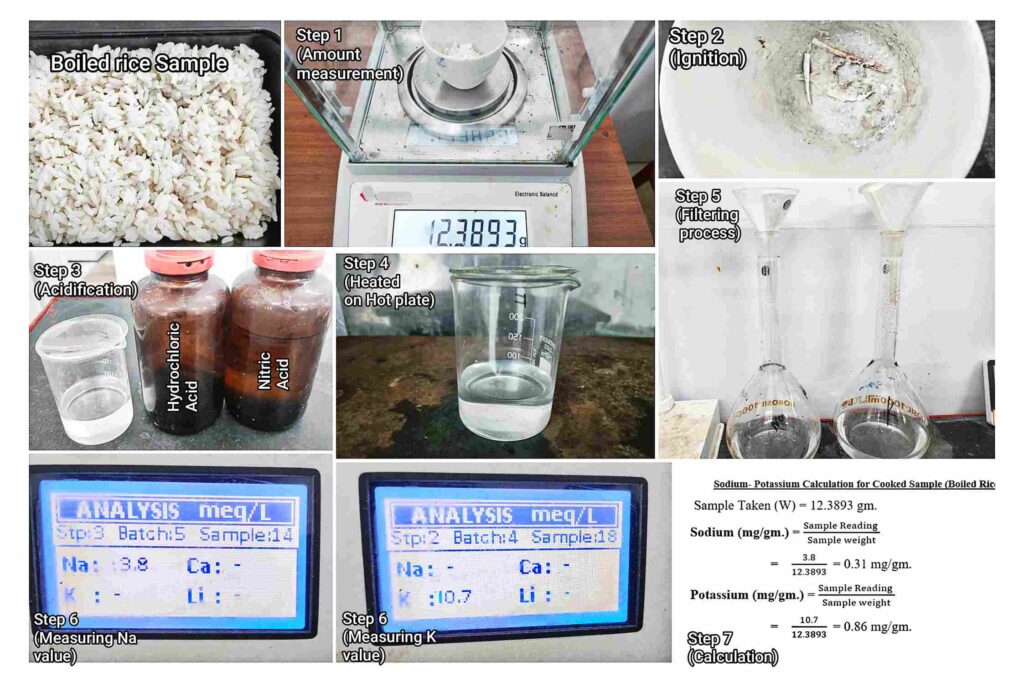
Here,Sodium-potassium determined by Flame Photometric Method followed in our Lab Pro Research & Testing Laboratory.
Glassware used in Sodium-Potassium Test of Cooked Food :
- Beakers (100 ml) – For sample extraction
- Silica Crucible(30 ml capacity) -To hold the sample
- Volumetric Flasks (100 ml, 1000 ml) – For standard and sample dilution
- Pipettes ( 5 ml, 10 ml) – For transferring standard solutions
- Glass Funnel & Filter Paper Whatman No. 42 – For filtration
Chemicals in Sodium-Potassium Test of Cooked Food :
- Sodium Chloride (NaCl) – To prepare sodium standard solution.
- Potassium Chloride (KCl) – To prepare potassium standard solution
- Hydrochloric Acid (HCl) & Nitric Acid (HNO3) – For sample extraction.These acids effectively break down the food matrix and release bound minerals.They form highly soluble salts with sodium and potassium and do not create precipitates or interfere with flame photometer readings.
- Distilled Water – For dilution and blank solution preparation.The conductivity of distilled water should be <5 μS/cm to prevent contamination.
Instruments in Sodium-Potassium Test of Cooked Food :
- Flame Photometer – For measurement of sodium and potassium concentration.Flame photometry is a simple and rapid method to determine sodium and potassium by measuring the intensity of light emitted by excited atoms in a flame. The higher the concentration, the brighter the emission.
- 4 Digit Analytical Balance – For accurate weighing of food samples and standards
- Hot Plate – For proper mixing and extraction
Standard Solution Preparation Process for Sodium-Potassium Test in Cooked Food :
| Standard Sodium Solution preparation (50 PPM) | Weigh 2.542 grams of NaCl.Dissolve it in distilled water and make the volume up to 1 liter.This gives a 1000 ppm sodium stock solution. Take 5ml from this stock solution volume make up to 100 ml distilled water in a volumetric flask. This standard sodium solution is used to calibrate the flame photometer for accurate measurement of sodium in food samples. |
| Standard Potassium Solution preparation (100 PPM) | Weigh 1.909 grams of KCl.Dissolve it in distilled water and make the final volume up to 1 liter.This gives a 1000 ppm potassium stock solution. Take 10 ml from this stock solution volume make up to 100 ml distilled water in a volumetric flask. This standard potassium solution is used to calibrate the flame photometer for accurate measurement of potassium in food samples. |
Testing Procedure followed to test Sodium-Potassium Test :
| Sample Preparation | Weigh desired of cooked food sample.Ignite it into muffle furnace to make it ash.(Process previously described) .Add 50–100 ml of distilled water ,5 ml HCl & 5 ml HNO3 (for better extraction of sodium and potassium). Mix well and heat. Stir the mixture for about 30 minutes to ensure proper extraction. Filter the extract using Whatman No. 42 filter paper & volume make up to 1000 ml. |
| Flame Photometer Setup | Turn on the flame photometer and allow it to stabilize. |
| Calibration | Aspirate the 50 ppm sodium standards and calibrate first to get the result accurate.Do the calibration of 100 ppm standard potassium solution in same way. |
| Sample Analysis | Aspirate the filtered food extract into the flame photometer & record the value. Perform each reading in triplicate for accuracy |
| Calculation | Finally calculate the result using following formula Sodium (mg/gm) = Sample Reading / Sample weight Potassium (mg/gm) = Sample Reading / Sample weight |
Purpose of Sodium and Potassium Testing in Cooked Food:
- To assess the nutritional quality of cooked food or any others food(like,Sauces & Pickles,Snacks,Ready to Eat foods,Ready to cook foods)
- To monitor sodium and potassium levels for maintaining a healthy electrolyte balance.
- To prevent health risks such as hypertension, heart disease, and kidney problems caused by excess sodium.
- To ensure compliance with food safety and nutritional labeling regulations.
- To maintain product standardization and quality control in the food industry.
Handling Mistakes to Avoid During Sodium & Potassium Testing by Flame Photometer :
Proper care during each step ensures reliable and reproducible results.
- Using unclean or contaminated glassware: Residual salts or contaminants can give false high readings of sodium and potassium.Proper cleaning Process described previously.
- Improper sample preparation or filtration: Unfiltered or poorly filtered samples may clog the nebulizer or cause inconsistent readings.
- Incorrect calibration of the flame photometer: Without proper calibration using standard solutions, the instrument may give inaccurate results.
- Using old or degraded standard solutions: Concentration of standards may change over time, leading to incorrect calibration and wrong results.
- Not maintaining a stable flame: Flame instability (due to gas pressure fluctuation or air mixing error) affects the consistency of the emitted light intensity.
- Rapid aspiration without steady flow: Inconsistent sample flow affects the stability of readings, leading to fluctuating values.
Conclusion of Sodium-Potassium Test in Cooked Food
The estimation of sodium and potassium in cooked food using a flame photometer is a rapid, reliable, and accurate method for determining the sodium and potassium essential for nutritional evaluation. By analyzing the emission intensity of sodium and potassium atoms in a flame, this technique provides precise concentration values, which are crucial for dietary planning, food quality control, and health risk assessment.To perform the sodium and potassium test at a food manufacturing company or laboratory should ensure by following standard procedures mentioned above to accurately determine the sodium-potassium and assess the quality of the food product with availability of the instruments and also the above real-time photo attachment will help to understand the testing process completely. In addition, if expert guidance is needed ,please reach out to Pro Research & Testing Laboratory.
FAQ about the Test of Sodium-Potassium Test in Cooked Food
Q: Why is it important to test sodium and potassium in cooked food?
A: To assess nutritional content, monitor health risks (like hypertension), and ensure compliance with dietary and food labeling standards.
Q: What principle does a flame photometer work on?
A: It works on emission spectroscopy, where excited atoms emit light at specific wavelengths that are measured to determine concentration.
Q: Why are NaCl and KCl used to prepare standard solutions?
A: They are pure, stable salts of sodium and potassium & they have the highest ionic mobilities, making them ideal for accurate and consistent standard preparation.
Q: Can I use the same sample extract for both sodium and potassium testing?
A: Yes, the same extract can be used to analyze both elements, provided the instrument is correctly calibrated for each.
Q: What causes inaccurate results in flame photometry?
A: Common causes include flame instability, dirty glassware, incorrect calibration, and interference from other ions.
Q: How often should calibration be done?
A: Calibration should be done each time before analysis, especially if the instrument has been turned off or settings changed.
Q: Why is HNO3 & HCl used in sample preparation?
A: It helps in efficient extraction of sodium and potassium from the food matrix by breaking down bonds and improving solubility.
How We Verified This Testing/Research Procedure :
This testing is done under qualified analysts in our lab.Continually monitored by expertise.Repeatedly testing is always done to get accurate result.

Written by
Anwesha Das (M.Sc Microbiology,BU)
Designation – Microbiologist
Reviewed by
Riya Ghosh (M.Sc. Food Technology, MAKAUT)
Designation – Chemist
Verified By
Dr. Jyotirmoy Kumar Dey (Phd,Chemistry)
Designation – Senior/Chief Chemist
Experience – 25 Years +