
| Malt chocolate powder is a complex powdered beverage mix composed of malt extract, cocoa , sugar, milk solids (optional), emulsifiers etc. Consumers expect malt chocolate powder to dissolve quickly and uniformly when mixed with water or milk, producing a smooth texture, consistent flavor, and no residue or lumps. |
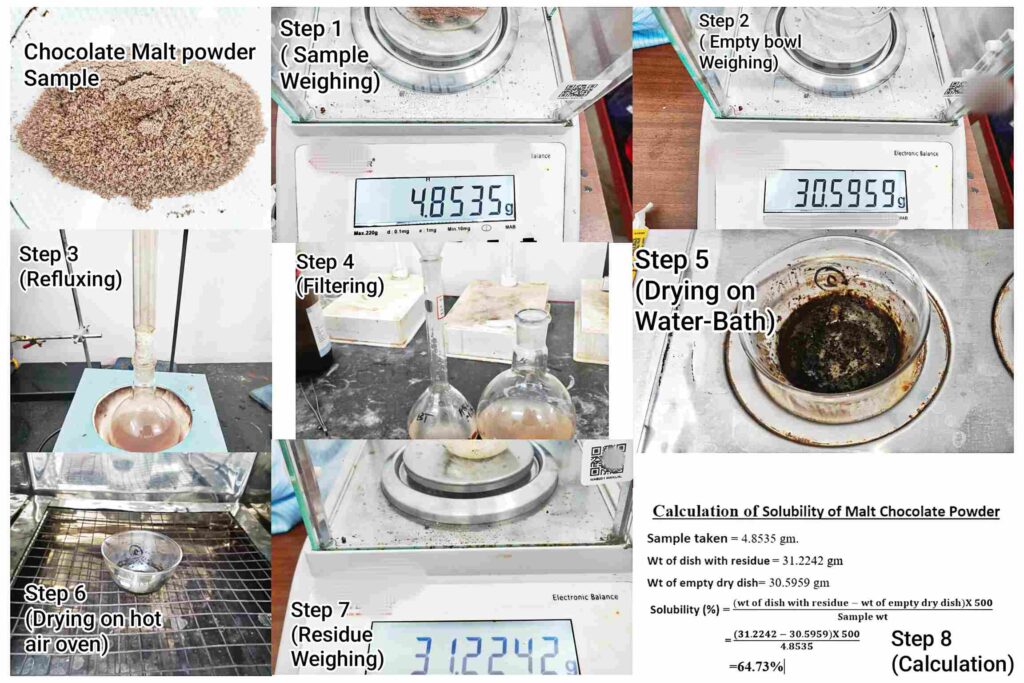
Solubility refers to the ability of the powder to dissolve in a liquid medium under specified conditions (temperature, agitation, volume of solvent, etc., which we test in Pro Research & Testing Laboratory
Instruments & Glassware Used-
- Analytical Balance- Used to weigh sample. We use 4-digit balance.
- Hot air oven(105°C)-Uses dry heat to uniformly heat and dry sample so accurate mass of dry residue can be obtained.
- Water Bath-Maintains a controlled, constant temperature(100°C) medium (via heated water) to dissolve solids.
- Heating Mantle-Provides uniform and controllable heat(60°C) directly to flask (especially round-bottom flasks) for dissolving solids.
- Evaporating dish-Holds solution during evaporation; allows solvent to evaporate leaving behind the undissolved solute residue for weighing.
- Measuring cylinder(250ml)- To add known volume of distilled water in to sample during reflux.
- Pipette(50ml)-Accurately measures known volume of solution .
- Volumetric flask(250ml)-Calibrated flask that holds a precise volume; for dissolving solute to prepare known concentration solutions for solubility determination.
- Flat bottom flask(500ml)-Provides a container for dissolution of solute with solvent; flat bottom offers stability when heating.
- Condenser-Cools vapors back into liquid during reflux,ensuring solvent is not lost during heating.
- Whatman 1 Filter paper-Acts as medium to separate undissolved particles from solution by filtration; retains solids so filtrate has only dissolved.
- Funnel-Supports filter paper and guides filtrate into collection vessel, preventing loss of sample and ensuring clean separation.
- Distilled Water-Used to dissolve sample.The conductivity of distilled water should be <5 μS/cm to prevent contamination.
- Water Tap -Supplies continuous cold water to the condenser for efficient condensation.
Procedure
| Weigh & Reflux | Take approx 5 gm sample in a flat bottom flask. Add 200 ml distilled water. Reflux for 1 hour at 60°C. |
| Filtration & Volume make up | After 1 hour filter into 250 ml volumetric flask and make up till the mark. |
| Drying | Weigh the empty dry evaporating dish. Pipette out 50 ml from the solution and dry until the solvent evaporates. Repeat the process at least 5 times to get accurate result. |
| Calculation | Dry the dish at 105°C in the hot air oven and calculate using following formula. Solubility(%)=(wt of dish with residue – wt of empty dry dish)X 500/ sample wt |
Purpose of Testing
- Consumer Experience-Ensures that when mixed with water or milk, the powder dissolves well, without leaving lumps or sediments.Good solubility means a smooth drink, good mouthfeel, and consistent taste.
- Standardization and Quality Control-Confirms batch-to-batch consistency: each production lot should dissolve similarly, so consumers get the same experience.
- Shelf Life and Stability-Over time, powders can become harder to dissolve if they absorb moisture.Solubility tests help monitor how well the product maintains properties over its shelf life.
- Safety Concerns-Poorly soluble or clumpy powders might trap moisture increasing risk of microbial growth or spoilage.Ensures that the product dissolves under expected conditions, without needing excessive heating or other manipulation which might degrade heat-sensitive components.
- Formulation & Production Optimization-Helps in selecting particle size, drying method (spray-dry etc.), granulation that aid solubility,allows manufacturers to fine-tune milling, drying, mixing, and other process parameters to get desired solubility performance.
Handling Mistakes
- Incorrect weighing of powder-If the amount of powder used is wrong (too much or too little),Solubility results may hamper.
- Using water (or solvent) at wrong temperature-Solubility of many powders depends strongly on temperature. If water is colder/hotter than specified, results will vary.
- Ignoring moisture content-If the powder has absorbed moisture, or has clumps, or has degraded, it may dissolve poorly.Leads to inconsistent solubility test
- Equipment not clean or inappropriate-Dirty glassware, un-clean balances, etc. Also using incorrect apparatus. Contamination or residual solids may mask real undissolved parts or affect measurement.
Conclusion
The malt chocolate powder/ovaltine/malt milk powder/protein powder exhibited good solubility under the test conditions, dissolving smoothly with minimal residue. Improving particle milling and refining wetting agents could enhance complete and rapid dissolution.By following the above-mentioned method, you can easily test solubility of malt extract at any laboratory or manufacturing industry with the availability of the equipments.This testing process ensures accurate results, which are crucial for quality control in various applications. Furthermore, if you can’t understand the procedure, you can check our real-time photo attached with this writing, which visually guides you through each step and enhances your understanding. Additionally, for those who prefer professional assistance or require more advanced testing, you can also reach out to Pro Research & Testing Laboratory for testing purposes.
FAQ
1.What does “solubility” mean for Ovaltine/malt powder?
Solubility refers to how well the ovaltine/malt powder dissolves in water or milk under particular conditions. High solubility means fewer lumps, less residue, and a smoother drink.
2.Why might Ovaltine not dissolve completely?
The ovaltine might not dissolve completely because low temperature of liquid (colder liquids slow down dissolution),insufficient reflux,large particle size or clumped powder.
3.How can manufacturers ensure good solubility in their product?
Control particle size (making them fine, uniform) Use effective wetting agents / emulsifiers Optimize drying and milling process Ensure packaging keeps product dry and free of moisture Provide clear preparation instructions (e.g. temperature, stirring)
4.What is the ideal temperature for dissolving Ovaltine?
Hot water/milk(60°C) helps to dissolve. Higher temperature increases solubility, speeds up dissolution, and reduces clumping. Very cold liquid may result in slow or incomplete dissolution.
5.Does storage affect solubility?
Yes. If the powder absorbs moisture (becomes damp or clumpy) or is stored improperly, its solubility can degrade. Also exposure to heat/humidity may cause particles to stick together, making it harder to dissolve.
6.Why is solubility important for consumer satisfaction?
Because poor solubility leads to lump,residue at the evaporating dish, uneven taste. Good solubility is part of a pleasant sensory experience, ease of preparation, and quality.
6.Which types of food powders are usually tested for solubility?
By this method you can test milk powder & dairy powders,malted powders & chocolate drinks,Protein powders,Cocoa powder,nutritional powders,Plant-based powders etc. or you can reach out to Pro Research & Testing Laboratory for testing purposes.
________________________________________
How We Verified This Testing/Research Procedure :
This testing is done under qualified analysts in our lab.Continually monitored by expertise & repeatedly testing is always done to get accurate result.
