
Carbon is a major component of soil organic matter, which consists of decomposing plant and animal tissue. Carbon helps the soil store and release essential plant nutrients such as nitrogen, phosphorus, and sulfur. Detecting Total Organic Carbon is crucial for assessing soil fertility and structural stability as it directly impacts nutrient retention, water holding capacity, and microbial activity.
Chemical & Apparatus Required in Total Organic Carbon Testing Of Soil:
Chemicals Required
- Potassium Dichromate solution( K2Cr2O7)-Potassium Dichromate acts as strong oxidizing agents in presence of con. sulfuric acid to oxidize organic carbon in soil sample.Dissolve 49.035 g potassium dichromate in distilled water to make one litre of solution.
- Silver Sulfate(Ag2SO4) and Mercuric Sulfate (HgSO4) – Both compounds are inorganic sulfate salts, commonly used together in Total Organic Carbon test .
- Ferrous Sulphate(FeSO4 ) – The volume of ferrous sulphate used directly correlates to the amount of organic carbon present in the soil sample.Dissolve approximately 140 g of ferrous sulphate in 0.5 N sulphuric acid to make one litre of solution (add 14 ml of concentrated sulphuric acid to distilled water to make one litre of solution for 0.5 N sulphuric acid).
- Sulfuric Acid(H2SO4) –Concentrated Sulfuric acid is added to Potassium Dichromate to generate Chromic Acid, which is powerful oxidizing agent.
- Orthophosphoric Acid(H3PO4)-Orthophosphoric acid plays a critical role in the detection and determination of carbon in soil samples.
- Potassium Iodide(KI)– Potassium iodide (KI) is used to prevent interference from chlorides.,
- Indicator Solution – Sodium Diphenylamine sulfonate functions as a redox indicator in soil testing. 0.25 g of sodium diphenylamine-sulphonate dissolved in 100 ml of distilled water.
Apparatus Required
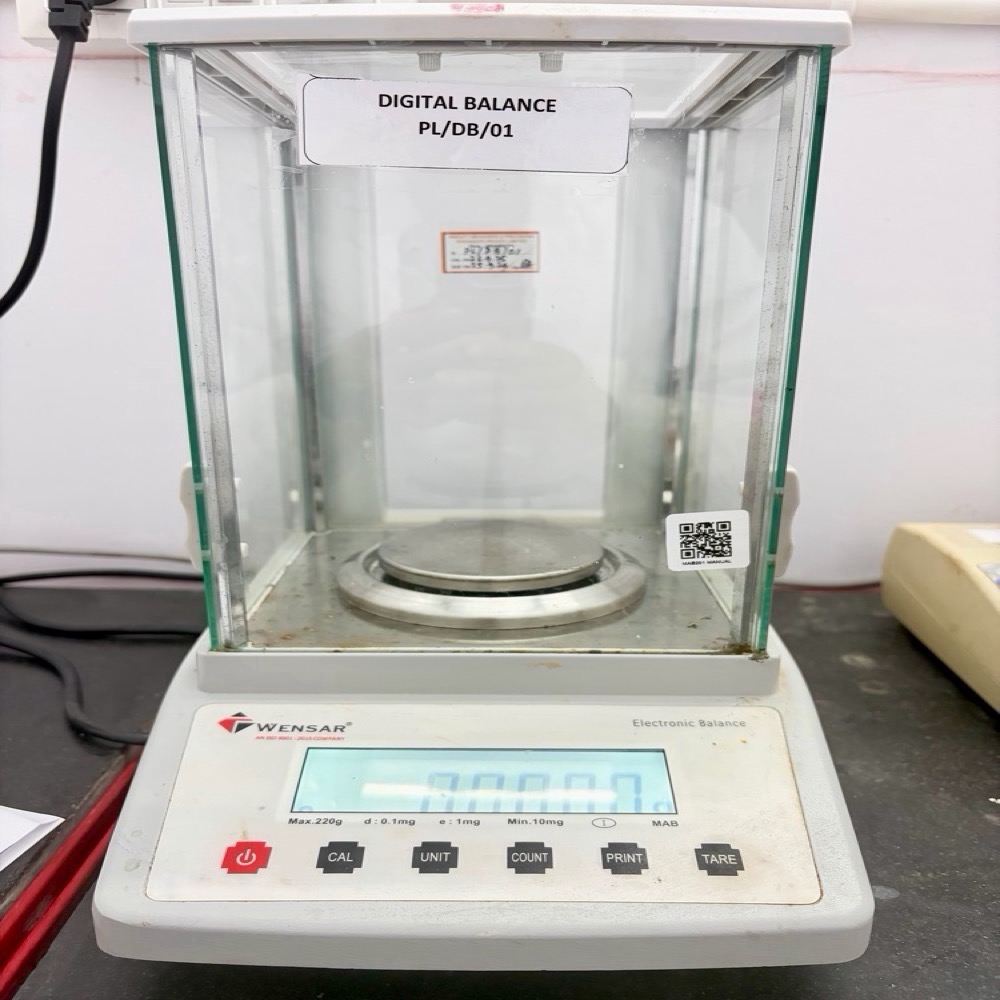
- Analytical Balance(4 digit)- Provides the highly accurate initial sample weight.
- Conical Flask(500 ml) – Used for Preparation of soil Sample.
- Burettes (50 ml)- Delivers precise volumes of standard acid during titration to quantify the amount of trapped carbon.
- Pipettes and Measuring Cylinders (10 ml,25ml) – Ensure the accurate volumetric measurement of reagents and soil extracts to maintain test consistency.
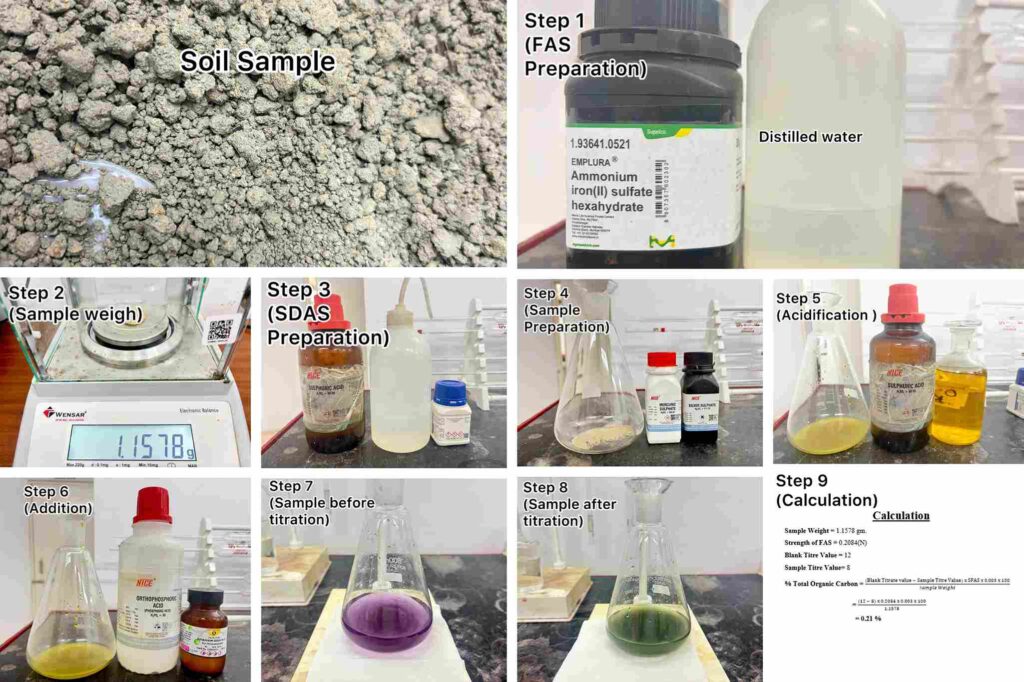
Method Followed To Test Total Organic Carbon Of Soil Sample:
| Sample Preparation | Weigh 0.5 – 1.0 gm sample taken in a conical flask. Add slight pinch of HgSO4 & Ag2SO4 . Add 20 ml Conc. H2SO4 and mix it properly. Next 10 ml 0.25 N Potassium dichromate added and keep it at least one hour. 5 ml H3PO4 & 0.5 gm KI is added with mixture and cool it . Add 5 to 6 drops of SDAS indicator. |
| Titration | Titrate with the help of Ferrous Sulfate (FeSO4) . Note volume of acid used. Colour will change from violet to green at the end point. |
| Calculation | % of Total organic Carbon= (Blank Titrate value – Sample Titre Value) x SFAS x 0.003 x 100 / Wt of Sample |
Importance Of Testing Total Organic Carbon Of Soil Sample:
- Total Organic Carbon is a primary indicator of soil quality.
- Its affecting physical structure, water-holding capacity, and nutrient availability.
- Monitoring Total Organic Carbon helps track soil carbon absorption capacity .
- Total Oraganic Carbon provides an index for biological capacity in the soil.
- It guides crop planning and expected yield.
Handling Mistakes should avoided during Total Organic Carbon Test in Soil Sample
- Incomplete sample preparation: Preparation of sample done carefully.
- Impure Reagents : Use fresh, standardized chemicals only.Degraded reagents can give false result.
- Titration errors: Use proper indicator and titrate carefully. Excess indicator may cause improper colour change.
- Weighing: Use a calibrated balance to prevent inaccurate sample weight.
- Use clean and dry glassware — Moisture or residue affects reagent strength.Avoid contamination of glassware and samples. Proper cleaning Process described previously.
Conclusion of Testing for Total Organic Carbon of Soil Sample
Total Organic Carbon (TOC) testing in soil is crucial for assessing soil fertility, structure and environmental health.It measures organic matter,key for nutrient cycling (nitrogen, phosphorus), water retention, and microbial activity. TOC is used to guide fertilization, and detect contamination. By following the above-mentioned method, you can easily test the Total Organic Carbon at any laboratory with the availability of the equipments and chemicals.This testing process ensures accurate results, which are crucial for quality control in various applications. Furthermore, if you can’t understand the procedure, you can check our real-time photo attached with this writing, which visually guides you through each step and enhances your understanding. Additionally, for those who prefer professional assistance or require more advanced testing, you can also reach out to Pro Research & Testing Laboratory for testing purposes.
FAQ- Testing for Total Organic Carbon of Soil Sample
1. Total Organic Carbon Of Soil Sample? Concentrated Sulfuric Acid acts as a oxidizing agents, works with potassium dichromate to oxidize organic carbon and generating heat.
2. What are common sources of error? Improper titration, inaccurate sample weight and use of impure reagents.
3. What is the Oxidation method used for? The Oxidation method used for detection of Total Organic Carbon of soil followed by Sample preparation, Titration and Calculation.
4. What is the function of Sodium Diphenylamine Sulfonate? Sodium Diphenylamine Sulfonate used as a redox indicator for testing of Total Organic Carbon of soil sample.
5.How is Carbon content is calculated? Carbon content is calculated from the volume of standard acid used during titration .
How We Verified This Testing/Research Procedure :
This testing procedure is done under qualified analyst .Continually monitored by expertise.Repeatedly testing is always done to get accurate result.

Written by
Ankita Samanta (M.Sc Microbiology,Vidyasagar University)
Designation – Junior Microbiologist
Reviewed by
Riya Ghosh (M.Sc. Food Technology, MAKAUT)
Designation – Chemist
Verified By
Dr. Jyotirmoy Kumar Dey (Phd,Chemistry)
Designation – Senior/Chief Chemist
Experience – 25 Years +