
Blue tea is an herbal infusion made from the dried petals or whole flowers of the butterfly blue pea flower(Oporajita Flower). It is not like regular tea, known for its vibrant blue color, which can change to purple when lemon is added. This blue tea is rich in antioxidants,anti-inflammatory & anti-aging and skin protective. Water extract matter refers to the soluble components of dried butterfly pea flowers that dissolve into hot water during soaking . These substances contribute to the color, flavor, aroma, and functional properties of the tea.
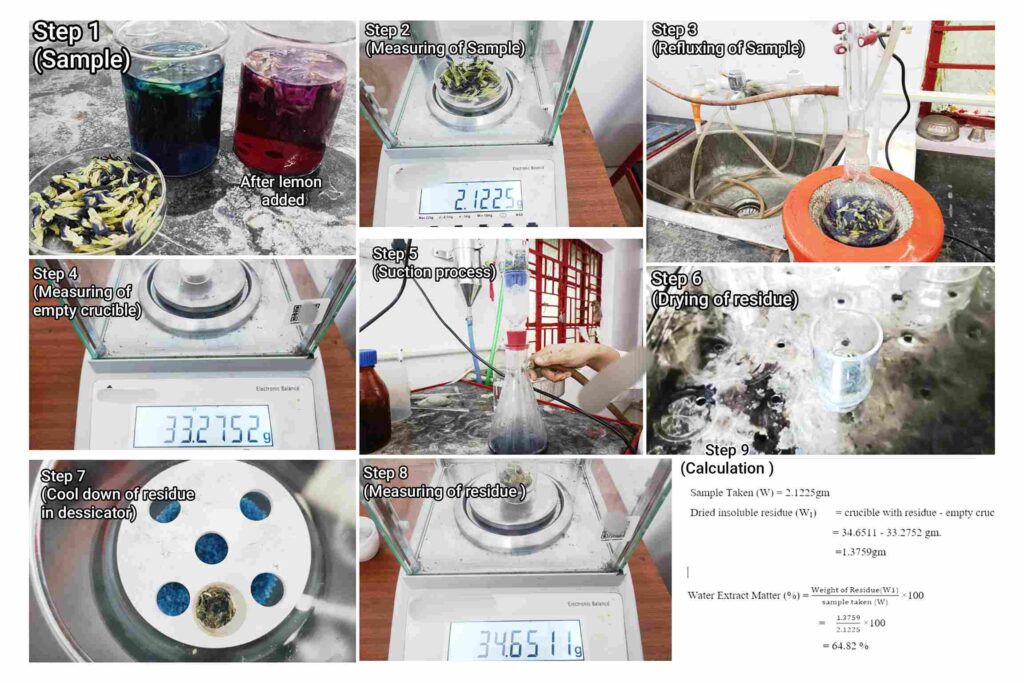
Here, we briefly describe the procedure to test Water extract matter of blue tea in our lab – Pro Research & Testing Laboratory
Apparatus & Instruments used for Analysing Water Extract Matter of Blue tea
- Hot Air Oven(103°c): Used for evaporation & drying.
- G-3 Crucible(30 ml): This G-3 crucible is glass crucible commonly used for filtration and residue analysis.
- Desiccator: To cool hot crucibles after heating to prevent moisture absorption before weighing with the presence of desiccant i.e silica beads.
- Filter-Flask(500ml): It is a thick-walled glass flask used for vacuum filtration.
- Condenser: It is used to condense vapors back to liquid during reflux.
- Flat Bottom flask(500ml): Used to hold the sample during reflux.
- 4 digit Analytical balance: High precision instrument used to measure accurately .
- Heating mantle: This is used to safely and evenly heat flat bottom flask during reflux.
- Distilled water: To mix the sample during reflux. The conductivity of distilled water should be <5 μS/cm to prevent contamination.
- Water Tap: Constant water supply during reflux.
- Rubber: To hold the crucible with the filter flask to avoid cracking.
- Motor: It is used for suction by generating pressure.
Procedure for Analysing Water Extract Matter of Blue tea
| Step-1 | Clean G-3 crucible is kept for drying in hot air oven for 1 hr at 103°C -105°C . Cool in the desiccator and weigh . |
| Step-2 | Take 2gm sample after moisture (previously described) in a flat bottom flask with 200 ml of hot distilled water,reflux over low heat approx 60°C-70°C for 1 hr, rotating the flask occasionally.Moisture is done to express the result in dry basis. |
| Step-3 | Filter in hot condition (to prevent precipitation) under vacuum through dried crucible using the filter flask. Wash out the flask with hot distilled water( at 100°C )8., transferring all the insoluble residue into the crucible. Finally, wash the residue with 200 ml of hot distilled water. |
| Step-4 | Dry the crucible and its contents in the oven set at 103 “C. Cool in the desiccator and weigh till constant weight to get accurate result. |
| Step-5 | Calculate using following formula. |
Calculation for Water Extract Matter of Blue tea
Water Extract Matter(%)= Weight of Residue(W1)/sample taken(W) x 100
where
W- Sample Taken
W1 – Weight of Residue( crucible with residue – empty crucible)
Purpose of Testing for Analysing Water Extract Matter of Blue tea
- Evaluate Soluble Components: To measure color-producing compounds that dissolve in hot water during brewing.
- Determine Quality and Strength: A higher water extract value indicates better strength, color intensity, and functional properties (e.g., antioxidant), which are key quality factors for blue tea.
- Detect Adulteration or Poor-Quality Material: A low water extract may suggest dilution, contamination, or use of degraded/dried-out petals, affecting product performance.
- Assess Nutritional and Functional Properties: The test helps determine the concentration of antioxidants that contribute to the tea’s health-promoting effects, such as anti-inflammatory.
- Source of Medicinal properties: The extract of blue tea is good for skin and hair and also while making the tea, the vapour is excellent for nasal blockage.
Handling Mistakes to Avoid in Water Extract Matter of Blue Tea Test
Incorrect Sample Weight : Using wrong tea weight leads to inaccurate results and wrong % calculation. Always use a calibrated balance.
Improper Soaking Time/Temperature: Under- or over-brewing changes the amount of extractable matter. Maintain exact 60°C-70°C for 1 hr for reflux.
Incomplete Filtration: Incomplete filtration and not proper washing can lead to low result.
Not Drying to Constant Weight: If the residue is not completely dried, water content remains, leading to overestimated results. Dry until weight is stable.
Contamination of Extract: Dust, foreign particles, or mixing other samples can lead to inaccurate data. Handle samples carefully in a clean environment.
Improper Equipment Calibration: Uncalibrated balance will cause systematic errors in test results. Regular calibration is essential.
Use of Impure Water: Non-distilled water may contain minerals affecting extract weight. Use only distilled or deionized water.
Conclusion for Analysing Water Extract Matter of Blue tea
The water extract of blue tea indicates the amount of soluble compound released during infusion. A higher water extract value reflects better color intensity, antioxidants & medicinal properties, and overall quality of the tea. This parameter is essential for assessing the functional potential, sensory appeal, and consistency of blue tea & any other tea or similar to tea. Therefore, testing the water extract is a reliable way to evaluate both the nutritional and commercial value of butterfly pea tea.By following the above-mentioned method, you can easily test the Water Extract Matter at any laboratory or manufacturing industry with the availability of the equipments.This testing process ensures accurate results, which are crucial for quality control in various applications. Furthermore, if you can’t understand the procedure, you can check our real-time photo attached with this writing, which visually guides you through each step and enhances your understanding. Additionally, for those who prefer professional assistance or require more advanced testing, you can also reach out to Pro Research & Testing Laboratory for testing purposes.
FAQ on Water Extract Matter
1.What is water extract matter in blue tea?
Ans: Water extract matter refers to the soluble components of dried butterfly pea flowers that dissolve into hot water during soaking . These substances contribute to the color, flavor, aroma, and functional properties of the tea.
2.What factors affect extract matter in blue tea?
Ans: Flower freshness and drying method, reflux time and temperature, flower-to-water ratio, storage conditions.
3.Is there a standard range for water extract matter in blue tea?
Ans: Unlike green or black tea, no fixed standard exists yet for blue tea.
4.Does water extract matter affect blue tea’s health benefits?
Ans: Yes. The higher the extract matter, the more bioactive compounds like antioxidants are present in the infusion.
5.Can extract matter vary between batches?
Ans: Yes, because climatic conditions, harvesting time, and drying process can all influence the amount of soluble compounds.
6.What happens if the flowers are over-boiled?
Ans: Over-boiling may reduce color and altering the actual extract matter result.
7.Why is distilled water recommended for testing?
Ans: To avoid interference from minerals or impurities present in tap water, which can affect extract matter readings
8. What is G-3 crucible? Why it is used for this test?
Ans: G -3 indicates porosity in terms of grades. This types of crucible undergo filtration with applied pressure as any other crucibles are not susceptible to pressure. Fine and coarse particles stuck into asbestos fibre bed present within this crucible.
How We Verified This Testing/Research Procedure :
This testing procedure is done under qualified analyst .Continually monitored by expertise.Repeatedly testing is always done to get accurate result.

Written by
Riya Ghosh (M.Sc. Food Technology, MAKAUT)
Designation – Chemist
Reviewed by
Anwesha Das (M.Sc Microbiology,BU)
Designation – Microbiologist
Verified By
Dr. Jyotirmoy Kumar Dey (Phd,Chemistry)
Designation – Senior/Chief Chemist
Experience – 25 Years +