
Total Kjeldahl Nitrogen (TKN) testing is a analytical method used to determine the concentration of organic nitrogen and ammonia in wastewater. It plays a crucial role in assessing water quality, particularly in environmental monitoring and wastewater treatment processes.
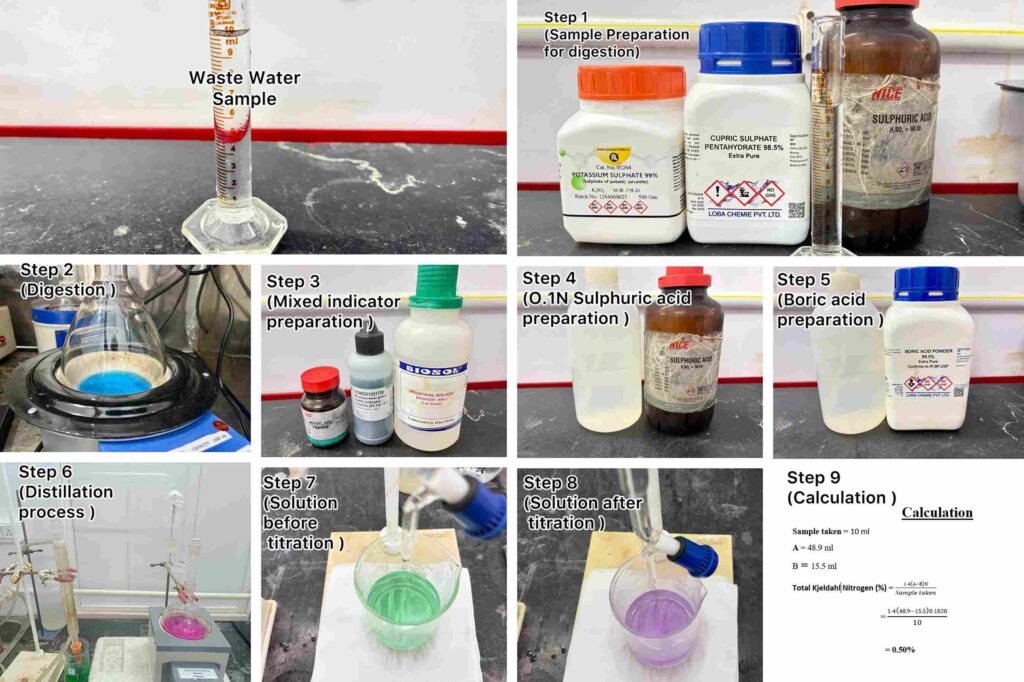
Chemical and Apparatus Used In Determination Of Total Kjeldahl Nitrogen in Wastewater
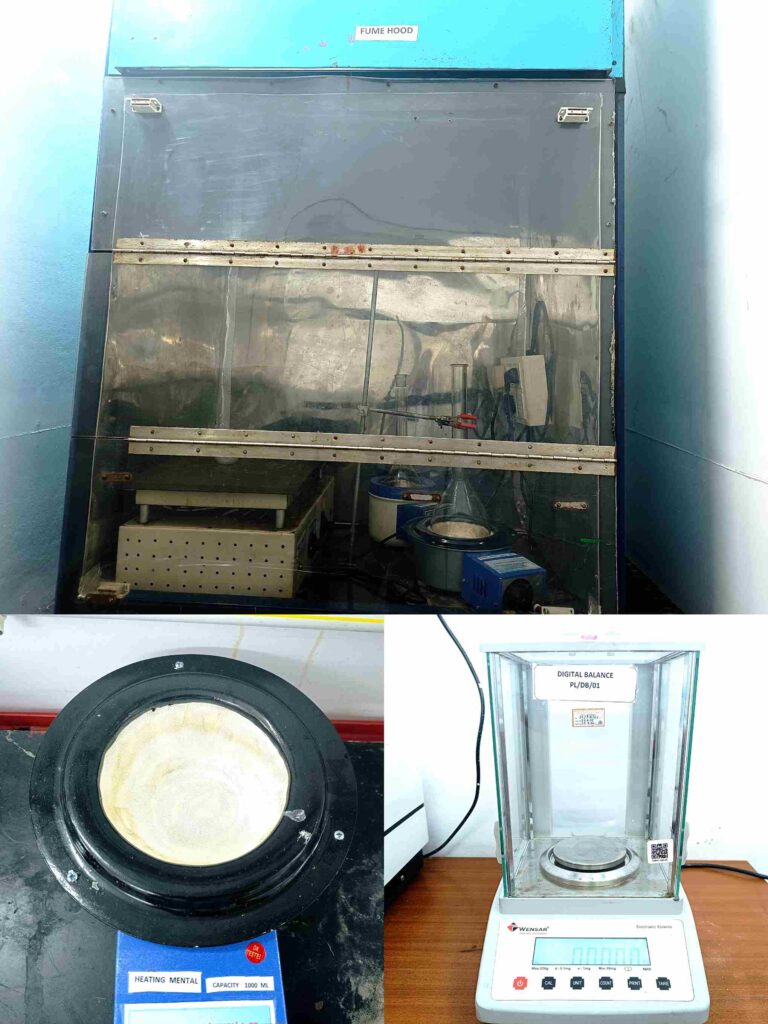
Apparatus Used
- Kjeldahl Digestion Unit: To digest the organic sample with sulfuric acid.
- Kjeldahl Distillation Unit :To distil ammonia from the digested mixture.
- Fume Hood : Ensures safe removal of toxic fumes during digestion.
- Condenser : Prevents loss of ammonia by condensing steam during distillation.
- Titration Burette (50 ml capacity) :To determine the amount of ammonia captured.
- Kjeldahl Flask : Used for digestion of sample with potassium sulphate, copper sulphate in the presence of concentrated sulphuric acid.
- Flat bottom flask(500 ml) : To hold the solution during distillation.
- Measuring Cylinder & Pipettes (25 ml & 50 ml capacity) : Accurate measurement of reagents and samples.
- Heating Mantle : It provides consistent heat during digestion.
- Beaker( 500 ml capacity): To collect the distilled converted ammonia mixed with 0.5 N sulphuric acid.
- Water Tap : To continuous supply of the water throughout the distillation process.
- Weigh Balance(4-digit): To weigh the sample & reagents.
Chemicals Used
- Catalyst mixture (K₂SO₄ + CuSO₄)-Potassium Sulphate(K₂SO₄) raises boiling point; Copper Sulphate (CuSO₄) catalyzes oxidation of organic compounds. Details mentioned previously.
- Concentrated Sulphuric Acid (H2SO4): It is used as digestion reagent. It oxidizes organic matter and converts organic nitrogen into ammonium sulphate.
- Sodium Hydroxide Solution(40%): Sodium Hydroxide solution is primarily used in the distillation step to convert Ammonium ions into Ammonia gas. Preparation mentioned previously.
- Standard 0.01 N Standard Sulfuric acid (H₂SO₄)- Neutralizes ammonia in boric acid; volume used gives nitrogen content.Preparation described previously.
- Boric Acid Solution :Boric acid solution is used in the TKN test as a receiving solution to capture ammonia gas during the distillation phase. Dissolve 60 g of boric acid in 1 litre of hot water to make boric acid solution.
- Mixed Indicator solution: It is used as an indicator. Dissolve 0.5 g bromocresol green and 0.1 g methyl red in 95 percent (m/v) ethanol.
- pH paper: Used to check pH before distillation.
- Distilled water- Acts as a solvent .The conductivity of distilled water should be <5 μS/cm to prevent contamination.
Testing Process Of Total Kjeldahl Nitrogen in Wastewater sample:
The Kjeldahl Method involves three main Stages: Digestion, Distillation & Titration.
| Step | Description |
| Sample Measuring | Take 10 ml of water sample & measured by the measuring cylinder. Transfer into a Kjeldahl Flask. |
| Digestion | Add 10 gm of Potassium Sulphate+0.50 gm of Copper Sulphate(catalyst) + 30 ml Conc. Sulphuric Acid. If the sample tends to foam or froth, heat very gently in the initial stages; add glass beads may also be added to reduce frothing. Continue boiling freely until the solution becomes clear, indicating organic nitrogen has been converted into ammonium sulphate. |
| Cooling | Let the digested sample cool at room temperature. |
| Distillation | Transfer completely the digested sample of the digestion flask into the round-bottom flask of the distillation assembly, using water and sodium hydroxide is added to raise the pH-12 . Distil the ammonia and trap it in 50 mL(for complete ammonia absorption) Boric acid with 2-3 drops of mixed indicator. |
| Titration | Titrate the ammonia with sulphuric acid until the green colour changes to purple colour. |
Calculation Of Total Kjeldahl Nitrogen Of Wastewater sample:
Total Kjeldahl Nitrogen, percent by weight = 1·4(A-B)N/W
where,
A = Titre value of blank
B = sample titre value
N = normality of the standard sulphuric acid
W =Sample weight
Purpose of Analysing Total Kjeldahl Nitrogen Of Wastewater sample :
- Total Kjeldahl Nitrogen is measured to monitor Nitrogen levels, as high concentration of lead to algal blooms, eutrophication, and reduced oxygen in aquatic ecosystems.
- It helps optimize biological treatment steps, specifically nitrification.
- It helps on municipal sewage treatment monitoring.
- Total Kjeldahl Nitrogen test measure organic nitrogen plus ammonia. It helps to assess contamination levels.
- It is assessing water quality in industrial areas and natural water bodies.
Handling Mistakes to be Avoided During Total Kjeldahl Nitrogen Test Of Wastewater sample:
- Using too much or too little water can lead to inaccurate Nitrogen calculation.
- Due to incorrect heating or insufficient acid or catalyst affects nitrogen release.
- Using dirty or wet glassware can introduce external nitrogen. Proper cleaning Process described previously.
- Using incorrectly prepared standard acid or alkali solutions affects result accuracy.
- Waiting too long after digestion before distillation or titration may cause nitrogen loss.
Conclusion of Testing of Total Kjeldahl Nitrogen Of Wastewater Sample :
Total Kjeldahl Nitrogen (TKN) testing in wastewater measures the sum of organic nitrogen and ammonia in wastewater. It is used to assess pollution levels, nutrient loading in wastewater treatment using a digestion , distillation and titration method. Kjeldahl method is the standard approach used for estimating Nitrogen in Wastewater .By following these method, you can easily test the Nitrogen at any laboratory or manufacturing industry with availability of the equipments & chemicals .If you can’t understand the procedure you can check our real time photo attached with this writing or also you can reach to Pro Research & Testing Laboratory for the testing purposes.

FAQ on Total Kjeldahl Nitrogen in Wastewater Sample:
Q: Which method is commonly used for Nitrogen determination in Wastewater sample?
A: The Kjeldahl method is the standard and widely accepted method.
Q: Why does the Kjeldahl method use 0.01(N) H₂SO₄ and not a stronger acid?
A: 0.01 (N) acid is ideal for accurate titration. Strong or weak concentrated acids would complicate titration control & cause error titre value.
Q: Why is a blank sample necessary?
A: To correct for background nitrogen and improve result accuracy.
Q: Can I do this test in any laboratory or manufacturing units?
A:Yes,by following above mentioned method, you can easily test the Total Kjeldahl Nitrogen at any laboratory or manufacturing industry with availability of the equipments & chemicals. If you can’t understand the procedure you can check our real time photo attached with this writing or also you can reach to Pro Research & Testing Laboratory for the testing purposes.
Q: Why is Nitrogen determination is important in Wastewater Sample?
A:Nitrogen determination is an important measure in environmental monitoring because excess nitrogen in water bodies can lead to harmful algal blooms and other negative impacts on aquatic ecosystems.
Q: Why do we use 40% NaOH solution in the Kjeldahl method and not more concentrated solution?
A: Higher concentrations can cause violent boiling or splashing, which can lead to bumping or sudden gas release, which may result in NH₃ loss.
How We Verified This Testing/Research Procedure :
This testing procedure is done under qualified analyst .Continually monitored by expertise.Repeatedly testing is always done to get accurate result.

Written by
Ankita Samanta (M.Sc Microbiology,Vidyasagar University)
Designation – Junior Microbiologist
Reviewed by
Riya Ghosh (M.Sc. Food Technology, MAKAUT)
Designation – Chemist
Verified By
Dr. Jyotirmoy Kumar Dey (Phd,Chemistry)
Designation – Senior/Chief Chemist
Experience – 25 Years +