
Biowaste (sludge) is rich in organic matter and contains a significant amount of carbon. This carbon comes from decomposed biological materials such as food waste, plant residues, and wastewater solids. Measuring the carbon content of sludge is important for assessing its potential for composting, biogas production etc.
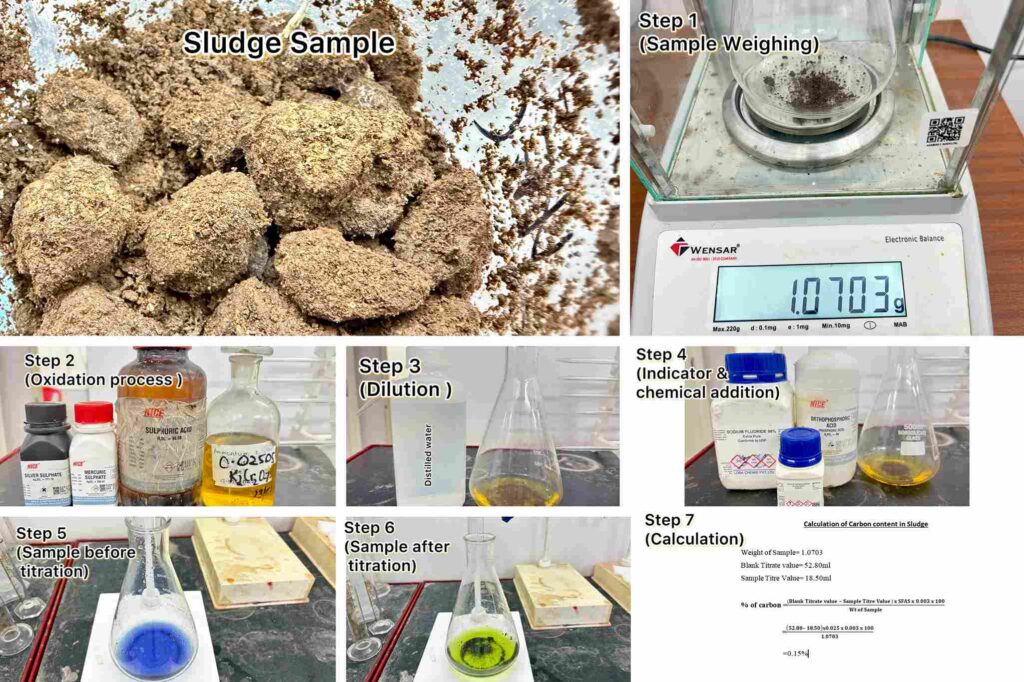
Here we follow the Titrimetric Method to determine the Carbon Content in sludge.
Instruments and Chemicals Used in Carbon Content Testing in Sludge
Instruments Used
- 4 digit Analytical balance: Used to accurately weigh the sludge sample.
- Hot air oven: Used to dry the sample before starting the analysis.
- Conical flask(250 mL): Used as the reaction medium where oxidation of organic carbon takes place.
- Burette(50ml): Used for titration of excess dichromate with ferrous ammonium sulfate.
- Pipette(25 mL,20 mL): Used to measure and transfer accurate volumes of reagents. It transfer fixed-volume liquid by suction.
- Volumetric Flask(100ml,1000ml) : Used for approximate measurement of liquid reagents.
Chemicals Used
- Mercuric Sulphate (HgSO₄) & Silver Sulphate (Ag₂SO₄):Removes interference caused by chloride ions & Silver Sulphate used as a catalyst to speed up oxidation of organic compounds.
- 0.025 N Potassium dichromate (K₂Cr₂O₇): Acts as a strong oxidizing agent. It oxidizes organic carbon present in the sludge to carbon dioxide under acidic conditions.Weigh 1.226 g of potassium dichromate (K₂Cr₂O₇). Dissolve it in a small amount of distilled water. Transfer the solution to a 1 L volumetric flask. Make up the volume to 1000 mL with distilled water. Mix well.
- Concentrated sulfuric acid (H₂SO₄): Provides the acidic medium required for oxidation by generating heat and improving reaction efficiency.
- 0.1 (N) Ferrous ammonium sulfate (FAS): Used as the titrant. It reduces excess dichromate during back titration.Preparation Process described previously.
- Phosphoric acid (H₃PO₄): Helps to complex iron ions and sharpen the end point during titration.
- Diphenylamine Sulphonate indicator: Used to detect the end point of titration by color change (violet-blue to green).Dissolve 0.5 g sodium diphenylamine sulphonate in distilled water. Make up the volume to 100 mL with distilled water. Store in an amber bottle.
- Sodium Fluoride:Sodium fluoride is added to stop iron and other metals in the sludge from interfering with the test. This helps the carbon test give more accurate results.
- Distilled Water:To prepare Standard Solution & reagent.The conductivity of distilled water should be <5 μS/cm to prevent contamination.
Process followed to test Carbon Content in Sludge
Sample Preparation and Weighing:
- Weigh about 1 g of dried sludge sample into a conical flask.
Oxidation Step:
- Add 1 pinch of Murcuric Sulphate & Silver Sulphate.
- Add 25 mL of 0.025N potassium dichromate (K₂Cr₂O₇) solution.
- Carefully add 20 mL of concentrated sulfuric acid (H₂SO₄) and mix gently.
- Allow the mixture to stand for 30 minutes to ensure complete oxidation of organic carbon.
Dilution and Indicator Addition:
- Volume make up with 100 mL of distilled water to dilute the solution.
- Add 2 gm Sodium Fluoride,5 mL of phosphoric acid and 1 mL of diphenylamine indicator.
Titration:
- Titrate the excess potassium dichromate with 0.1 N ferrous ammonium sulfate (FAS) until the color changes from violet-blue to bright green.
- Perform a blank titration using the same procedure without the sludge sample.
- Record the volume of FAS used for both the sample and blank.
Calculation:
- Calculate the % of carbon by following formula
(Blank Titrate value – Sample Titre Value) x SFAS x 0.003 x 100 / Wt of Sample
Importance of Carbon Content Testing in Sludge
- To determine organic carbon content: Measure the amount of organic carbon present in the sludge.
- To assess sludge quality: Evaluate the overall composition and characteristics of biowaste sludge.
- To check compost suitability: Determine whether the sludge can be effectively used for composting and soil improvement.
- To evaluate energy potential: Estimate the potential for biogas and other bioenergy production.
- To monitor treatment efficiency: Assess how effectively waste treatment processes are working.
- To ensure regulatory compliance: Confirm adherence to environmental and waste management standards.
Handling Mistakes and Precautions should be taken during determination of Carbon in Sludge
| Handling Mistake | Precaution |
|---|---|
| Improper sample collection | Collect a representative sludge sample using clean tools and containers. |
| Sample contamination | Avoid contact with foreign materials and keep samples in sealed containers. |
| Inaccurate weighing of sample | Use a calibrated analytical balance and record measurements carefully. |
| Incomplete drying of the sample | Dry the sample thoroughly at the recommended temperature before analysis. |
| Loss of sample during handling | Handle samples gently and use appropriate containers to prevent spillage. |
| Incorrect instrument calibration | Calibrate instruments regularly according to standard procedures. |
| Recording or calculation errors | Double-check all observations, calculations, and data entries. |
| Use clean and dry glassware | Moisture or residue affects reagent strength.Avoid contamination of glassware and samples, as even small impurities can alter results. Proper cleaning Process described previously. |
Conclusion of Carbon Content Analysis in Sludge
Carbon content testing is an important method for evaluating the quality and characteristics of biowaste sludge. It helps determine the amount of organic matter present and assess the sludge’s potential for composting, bioenergy production, and resource recovery. Accurate testing, proper sample handling, and adherence to standard procedures ensure reliable results, supporting effective waste management and environmental sustainability.By following these method, you can easily test the Carbon content at environmental science laboratory or any laboratory & also manufacturing industry with availability of the equipments & chemicals. If you can’t understand the procedure you can check our real time photo attached with this writing or also you can reach to Pro Research & Testing Laboratory for the testing purposes.
Frequently Asked Questions (FAQ) – Carbon Test in Sludge Sample
- Why is the carbon test performed on sludge?
To determine the amount of organic carbon present in the sludge, which indicates its organic matter content. - Which method is commonly used?
The Titrimetric Method is commonly used. - What is the role of potassium dichromate (K₂Cr₂O₇)?
It acts as an oxidizing agent and oxidizes the organic carbon in the sludge.. - What precautions should be taken?
Use clean glassware,measure reagents accurately,handle concentrated sulfuric acid carefully. - Why is a blank test performed?
To correct for reagents and improve the accuracy of the carbon calculation. - What does a high carbon value indicate?
A high amount of organic matter in the sludge. - What is the endpoint of the titration?
The color changes from violet/blue-violet to green. - Why are duplicate samples analyzed?
To check the precision and reliability of the results.
How We Verified This Testing/Research Procedure :
This testing is done under qualified analysts in our lab.Continually monitored by expertise.Repeatedly testing is always done to get accurate result.

Written by
Anwesha Das (M.Sc Microbiology,BU)
Designation – Microbiologist
Reviewed by
Riya Ghosh (M.Sc. Food Technology, MAKAUT)
Designation – Chemist
Verified By
Dr. Jyotirmoy Kumar Dey (Phd,Chemistry)
Designation – Senior/Chief Chemist
Experience – 25 Years +