
Fat is one of the major nutritional components of food and plays an essential role in providing energy.It helps to ensure the food quality & nutritional properties required in labelling during food packaging. In cooked foods, the fat content may vary depending on the ingredients used, cooking methods.
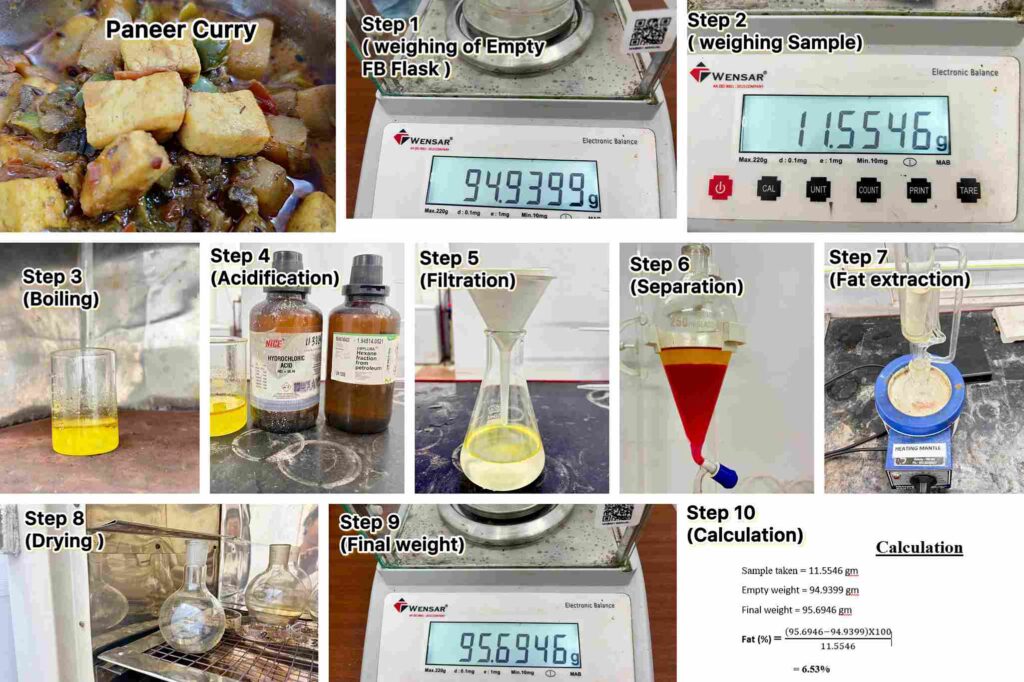
Here we have taken Paneer Curry as sample.
Equipments and Chemicals used in determination of Food Content in Cooked Food
Chemicals Used
- n-Hexane : The solvent dissolves the fat, which is then separated from the solid residue.
- Petroleum Ether : It is ideal for soxhlet extraction that helps to extract fat from sample without damaging it.
- Hydrochloric Acid (HCl) : Used to release fat before extraction.
- Anhydrous Sodium Sulfate : Removes moisture from the solvent extract.
- Methyl red indicator: Used to create visual differentiate aquous and fat layer.Making process descibed previously.
- Distilled Water : Used for Sample preparation.The conductivity of the distilled water should be <5 µS/cm.
Equipments Used
- Separeting Funnel : A separating funnel is used to separate aquous and fat layer.
- Heating Mantle : This instrument provides constant heat to boil the solvent.
- Flat-Bottom Flask:It is used to collect and hold the solvent with fat.
- Soxhlet Extractor : A specialized apparatus that continuously extract the fat from sample using solvent.
- Extraction Thimble(Cellulose Thimble) : This thimble is made of cellulose,holds the sample during extraction and also acts as filtered membrane so that only fat residue can release from the sample using solvent without leaking the sample.
- Condenser : It is attached on top of the extractor that condenses solvent vapour back into liquid through the sample.
- Splash Head Condenser : It operates between the flask and the condenser while recovering the ether.
- Recovery Funnel : It attached with the condenser while recovering the petroleum ether.
- Desiccator : It allows to cool the flask with extracted fat sample without interference of moisture.
- Weigh Balance(4 digit) : It is used to weigh the sample and the flask.
- Hot-Air-Oven :Typically set at 85°C to remove moisture before and after the extraction.
- Funnel with Whatman Filter paper-Acts as medium to separate undissolved particles from solution by filtration.
Procedure To Test the Fat Content In Cooked Foods
- Weigh 10 g of sample in a beaker and add 50 ml distilled water and transfer the beaker into a heating mantle to boil for about 5 minutes.
- Cool & filter the sample with a filter paper.
- Separate the liquid & take it in the separating funnel.Add 1 ml HCL ,shake & add 2 drops of methyl red indicator in it.
- Add 25 mL of n-hexane & petroleum ether in the separating funnel.
- Shake vigorously for 10 minutes.
- Drain out the aquous extract and transfer the solvent using filter paper and sodium sulphate in it.
- Repeat the extraction 2–3 times for complete recovery.
- Combine all solvent extracts in a pre-weighed flat bottom flask, keep aside.
- Dry(at 105°C) the filter paper for 2-3 hours in the oven to remove moisture.
- Place it in the extraction cellulose thimble with the flat bottom flask containing extracted solvent & follow the fat determination method.Detailed Process described previously.
Calculation for Determination of Fat Content in Cooked Foods
Fat Content( %)=[ ( mass of the flask with the fat, after drying – mass of the empty dry flask)/ Sample taken for the test]×100
Purpose for Determination of Fat Content in Cooked Foods
- Determine the total fat content of the food sample.
- Assess the nutritional value for nutrition labeling.
- Monitor product quality and consistency during manufacturing.
- Control the amount of added fat during food preparation and processing.
- Support shelf-life studies.
- Maintain quality assurance by ensuring the finished product meets established standards.
Handling mistakes to avoid during analysis of Fat content in Cooked Foods
- Incomplete drying of sample re-absorbs moisture in the sample can cause inaccurate fat yield .
- Inaccurate weighing of empty thimble, flasks, or samples causes errors in fat calculation.
- Discontinuous supply of cold water can cause solvent loss.
- Incomplete fat extraction yields lower fat content values.
- Weighing hot flasks can cause mass reading errors.
- Residual grease or previous sample residue can affect fat weight.
- Keep all glassware clean and dry to avoid contamination .Proper cleaning Process described previously.
Conclusion of determination of Fat content in Cooked Foods
Fat play a crucial role in determining the overall physical characteristics of foods.By following these method,you can easily test the fat content at any laboratory or manufacturing industry with availability of the equipments & chemicals.If you can’t understand the procedure you can check our real time photo attached with this writing or also you can reach to Pro Research & Testing Laboratory for the testing purposes.
FAQ On determination of Fat content of Cooked Foods
1. What is the purpose of determining fat content in cooked food?
Answer: To measure the total amount of oil present in cooked food for nutritional labeling, quality control, and regulatory compliance.
2.Which solvents are commonly used for extraction?
Answer: n-Hexane & petroleum ether are commonly used for extraction
3. Why is the food sample homogenized before analysis?
Answer: To ensure the fat is evenly distributed and a representative sample is analyzed.
4. Why is the extracted residue dried before weighing?
Answer: To remove residual solvent and moisture, ensuring only fat is weighed.
5. What are the major sources of error in this method?
Answer: Incomplete extraction, Loss of solvent during handling & Moisture remaining in the sample are the major sources of error in this method.
6. Why is anhydrous sodium sulphate sometimes used?
Answer: To remove water from the solvent extract before evaporation.
7. Why is duplicate analysis recommended?
Answer: To verify the precision and repeatability of the test.
How We Verified This Testing/Research Procedure :
This testing procedure is done under qualified analyst .Continually monitored by expertise.Repeatedly testing is always done to get accurate result.

Written by
Ankita Samanta (M.Sc Microbiology,Vidyasagar University)
Designation – Junior Microbiologist
Reviewed by
Anwesha Das (M.Sc Microbiology,BU)
Designation – Microbiologist
Verified By
Dr. Jyotirmoy Kumar Dey (Phd,Chemistry)
Designation – Senior/Chief Chemist
Experience – 25 Years +