
Iron is an essential trace element in animal nutrition, and its accurate estimation in feed ingredients such as meat meal is important for quality control, nutritional formulation, and regulatory compliance. Meat meal, being rich in proteins and minerals, is a common source of iron, but its high organic content requires proper sample preparation before analysis. The ammonium thiocyanate colorimetric method is widely applied for iron determination because of its sensitivity, simplicity, and reliability.
Here we test the Meat Meal Sample in our lab
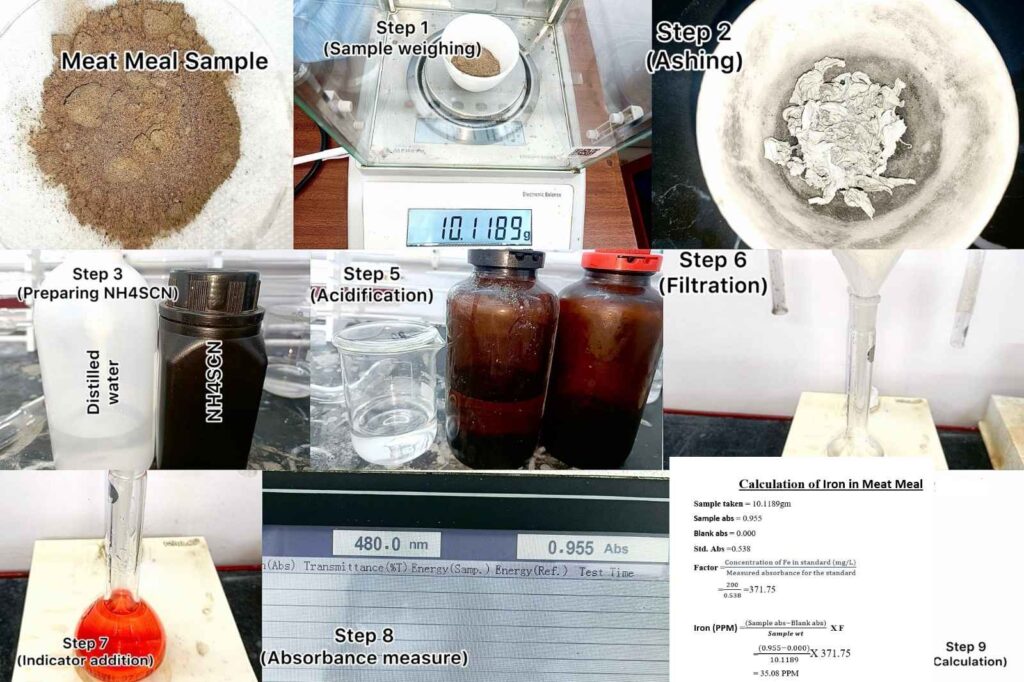
In this method, which is tested in Pro Research & Testing Laboratory iron is converted to its ferric state (Fe³⁺) and then reacts with thiocyanate ions (SCN⁻) to form a stable red-colored ferric thiocyanate complex. The intensity of this color, measured spectrophotometrically at 480 nm, is directly proportional to the iron concentration.
Fe3++ SCN– → Fe(SCN)2+
Instruments Used in Iron Testing Process of Meat Meal Sample
- Spectrophotometer – Measures absorbance of the ferric thiocyanate complex at its 480 nm.
- Muffle Furnace – Removes organic matter by dry ashing at high temperature(600-700°C), leaving mineral residues.
- Hot plate – Supplies controlled heating(80-90°C) for wet digestion and sample preparation.
- Analytical balance(4-digit) – Measures sample and reagent masses with high precision.
- Volumetric flasks (100 ml & 1000ml) & pipettes (5ml & 1ml) – Provide accurate dilution and transfer of solutions for reproducibility.
- Measuring Cylinder (50ml)- To add distilled water.
- Beaker(250ml)- To hold the sample during wet digestion.
- Filter paper– Separates insoluble residues from the digest solution.
Chemicals used in Iron Testing Process of Meat Meal Sample
- Ammonium thiocyanate ( 10% NH₄SCN) – Forms a stable red ferric thiocyanate complex with Fe³⁺ for colorimetric detection.To prepare 10% NH₄SCN take 10 gm ammonium thiocyanate & diluted into 100 ml distilled water.Here we have used the Nice company’s Ammonium thiocyanate . You can use the same company or any other companies.
- Hydrochloric acid (HCl) – Dissolves ash and maintains acidic medium for complex formation.
- Nitric acid (HNO₃) – Oxidizes organic matter and converts iron into soluble ferric form during digestion.
- Standard iron solution (Fe³⁺ stock) – Provides known concentrations for calibration curve preparation. Preparation described previously.
- Distilled water – Prevents contamination and ensures accuracy in dilutions and reagent preparation.The conductivity of distilled water should be <5 μS/cm to prevent contamination.
Procedure to test the Iron in Meat Meal Sample
| Weighing & Igniting | Take 10 gm sample & ignite in muffle -furnace until it turns into ash. Process described previously. |
| Acidifying | Take the ash in a beaker. Add 5 ml HCL & 1 ml HNO₃. Add 50 ml distilled water. Boil gently at 80-90°c for 15 minutes. |
| Filtration | Filter in a 100 ml volumetric flask using filter paper. Add 10 ml NH₄SCN into it & volume make upto the mark. |
| Std solution | Pipette 10 mL of the iron stock solution into a 100 mL volumetric flask. Add 10 ml NH₄SCN into it. Dilute with distilled water to mark. Factor calculation is mentioned previously. This solution contains 1 ml= 200 µg of iron |
| Measuring the Absorbance | Measure the absorbance at 480 nm within 15 minutes of color development. Run a blank sample using distilled water in the same way. Perform the test at least in 2 set to get accurate result. |
| Calculation of Iron | Iron(PPM)= (Sample abs-Blank abs) x F/Sample taken |
Purpose of testing of Iron in Meat Meal Sample
- To determine the iron content in meat meal accurately for nutritional evaluation.
- To ensure quality control of feed ingredients and maintain product consistency.
- To verify compliance with feed safety regulations and nutritional labeling requirements.
- To help in formulating balanced animal diets, preventing iron deficiency or excess.
- To provide a cost-effective and reliable method for routine analysis in feed laboratories.
Care Should be taken during the Test of Iron in Meat Meal
- Incomplete ashing/digestion – Leaves organic residues that interfere with color development.
- Incorrect oxidation state – Not converting all iron to ferric (Fe³⁺) leads to weak or inconsistent color.
- Improper reagent preparation – Wrong concentration of ammonium thiocyanate or standard iron solution affects accuracy.
- Delay in measurement – Reading absorbance after long time causes fading or instability of the red complex.
- Contamination – Using iron-contaminated glassware, water, or filter paper increases false readings. Proper cleaning Process described previously.
- Inaccurate pipetting or dilution – Leads to errors in calibration curve and sample concentration calculations.
- Improper blank correction – Failing to run a reagent blank results in background absorbance errors.
Conclusion of Iron Testing Process of Meat Meal Sample
The ammonium thiocyanate method provides a simple, sensitive, and cost-effective approach to estimate iron in meat meal. By forming a stable red ferric–thiocyanate complex and measuring its absorbance, the method ensures reliable results for nutritional evaluation, quality control, and regulatory compliance in feed analysis.This technique provides a rapid and cost-effective means of estimating iron levels in meat meal/cattle feed/poultry feed/horse feed samples, ensuring both nutritional adequacy and compliance with feed safety standards.To perform iron test at a feed manufacturing company or laboratory should ensure by following standard procedures mentioned above to accurately determine the iron and assess the quality of any feed with availability of the apparatus & chemicals and also the above real-time photo attachment will help to understand the testing process completely. In addition, if expert guidance is needed ,please reach out to Pro Research & Testing Laboratory.
Frequently Asked Questions about Iron Testing in Meat Meal
1.What does the thiocyanate method detect?
Ans-It detects Fe³⁺ (ferric iron) by forming a red complex with SCN⁻: Fe3++ SCN– → Fe(SCN)2+
2.What wavelength is typically used for measurement?
Ans-Around 480 nm is used for the Fe–SCN complex in acidic solutions.
3.Why do I prepare standard solutions?
Ans-For factor calculation to compare your sample’s absorbance to std iron content.
4.What are major interferences or errors?
Ans-Turbidity or particles in solution, Incomplete digestion / extraction of iron, Reagent contamination or impure reagents.
5.Why is Acidification important?
Ans-Acidic conditions keep iron in a soluble form, preventing it from forming insoluble compounds & maintains iron in a consistent oxidation state, ensuring reliable results.
6.Why are both Nitric Acid (HNO₃) and Hydrochloric Acid (HCl) used detect?
Ans-Nitric acid Converts iron into a soluble form, making it easier to measure & Hydrochloric acid Ensures that all forms of iron are dissolved, preventing precipitation.
7.Which types of feed are tested by this method?
Ans-By this method animal feed,fish feed,dog feed, poultry feed or any type of feed samples can be tested or you can reach out to Pro Research & Testing Laboratory for further details.
How We Verified This Testing/Research Procedure :
This testing is done under qualified analysts in our lab.Continually monitored by expertise.Repeatedly testing is always done to get accurate result.

Written by
Riya Ghosh (M.Sc. Food Technology, MAKAUT)
Designation – Chemist
Reviewed by
Anwesha Das (M.Sc Microbiology,BU)
Designation – Microbiologist
Verified By
Dr. Jyotirmoy Kumar Dey (Phd,Chemistry)
Designation – Senior/Chief Chemist
Experience – 25 Years +