
P-alkalinity (Phenolphthalein Alkalinity) is a measure of the alkalinity of water due to the presence of hydroxide (OH⁻) ion. It is determined by titrating a water sample with a standard acid using phenolphthalein as the indicator. The endpoint of the titration occurs at pH 8.3, where the pink color of the indicator disappears.
Here we take the Waste Water to determine the p-Alkalinity.
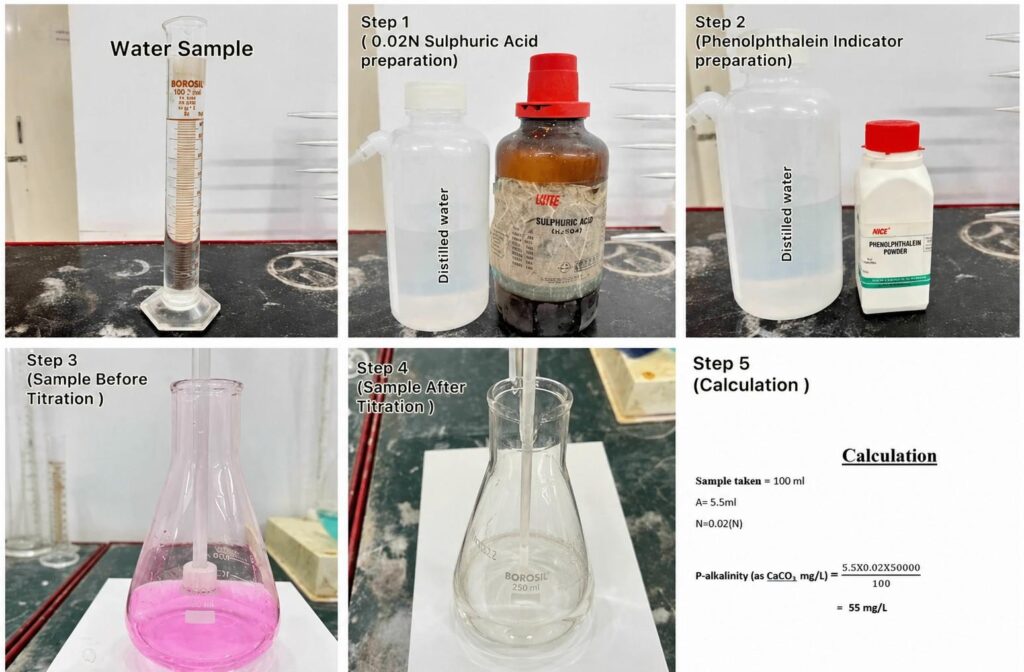
Materials & Chemical Required For p-alkalinity testing
- Burette(50ml) -Delivers precise volumes of standard acid during titration.
- Conical flask(250ml)-To hold the sample solution during titration.
- Measuring Cylinder(100ml)– To measure the water sample.
- pH paper: To check the pH of Water.Extreme low pH cannot detect the level of p-alkalinity properly.
Chemical Required
- Phenolphthalein indicator -Changes from pink to colorless at pH 8.3, indicating the endpoint of the P-alkalinity titration.Preperation mentioned previously.
- Standard acid (0.02 N H₂SO₄)-Supplies H⁺ ions to neutralize alkalinity (OH⁻ and CO₃²⁻) until the endpoint is reached.Preparation described previously.
Procedure to follow while doing p-Alkalinity of Water Sample
- Pipette 100 mL of the water sample into a conical flask.
- Add 2–3 drops of phenolphthalein indicator.
- Titrate with the standard acid until the pink color disappears. Record the volume of acid used.
Calculation
p-alkalinity (mg/L)=A×N×50,000/ sample taken
Importance of P-Alkalinity Testing of Water
- Determines Water Quality: Helps evaluate the alkalinity of water and its ability to neutralize acids.
- Controls Corrosion and Scaling: Assists in maintaining proper water chemistry to prevent corrosion of pipes and equipment and reduce scale formation.
- Supports Water Treatment: Provides essential information for adjusting chemical dosages during drinking water and wastewater treatment processes.
- Monitors Boiler and Cooling Water: Ensures that boiler and cooling systems operate efficiently by maintaining the correct alkalinity levels.
- Identifies Alkalinity Components: When compared with total alkalinity, it helps determine the presence of hydroxide.
- Protects Aquatic Life: Maintaining appropriate alkalinity helps stabilize the pH of natural water bodies, creating a healthier environment for aquatic organisms.
- Improves Industrial Processes: Many industries require controlled alkalinity to ensure product quality and protect processing equipment.
Common Handling Mistakes in P-Alkalinity Test of Water
- Using contaminated glassware: Dirty or improperly rinsed equipment can affect the test results. Proper cleaning Process described previously.
- Incorrect sample volume: Measuring the wrong volume of the water sample leads to inaccurate calculations.
- Using expired or incorrect indicator: Old or contaminated phenolphthalein indicator may not produce a clear endpoint.
- Incorrect acid concentration: Using acid with the wrong normality or an unstandardized solution causes errors in alkalinity values.
- Over-titration: Adding excess acid beyond the endpoint results in a higher-than-actual P-alkalinity value.
- Missing the endpoint: Stopping the titration too early gives a lower-than-actual alkalinity value.
- Adding acid too quickly: Rapid addition of acid can make it difficult to observe the exact disappearance of the pink color.
- Improper mixing: Failing to swirl the flask continuously during titration can delay the reaction and affect the endpoint.
- Incorrect burette reading: Errors due to parallax or inaccurate reading of the burette scale can alter the calculated result.
Conclusion for P-Alkalinity Testing of Water
P-alkalinity testing plays an important role in maintaining water quality, protecting equipment, and ensuring efficient water treatment.To perform the p-alkalinity as CaCO3 test at a water manufacturing company or laboratory should ensure by following standard procedures mentioned above to accurately determine the p-alkalinity and assess the quality of the drinking water with availability of the apparatus & chemicals and also the above real-time photo attachment will help to understand the testing process completely. In addition, if expert guidance is needed ,please reach out to Pro Research & Testing Laboratory.
FAQ related to P-Alkalinity Testing of Water
1.What is the unit of P-alkalinity?
Answer: It is usually reported as mg/L (ppm).
2.What happens if alkalinity is too low?
Answer: Low alkalinity can cause-corrosion of pipes,leaching of metals (lead, copper),unstable pH & potential health hazards due to metal contamination.
3.What happens if alkalinity is too high?
Answer: High alkalinity can lead to bitter taste of water,scaling in pipes and appliances,reduced effectiveness of disinfection.
4.Is alkalinity the same as pH?
Answer: No. pH measures the hydrogen ion concentration (acidity/basicity), while alkalinity measures how well water resists pH changes.
5.For which type of water the alkalinity test is mandatory?
Answer: Including drinking water, water treatment plant and also before treating STP & ETP , the alkalinity testing should be done.
How We Verified This Testing/Research Procedure :
This testing is done under qualified analysts in our lab.Continually monitored by expertise.Repeatedly testing is always done to get accurate result.

Written by
Riya Ghosh (M.Sc. Food Technology, MAKAUT)
Designation – Chemist
Reviewed by
Anwesha Das (M.Sc Microbiology,BU)
Designation – Microbiologist
Verified By
Dr. Jyotirmoy Kumar Dey (Phd,Chemistry)
Designation – Senior/Chief Chemist
Experience – 25 Years +