
| AdBlue (Diesel Exhaust Fluid) helps diesel vehicles run cleaner by converting harmful exhaust gases into harmless nitrogen and water vapor making it essential for modern emission control systems.Phosphate testing in Diesel Exhaust Fluid (DEF) is performed to ensure purity. Excess phosphate can damage the catalyst and reduce emission control efficiency. |
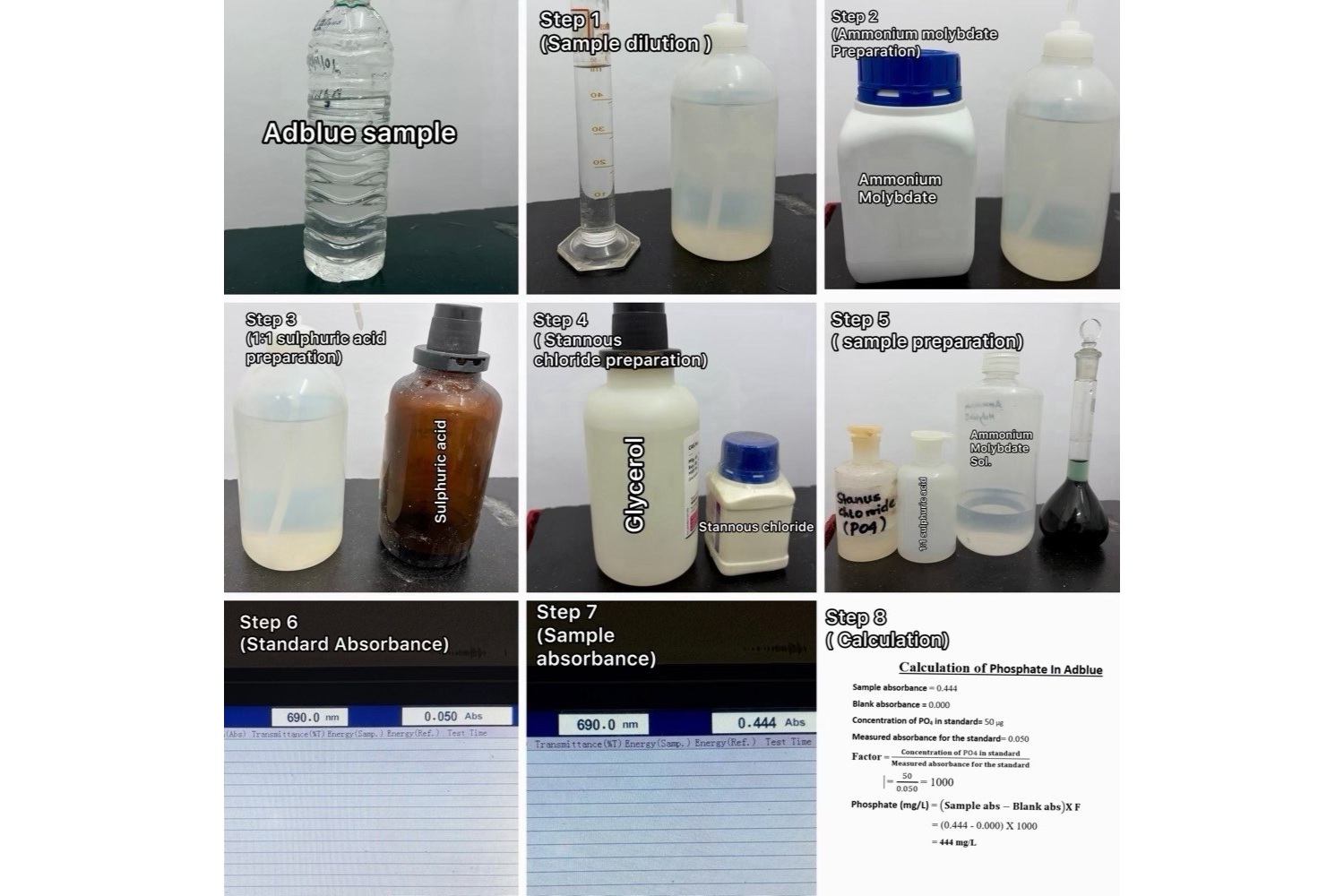
| Phosphate reacts with ammonium molybdate under acidic conditions to form phosphomolybdic acid, which is then reduced by a reducing agent (stannous chloride) to form a blue-colored complex. The intensity of the blue color is measured spectrophotometrically at around 690 nm, and is directly proportional to the phosphate concentration. |
PO43- +12MoO4 2-+3NH4++24H+→(NH4 )3[P(Mo12O40)] + 12H2O
Chemicals/Reagents Used
- Ammonium molybdate solution: Reacts with phosphate ions in acidic medium to form phosphomolybdic acid complex.Dissolve 25g of ammonium molybdate in 175 ml of distilled water. Continuously add 280 ml of concentrated sulphuric acid to 400 ml of distilled water in a separate beaker, cool and add the molybdate solution to this acid solution and dilute to 1 litre.
- Sulphuric acid(1:1): Provides the acidic environment necessary for the molybdate-phosphate reaction. Add 10 ml H2SO4 and 10 ml distilled water to make 1:1 sulphuric acid solution.
- Stannous chloride: Reduces phosphomolybdic acid to a blue-colored complex (molybdenum blue) for measurement. Dissolve 2.5 g of a fresh stannous chloride ( SnCl2.2H2O ) in 100 ml of glycerol.Here we have used all the following chemicals/reagents of Researchlab company. You can use the same company or any other companies.
- Standard phosphate solution: Used to prepare a calibration curve for determining phosphate concentration in the sample.Dissolve 219.5 mg of anhydrous potassium dihydrogen phosphate in distilled water and dilute to 1000 ml, 1 ml = 50 μg phosphorus.
- Distilled water: Serves as a solvent and blank to ensure accurate and contamination-free results.The conductivity of distilled water should be <5 μS/cm to prevent contamination.
Instruments & Glassware Used
- Spectrophotometer-Measures absorbance of blue complex at specific wavelength (690 nm) to find phosphate concentration.
- Volumetric flask(100ml&1000ml)-Used to prepare accurate reagent and standard solutions by precise dilution.
- Dropper-Helps in controlled reagent addition to prevent excess or spillage.
- Pipette(1ml, 5ml)-Used to measure and transfer exact liquid volumes for reproducible results.
Procedure to be followed
| Std solution | Take 1 ml standard solution in 100 ml volumetric flask. Add 4 ml 1:1 H2SO4 solution then 4 ml ammonium molybdate & 10 drops stannous chloride. Volume make up to the mark. |
| Sample preparation | Take 1 ml sample in 100 ml volumetric flask. Add 4 ml 1:1 H2SO4 solution then 4 ml ammonium molybdate & 10 drops stannous chloride. Volume make up to the mark. |
| Taking absorbance | Take absorbance at 690 nm. Run a blank sample using distilled water in the same way. Perform the test at least in 2 set to get accurate result. |
| Calculation | F=C/A C = Concentration of PO4 in standard (mg/L) A = Measured absorbance for the standard F =phosphate factor Phosphate(mg/L)= (Sample abs-Blank abs) x F |
Purpose of Phosphate Testing of AdBlue (Diesel Exhaust Fluid)
- To ensure the purity of AdBlue by detecting any phosphate contamination.
- To protect the SCR(Silicon Controlled Rectifier) catalyst from poisoning or damage caused by phosphate deposits.
- To maintain efficient NO2 reduction performance in diesel exhaust systems.
- To verify product quality before distribution or use in vehicles.
Handling Mistakes While Doing Phosphate Testing of AdBlue (DEF)
- Using contaminated glassware: Can introduce phosphate traces and give false high results.
- Improper reagent preparation: Wrong concentration or expired reagents affect color development accuracy.
- Incorrect acidity level: Too much or too little sulfuric acid can prevent proper complex formation.
- Delay in reading absorbance: The blue color fades over time, leading to lower readings.
- Dirty or wet cuvettes: Can scatter light and cause errors in spectrophotometer readings.
- Not using distilled water: Impurities in water can interfere with the reaction.
- Improper standard calibration: Inaccurate standard curve results in incorrect phosphate estimation.
Conclusion of Phosphate Testing
Phosphate testing in Diesel Exhaust Fluid (DEF)/ Aqueous Urea Solution/automotive grade urea solution ensures that the product meets purity standards.Maintaining phosphate levels is crucial to protect the SCR catalyst and maintain compliance with specifications. Accurate phosphate testing confirms the quality, safety, and performance reliability of DEF used in modern diesel engines.To perform phosphate test at any manufacturing company or laboratory should ensure by following standard procedures mentioned above to accurately determine the phosphate and assess the quality of adblue with availability of the apparatus & chemicals and also the above real-time photo attachment will help to understand the testing process completely. In addition, if expert guidance is needed ,please reach out to Pro Research & Testing Laboratory.
FAQ
Q1. What is phosphate in AdBlue?
A:Phosphate is a protective additive present in AdBlue.
Q2. Why is phosphate testing important in AdBlue?
A:Because phosphate can coagulate the unbound carbon particles which can be ultimately removed by blowdown.
Q3. How is phosphate tested in AdBlue?
A:It is usually tested by the molybdenum blue spectrophotometric method, where phosphate forms a blue-colored complex measured at 690 nm.
Q4.What happens if the sample is not acidified?
A:If the solution is not properly acidified it can prevent proper complex formation and the solution will not show proper blue colour.
Q5. Can I test the phosphate in any manufacturing laboratory??
A:Yes, with availability of chemicals & apparatus mentioned above, you can test phosphate of adblue in any manufacturing industry/lab.
How We Verified This Testing/Research Procedure :
This testing is done under qualified analysts in our lab.Continually monitored by expertise.Repeatedly testing is always done to get accurate result.
Written by
Riya Ghosh (M.Sc. Food Technology, MAKAUT)
Designation – Chemist

Reviewed by
Anwesha Das (M.Sc Microbiology,BU)
Designation – Microbiologist
Verified By
Dr. Jyotirmoy Kumar Dey (Phd,Chemistry)
Designation – Senior/Chief Chemist
Experience – 25 Years +