
The sand content test of Earthing powder/Bentonite Powder/Bentonite Clay is carried out to find the amount of sand present in the material. Earthing powder is used in grounding systems to improve electrical insulation, earth neutralisation and reduce earth resistance. A good-quality earthing powder should contain only a limited amount of sand because too much sand can reduce its effectiveness.
Apparatus & Equipment Required for Sand Content test of Earthing Powder-
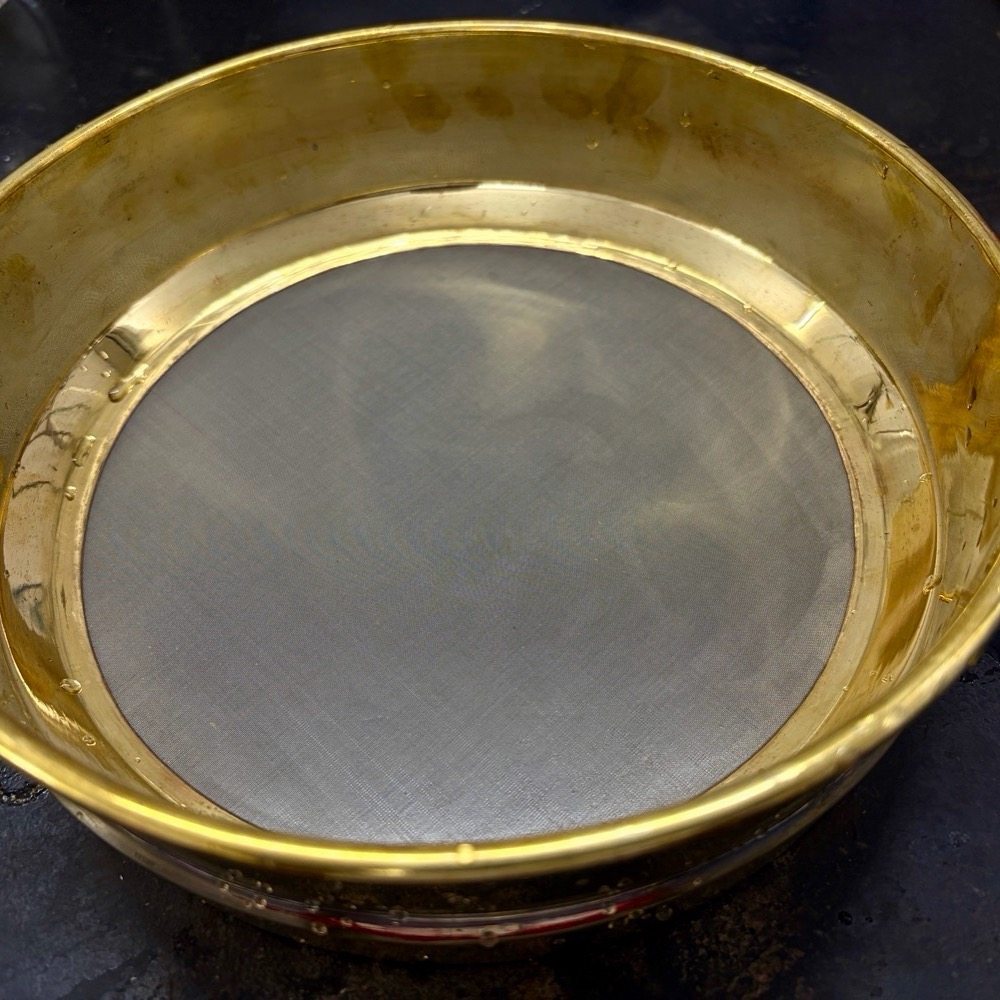
- 45 micron sieve-Works on the principle of particle size separation, allowing particles smaller than 45 μm to pass through while retaining larger particles.
- Hot air oven(105°C)–Works on the principle of forced hot air circulation to remove moisture from the sample by evaporation at a controlled temperature.
- Petri Dish- Use to hold the sample.
- Digital Balance (4-digit)- To accurately measure the mass of the sample up to four decimal places.
Procedure to be followed while doing Sand Content analysis of Earthing Powder-
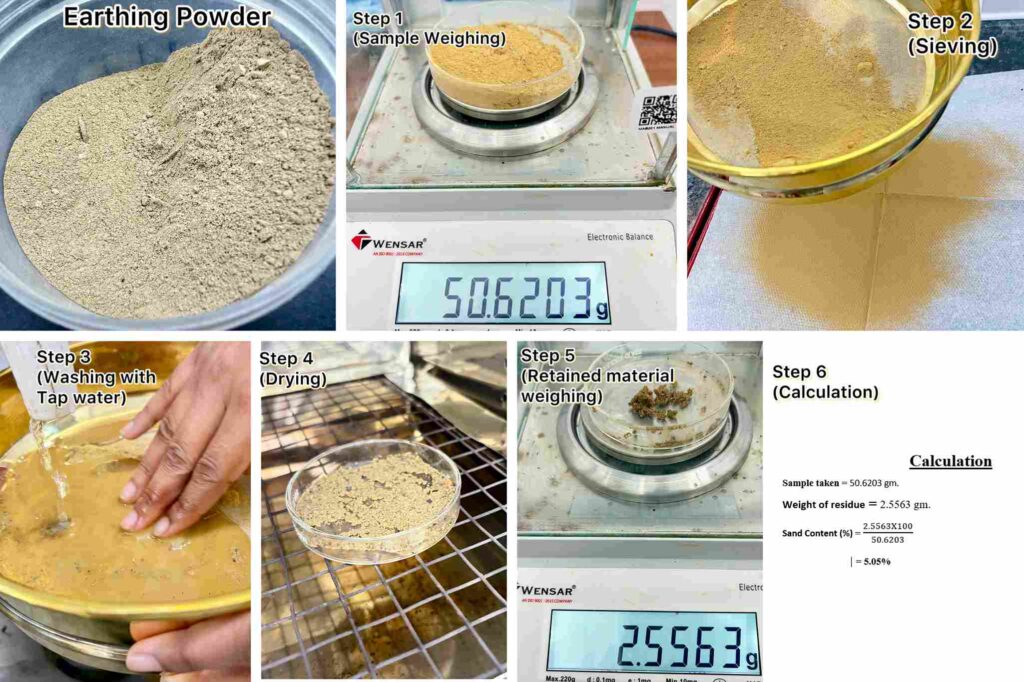
Weigh approximately 50 g of the sample using a 4-digit digital balance.
│
▼
Place the dried sample on a 45-micron sieve. Sieve the sample manually or for 10–15 minutes. Ensure all fine particles pass through the sieve.
│
▼
Collect the material retained on the 45-micron sieve (sand/coarse particles).Sieve the retained material under tap water.
│
▼
Transfer the material in a clean pre-weight petri dish & dry the retained material in hot air oven at 105°C.Dessicate and record the weight.
│
▼
Calculate the sand content using the formula: Sand Content(%) = (retained material X 100)/ sample weight
Importance of Sand Content Test of Earthing Powder-
- Ensures Product Quality – Confirms that the earthing powder meets specified quality requirements.
- Maintains Insulation – Low sand content helps achieve lower earth resistance by ensuring better electrical insulation.
- Improves Moisture Retention – Fine particles retain moisture better than sand, maintaining effective grounding over time.
- Compliance with Specifications – Verifies conformity with quality standards.
Precautions to be maintained to do Sand Content testing of Earthing Powder-
- Use a clean and undamaged 45-micron sieve.
- Ensure complete drying before weighing.
- Avoid loss of material during transfer and sieving.
- Calibrate the digital balance periodically.
- Clean the sieve thoroughly after each test.
- Perform the test in a dry environment to prevent moisture absorption
- Contaminated glassware leads to entry of unwanted particles which provides false-positive result.Proper cleaning Process described previously
Conclusion for Sand Content determination in Earthing Powder-
The sand content test is a simple but critical quality control test for earthing powder. It evaluates the amount of coarse inert material present in the product and helps ensure consistent insulation, moisture retention, and long-term performance of the earthing system.By following the above-mentioned method, you can easily test the Sand Content testing of Earthing powder/Bentonite Powder/Bentonite Clay at any laboratory or manufacturing industry with the availability of the equipments. This testing process ensures accurate results, which are crucial for quality control in various applications. Furthermore, if you can’t understand the procedure, you can check our real-time photo attached with this writing, which visually guides you through each step and enhances your understanding. Additionally, for those who prefer professional assistance or require more advanced testing, you can also reach out to Pro Research & Testing Laboratory for testing purposes.
FAQ related to Sand Content testing of Earthing Powder
Q1: Why is sand content tested in earthing powder?
Ans: Sand content is tested to determine the amount of coarse inert particles present, which can affect the fineness and moisture-retention properties of the earthing powder.
Q2: Why is a 45-micron sieve used?
Ans: 45-micron sieve separates coarse sand particles from the finer conductive components of the earthing powder, enabling accurate sand content measurement.
Q3:How much sample is generally used for the test?
Ans: Approximately 50 g of earthing powder is commonly used.
Q4:What is the major precaution should be maintained during this test?
Ans:To measure the content of Sand wash the equipment properly to remove foreign particles.
Q5:What can cause high sand content results?
Ans: High sand content may result from poor raw material quality, contamination during manufacturing, or insufficient processing.
How We Verified This Testing/Research Procedure :
This testing is done under qualified analysts in our lab.Continually monitored by expertise.Repeatedly testing is always done to get accurate result.

Written by
Riya Ghosh (M.Sc. Food Technology, MAKAUT)
Designation – Chemist
Reviewed by
Anwesha Das (M.Sc Microbiology,BU)
Designation – Microbiologist
Verified By
Dr. Jyotirmoy Kumar Dey (Phd,Chemistry)
Designation – Senior/Chief Chemist
Experience – 25 Years +