
Nickel content determination in water is essential to protect health, prevent environmental degradation and ensure industrial compliance.Nickel is a non-biodegradable heavy metal that is highly toxic.If high levels of nickel are present in water ,that need accurate monitoring.
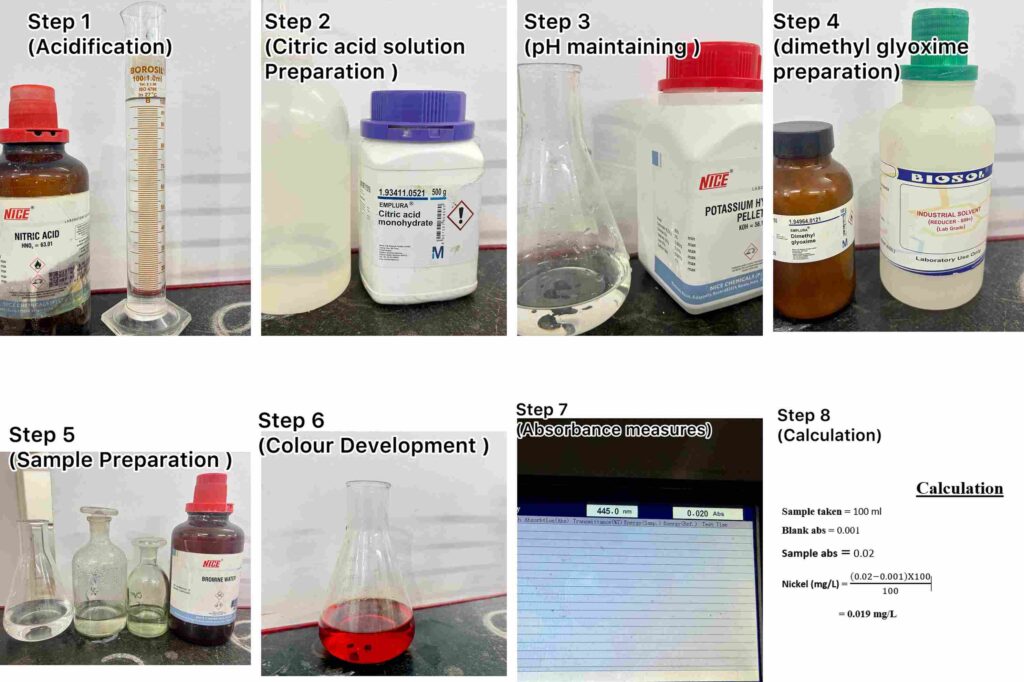
To determinate the nickel content in water , we followed Dimethylglyoxime Method in our laboratory .Here we take Waste Water to test the nickel.
Chemicals & Equipments Used During Testing of Nickel Content Determination In Water
Chemicals Used
- Nitric Acid : Used for pH adjustment or dissolution of precipitates during sample preparation.Preserves water samples and prevents nickel precipitation or adsorption.
- Citric Acid : It is maintaining a stable environment.To prepare dissolve 10gm in 100ml distilled Water.
- Dimethylglyoxime(DMG) : The primary color-forming reagent. DMG reacts specifically with nickel in an alkaline medium to form a red-colored nickel-dimethylglyoxime complex.Dissolve 1.0 g DMG in 100 mL ethyl alcohol to prepare the solution.Store in an amber bottle.
- Potassium Hydroxide : Provides the alkaline medium (pH about 9–10) required for the reaction between nickel and DMG. It also helps keep many interfering metals in solution.
- Ethyl Alcohol : Ethyl alcohol (ethanol) is primarily used in nickel testing as an organic solvent to dissolve dimethylglyoxime.
- Bromine Water : In water analysis, bromine water acts as a strong oxidizing agent.
- Distilled Water: Used for reagent preparation, dilution of standards & washing.The conductivity of distilled water should be <5 μS/cm to prevent contamination.
Equipments Used
- Spectrophotometer : Measures the absorbance at a wavelength of around 445 nm.
- pH paper : To check the pH range in sample.
- Pipettes(5 ml) : Ensure the accurate volumetric measurement of reagents.
- Measuring Cylinder : Accurate measurement of reagents and samples.
- Conical Flask(250 ml) : To hold the sample during testing.
Testing Process Of Nickel content in Water
| Sample Preservation | Collect sample cleaned bottles. Preserve with concentrated nitric acid to pH < 2. Analyze preferably within 24 hours. |
| Color Development | Take 100 ml sample. Add 5 ml citric acid solution Adjust pH to the required alkaline range using potassium hydroxide. Add 1 ml bromine water (oxidizing agent). Add 1-2 ml dimethylglyoxime reagent. Allow the red color to develop fully. |
| Measurement | Measure absorbance at 445 nm against a blank using a spectrophotometer. Use distilled water as blank. |
| Calculation | Nickel Content= Concentration ×Dilution Factor/Sample Volume |
Purpose of Test the Nickel Content In Water
- To determine whether water contains nickel contamination.
- To evaluate the suitability of water for drinking, domestic, industrial, or environmental use.
- Nickel is highly toxic for human and aquatic ecosystem. Evaluation can determine the level which helps in water treatment.
- It prevents ecosystem degradation. Helps to detect water quality.
- Monitoring nickel levels helps ensure compliance with standards.
Handling Mistakes to be Avoided during Testing of Nickel Content Determination In Water
- Contaminated or old reagents : Impurities or degraded reagents affect colour development and absorbance.
- Improper timing during colour development : Over or underdeveloped colour causes inaccurate absorbance readings.
- Not using a blank : Instrument errors may go incorrected, causing false readings.
- Dirty or scratched cuvettes or glasswares : Affects light transmission, resulting in inaccurate absorbance.Using unclean or contaminated glassware, which may affect test results. Proper cleaning Process described previously.
Conclusion of Nickel Content Determination In Water
High concentrations of nickel in water can lead to adverse health effects.Nickel is highly toxic to fish, algae, and other aquatic organisms.Nickel content determination in water and wastewater is essential to prevent environmental degradation, and ensure quality.By following the above-mentioned method, you can easily test the Nickel Content at any laboratory with the availability of the equipments and chemicals .This testing process ensures accurate results, which are crucial for quality control in various applications. Furthermore, if you can’t understand the procedure, you can check our real-time photo attached with this writing, which visually guides you through each step and enhances your understanding. Additionally, for those who prefer professional assistance or require more advanced testing, you can also reach out to Pro Research & Testing Laboratory for testing purposes.
FAQ- Testing for Determination Of Nickel content In Water
Q: What equipment is used for colour measurement of the sample?
A: UV-Vis Spectrophotometer is used for colour measurement of the sample.
Q: What is the purpose for determination of Nickel content in water and wastewater sample ?
A: Determines the purity of water by measuring the concentration of Heavy metal like nickel.
Q: What is the role of Potassium Hydroxide in this test?
A:Potassium Hydroxide provides the necessary alkaline environment to prevent side reactions and it also keeps the exact pH range in sample during testing .
Q:What is the major mistake should avoided during Test in Water?
A:To measure the colour within recommended time is the major mistake should avoided during this test in Water as colour will start degraded after a certain time.
Q: What is the method & wavelength is used for Nickel measurement?
A: The Dimethylglyoxime Method is commonly measured at a wavelength of 445 nm.
How We Verified This Testing/Research Procedure :
This testing procedure is done under qualified analyst .Continually monitored by expertise.Repeatedly testing is always done to get accurate result.

Written by
Ankita Samanta (M.Sc Microbiology,Vidyasagar University)
Designation – Junior Microbiologist
Reviewed by
Anwesha Das (M.Sc Microbiology,BU)
Designation – Microbiologist
Verified By
Dr. Jyotirmoy Kumar Dey (Phd,Chemistry)
Designation – Senior/Chief Chemist
Experience – 25 Years +