
A vital nutrient for plants, nitrogen is a key building block of proteins. Thus, calculating total nitrogen is crucial for planning fertilizer applications and assessing soil fertility.
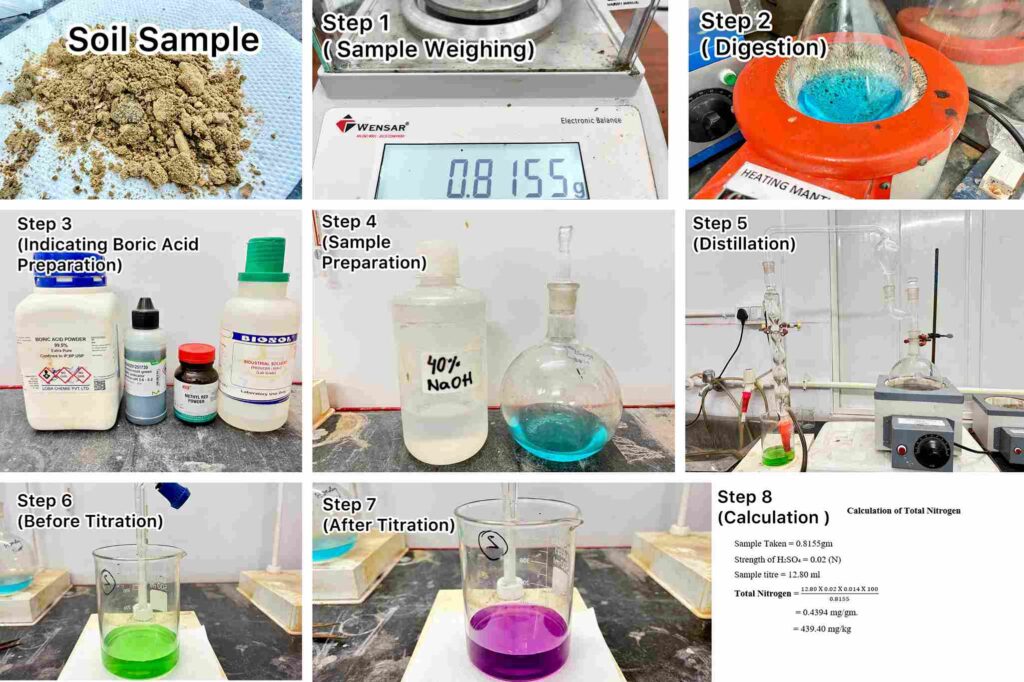
Organic nitrogen in soil is digested with concentrated sulfuric acid in the presence of a catalyst mixture. The nitrogen is converted into ammonium sulfate. Upon alkalization, ammonia is liberated, distilled, absorbed in boric acid solution, and titrated with standard acid.
Chemical required To Test Total Nitrogen of Soil
- Concentrated Sulfuric Acid (H₂SO₄)- Oxidizes organic matter, converts organic N into ammonium sulfate (NH₄)₂SO₄.
- Catalyst mixture (K₂SO₄ + CuSO₄)-Potassium Sulphate(K₂SO₄) raises boiling point; Copper Sulphate (CuSO₄) catalyzes oxidation of organic compounds. Details mentioned previously.
- Sodium Hydroxide (40% solution)– Converts NH₄⁺ into NH₃ gas for distillation.Preparation mentioned previously.
- 2–4% Boric acid solution-Traps NH₃ as ammonium-borate complex for titration. 2% aqueous solution containing 5 ml of mixed indicator solution per litre.
- Mixed indicator (Bromocresol green + Methyl red)- Shows color change when titration is complete.Dissolve 0.5 g bromocresol green and 0.1 g methyl
- red in 95 percent (m/v) ethanol.
- Standard 0.02 N Standard Sulfuric acid (H₂SO₄)- Neutralizes ammonia in boric acid; volume used gives nitrogen content.Preparation described previously.
- Zinc metal granules- Used to converts the nitrate & nitrite into ammonia.
- Distilled water- Acts as a solvent .The conductivity of distilled water should be <5 μS/cm to prevent contamination.
Apparatus used To Test Total Nitrogen of Soil
- Kjeldahl digestion unit-Uses high heat and sulfuric acid to break down organic matter and convert soil nitrogen into ammonium sulfate
- Kjeldahl distillation assembly-Converts ammonium ions into ammonia gas via steam distillation and collects it in a receiving solution.
- Beaker (250 mL)-used as receiver to collect distillate.
- Burette (50 mL)- Delivers precise volumes of standard acid during titration to quantify the amount of trapped nitrogen.
- Pipettes and measuring cylinders-Ensure the accurate volumetric measurement of reagents and soil extracts to maintain test consistency
- Analytical balance (4-digit)-Provides the highly accurate initial sample weight necessary for calculating the final nitrogen percentage.
- Fume hood-Safely exhausts the hazardous acid fumes and toxic gases generated during the high-heat digestion process.
Testing Procedure of Total Nitrogen of Soil
| Digestion | Weigh approx 0.5-1.0 g soil into Kjeldahl flask. Add 10–15 mL concentrated H₂SO₄. Add 5 g catalyst mixture & few 2-3 zinc granules. Heat gently, then strongly until solution becomes clear. Cool and dilute with distilled water (about 50 mL). |
| Distillation | Transfer digest to distillation unit. Add excess 40% NaOH carefully to make solution strongly alkaline. Distil ammonia into a beaker containing 50 mL boric acid solution with mixed indicator Continue distillation until about 100–150 mL distillate is collected. |
| Titration | Titrate the distillate with standard H₂SO₄ Note volume of acid used (V₁). Run reagent blank with boric acid with mix indicator and note blank reading (V₂). |
| Calculation | Total nitrogen= (titre value X Strength of H₂SO₄ X 0.014 X 100) / Sample taken |
Purpose of testing for Total Nitrogen of Soil Sample
- Measures total nitrogen present in soil for fertility assessment.
- Helps determine the right type and amount of nitrogen fertilizer.
- Indicates the level of organic matter in the soil.
- Guides crop planning and expected yield.
- Prevents environmental pollution from excess nitrogen.
Handling Mistakes should avoided during Total Nitrogen of Soil Sample
- Sample handling: Always air-dry, grind, and sieve soil to avoid heterogeneity.
- Weighing: Use a calibrated balance to prevent inaccurate sample weight.
- Digestion incomplete: Continue heating until the solution is clear.
- Incomplete distillation: Make solution strongly alkaline and distill fully.
- Titration errors: Use proper indicator and titrate carefully.
- Impure reagents: Use fresh, standardized chemicals only.
Conclusion of testing for Total Nitrogen of Soil Sample
Total nitrogen testing is a vital process used to measure the entire nitrogen stored in the soil, including both organic and inorganic forms as nitrogen is the most critical nutrient for plant growth.By following the above-mentioned method, you can easily test the Total nitrogen at any laboratory with the availability of the equipments and chemicals.This testing process ensures accurate results, which are crucial for quality control in various applications. Furthermore, if you can’t understand the procedure, you can check our real-time photo attached with this writing, which visually guides you through each step and enhances your understanding. Additionally, for those who prefer professional assistance or require more advanced testing, you can also reach out to Pro Research & Testing Laboratory for testing purposes.
FAQ-Total Nitrogen of Soil Sample
1. What is the Kjeldahl method used for?
The Kjeldahl method is used to determine the total nitrogen content in soil by converting organic nitrogen into ammonium through acid digestion, followed by distillation and titration.
2. Why is concentrated sulfuric acid used in the digestion step?
Concentrated sulfuric acid breaks down organic matter and converts organic nitrogen into ammonium sulfate.
3. What is the role of a catalyst in the Kjeldahl digestion?
Catalysts such as copper sulfate increase the speed and efficiency of digestion.
4. Why is sodium hydroxide added before distillation?
Sodium hydroxide makes the solution alkaline, which converts ammonium ions into ammonia gas for distillation.
5. How is nitrogen content calculated?
Nitrogen content is calculated from the volume of standard acid used during titration after distillation.
6. What are common sources of error?
Incomplete digestion, loss of ammonia during distillation, improper titration, and contamination.
How We Verified This Testing/Research Procedure :
This testing is done under qualified analysts in our lab.Continually monitored by expertise.Repeatedly testing is always done to get accurate result.
Written by
Riya Ghosh (M.Sc. Food Technology, MAKAUT)
Designation – Chemist

Reviewed by
Anwesha Das (M.Sc Microbiology,BU)
Designation – Microbiologist
Verified By
Dr. Jyotirmoy Kumar Dey (Phd,Chemistry)
Designation – Senior/Chief Chemist
Experience – 25 Years +