
Total solids (TS) refers to all the components in a liquid food sample that remain after all the water has evaporated. This includes both dissolved solids (such as sugars, salts, and proteins) and suspended solids (like minute particles), as well as fats, minerals, and other constituents found in food. In products like milk, Total solids includes proteins, fats, lactose, and minerals.
Testing for total solids in a liquid food sample is a widely used analytical method that assesses the amount of non-water substances present after all moisture has been eliminated. This parameter is crucial for quality control in various liquid foods, including milk, juices, sauces, syrups, and beverages, as it influences nutritional value, texture, shelf stability, processing quality, and adherence to regulations.
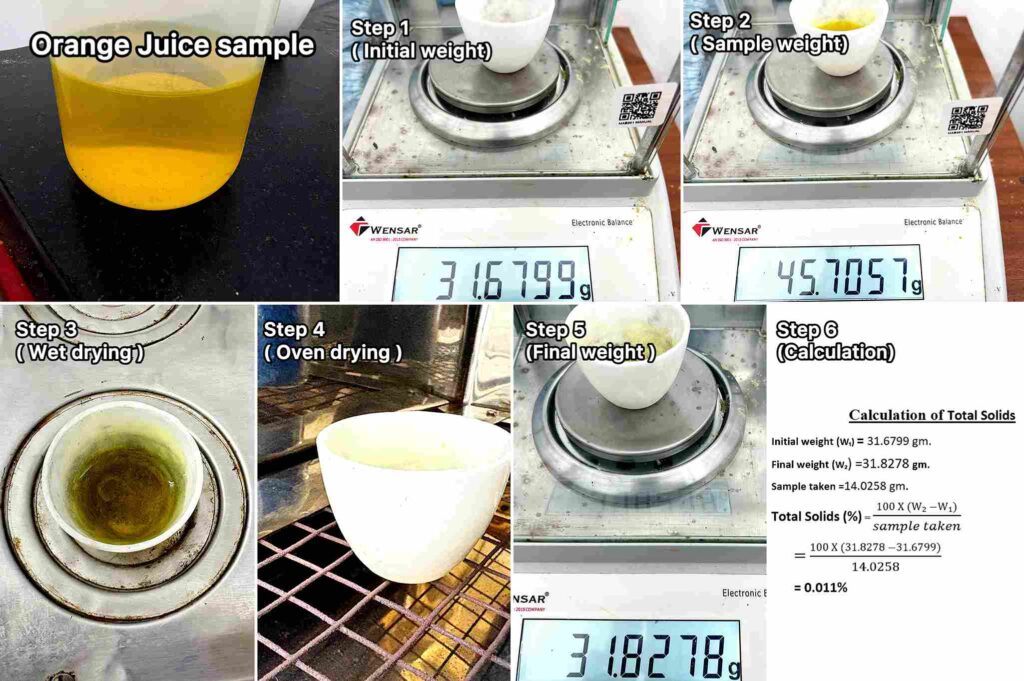
We can test the Total Solid of various type of liquid food samples by this process.Here we take orange juice sample to analysis the Total Solid.
Instruments & Glasswares used during this test :
- Analytical Balance(4 digit) :To accurately measure the mass of glasswares and samples before and after drying.
- Water Bath:A container of hot water produces steam heat to evaporate water from the sample in the dish more slowly and uniformly before final drying. This reduces splattering and loss of solids.
- Hot Air Oven(105°C) :To dry the sample to constant mass by evaporating water.
- Desiccator :To cool dry samples without moisture absorption from the air.
- Silica Crucible(50ml) :Holds the liquid food sample while water is evaporated and then while drying the residue.
Procedure :
- Sample Preparation
- To assure an even dispersion, homogenize the liquid food sample.
- Accurately transfer a known volume or mass of sample to a pre-weighed dry crucible.
- Drying
- Place the dish with sample in water-bath for slow & uniform drying.After complete drying set hot air oven to a specific temperature (105 °C) for several hours or until it reaches constant weight.This ensures most of the water evaporates without decomposing other food components.
- Cooling & Weighing
- After drying, cool the dish in a desiccator to prevent moisture absorption from the air.
- Weigh the dried residue.
- Calculation
- Total solids are calculated as the percentage of the dry residue relative to the original sample:
Total Solids (%) = (Final Weight – Initial weight) / weight of sample) × 100
- Total solids are calculated as the percentage of the dry residue relative to the original sample:
Why Total Solid is important to test?
Total solids analysis in liquid foods is useful for:
- Quality control: Ensures product meets label claims and standards (e.g., total solids in milk).
- Process control: Helps manufacturers monitor concentration changes during processing (e.g., concentration, blending).
- Shelf-life & stability: High or low solids content can affect texture, microbial stability, and processing behavior.
- Nutritional analysis: Contributes to calculation of energy, protein, carbohydrate and other nutrient contents.
Key Handling Mistakes to Avoid:
1. Poor Sample Handling Before Analysis
- Mass can be changed by allowing moisture gain or loss prior to weighing (e.g., prolonged exposure to air). To avoid absorption or evaporation, samples should be handled promptly and stored in airtight containers.
- Diversity in food liquids can contribute to inaccurate conclusions; improper homogenization of the sample produces inaccurate sections.
2. Incorrect Weighing Procedures
- Weighing after drying allows moisture to re-absorb into a warm dish, which alters the weight. After cooling in a desiccator, weigh immediately.
- Measured mass is changed when plates or samples are touched with bare hands, leaving oils or residues on glassware.
- Systematic inaccuracies are introduced by an uncalibrated balance; always verify calibration before beginning.
3. Drying Errors
- Moisture may be trapped internally by uneven drying produced on either clumping or thick sample layers, preventing full evaporation.
- Moisture underneath may not evaporate correctly if particles of the sample form a top crust.
4. Environmental Influences
- Humidity and air currents surrounding the balance or oven might lead to measurement errors or moisture gains or losses.
- Improper desiccator use, such as keeping it open for too long or failing to apply fresh desiccant, leads to inaccurate weights or moisture uptake.
5. Contamination
- Unclean glassware or residues from detergents or previous tests alter the mass of dried residue. Clean and dry all glassware before use.
- Dust or airborne particles settling on dishes before weighing also impacts accuracy—perform weighing in clean, controlled spaces.
Conclusion :
Total solids testing in liquid food samples provides an essential measure of the overall content of dissolved and suspended matter, reflecting the product’s concentration, quality, and consistency. Accurate determination of total solids is important for quality control, regulatory compliance, and ensuring uniformity in food processing and storage.By following the above-mentioned method, you can easily test the Total solid of any liquid food like sauces,juices,milk etc at any laboratory or manufacturing industry with the availability of the equipments and chemicals.This testing process ensures accurate results, which are crucial for quality control in various applications. Furthermore, if you can’t understand the procedure, you can check our real-time photo attached with this writing, which visually guides you through each step and enhances your understanding. Additionally, for those who prefer professional assistance or require more advanced testing, you can also reach out to Pro Research & Testing Laboratory for testing purposes.
FAQ :
What are total solids in a liquid food sample?
Total solids refer to all the non-water components in a liquid food sample including proteins, fats, sugars, minerals, and other dissolved or suspended matter that remain after all moisture is removed by drying.
2. Why is total solids analysis important?
Total solids testing is a critical quality and composition parameter for liquid foods like milk, juices, sauces, and dairy products. It helps evaluate nutritional value, product consistency, label compliance, shelf-life potential, and processing quality.
3. How is total solids measured?
It’s usually done by a gravimetric method: a known amount of sample is dried in a controlled oven to remove water, and the dry residue left is weighed. The result is expressed as a percentage of the original sample.
4. At what temperature is total solids drying performed?
Typical oven drying temperatures are around 105 °C for food products. Too low a temperature may leave moisture behind; too high may degrade sample constituents and lead to inaccurate results.
5. How long should the sample be dried?
Dry until constant weight is achieved meaning repeated weighings show no further loss of mass. This ensures all moisture is removed without over-drying.
6. Should the sample be homogenized before testing?
Yes, liquid food samples must be well mixed to ensure a representative portion is taken. Inadequate homogenization leads to inconsistent results.
7. Can total solids testing be used for all liquid foods?
Yes, it’s widely used for liquid food products, but the specific method parameters (temperature, time) may vary depending on the nature of the food (e.g., dairy vs. fruit juices).
How We Verified This Testing/Research Procedure :
This testing is done under qualified analysts in our lab.Continually monitored by expertise.Repeatedly testing is always done to get accurate result.

Written by
Anwesha Das (M.Sc Microbiology,BU)
Designation – Microbiologist
Reviewed by
Riya Ghosh (M.Sc. Food Technology, MAKAUT)
Designation – Chemist
Verified By
Dr. Jyotirmoy Kumar Dey (Phd,Chemistry)
Designation – Senior/Chief Chemist
Experience – 25 Years +