
Total Suspended Solids (TSS) represents the amount of undissolved particles—like silt, clay, organic matter, and industrial waste—present in water. It is one of the most important parameters for assessing water quality in drinking water, wastewater, rivers, and industrial effluents.Here we tested TSS in surface water.
Glassware Used in TSS Detection
- Measuring Cylinder(100ml)- Measures an accurate volume of the water sample to ensure correct TSS calculation.
- Gooch Crucible – It is a glazed porcelain crucible with a perforated bottom used to collect and weigh suspended solids (TSS) after filtration and drying in water quality testing.
- Filtration Assembly (Glass Funnel or Vacuum Filtration Flask)-Provides a passage for the sample to pass through the filter paper, allowing suspended solids to remain on the filter.
- Vacuum Pump: In membrane filtration, a vacuum pump generates a pressure differential that compels the liquid to flow through the filter paper.
- Glass Fiber Filter Paper -Traps suspended solids while allowing water to pass through, enabling gravimetric measurement.
- Desiccator-Maintains a moisture-free environment to cool and stabilize the filter paper weight.
- Hot air oven(105°C) -Uses dry heat to uniformly heat and dry filter paper so accurate mass of dry residue can be obtained.
- Analytical Balance(4-digit)- To weigh filter paper accurately.
Procedure
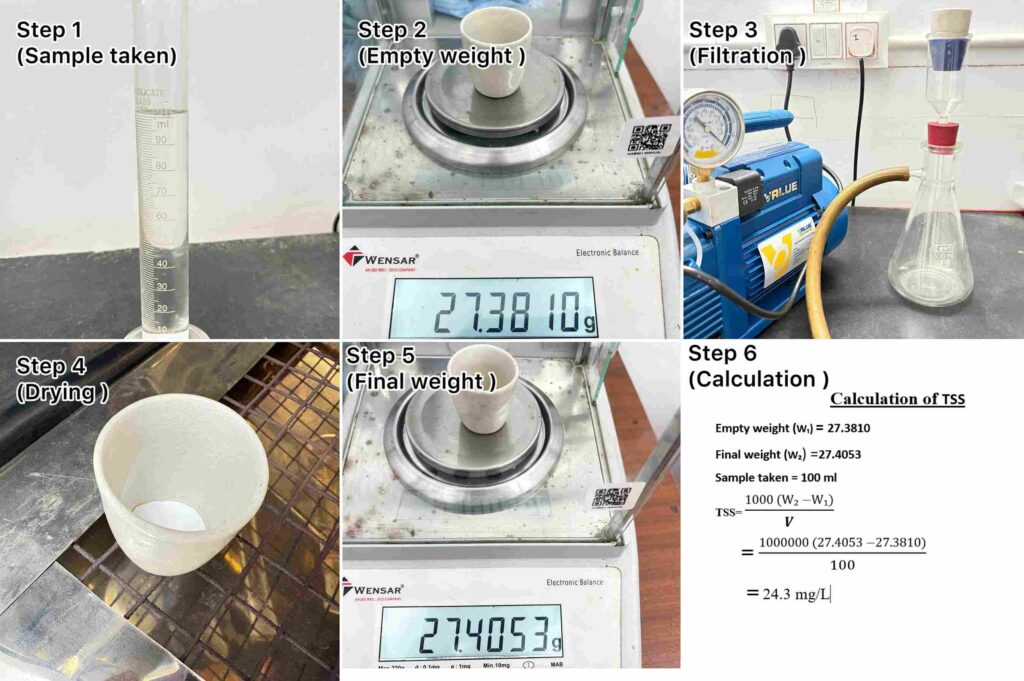
| Prepare Filter Paper | Dry the filter paper with gooch crucible in an oven at 103–105°C for 1 hour. Cool in a desiccator and weigh (W₁) |
| Filter the Sample | Measure a known volume of well-mixed water sample (usually 100 mL). Filter the sample through the pre-weighed filter paper. |
| Dry the Filter Paper | Transfer the filter paper containing the retained solids into the oven. Dry at 103–105°C for 1 hour. |
| Cool & Reweigh | Place it in a desiccator to cool. Weigh again (W₂). |
| Calculation | TSS(mg/L)= 100000 (W₂ –W₁)/ V (W₂ –W₁)= mass in mg of non-filterable residue, V = volume in ml of the sample. |
Purpose of TSS Testing
- To assess water clarity-High TSS indicates cloudy water, affecting visibility and appearance.
- To evaluate pollution levels-Suspended solids often carry organic waste, silt, industrial residues, and pathogens.
- To monitor wastewater treatment efficiency-TSS helps check whether settling, filtration, or aeration processes are working properly.
- To prevent filter clogging-High TSS can damage RO membranes, pipes, and filtration systems.
- To assess drinking water safety-Lower TSS improves taste, odor, and overall physical quality.
Handling Mistakes in TSS Testing
- Not mixing the sample before filtration-Suspended solids settle quickly,not stirring gives lower TSS values.
- Using a wet or partially dried filter paper-Moist filters increase weight and lead to false high results.
- Not cooling in a desiccator-Hot filter paper weighs lighter, causing weight fluctuation errors.
- Touching the filter paper with bare hands-Oil or moisture from fingers contaminates the paper and alters weight.
- Using dirty or dusty glassware-Foreign particles add extra solids and give incorrect TSS readings.
- Incomplete filtration-If the sample passes too quickly or filter gets damaged, some solids escape.
- Ignoring vacuum pressure stability-Uneven suction may cause filter tearing or incomplete capture of solids.
Conclusion
TSS detection is a simple gravimetric method that measures the total undissolved particles present in water. It is essential for determining the physical quality of water, pollution level, and treatment efficiency.By following these method, you can easily test the TSS of any water testing laboratory & also manufacturing industry with availability of the equipments. If you can’t understand the procedure you can check our real time photo attached with this writing or also you can reach to Pro Research & Testing Laboratory for the advance testing.
FAQ
1.What is TSS in wastewater?
TSS refers to all undissolved particles organic and inorganic present in wastewater that can be trapped using a filter paper.
2.Why is TSS important in wastewater testing?
It indicates pollution load, treatment efficiency, and compliance with discharge standards
3.How is TSS different from turbidity?
TSS measures the actual weight of solids, while turbidity measures cloudiness using light scattering.
4.Why must the sample be mixed before filtration?
Suspended solids settle quickly; mixing ensures a representative sample
5.Can high TSS affect water treatment plants?
Yes, it can overload filters, reduce aeration efficiency, and increase sludge production..
6.What causes high TSS in wastewater?
Industrial discharge, organic waste, soil erosion, poor settling, and inadequate filtration.
How We Verified This Testing/Research Procedure :
This testing is done under qualified analysts in our lab.Continually monitored by expertise.Repeatedly testing is always done to get accurate result.
Written by
Riya Ghosh (M.Sc. Food Technology, MAKAUT)
Designation – Chemist

Reviewed by
Anwesha Das (M.Sc Microbiology,BU)
Designation – Microbiologist
Verified By
Dr. Jyotirmoy Kumar Dey (Phd,Chemistry)
Designation – Senior/Chief Chemist
Experience – 25 Years +