
Turbidity is a key physical parameter used to assess the quality of drinking water. It refers to the cloudiness or haziness caused by the presence of suspended particles such as clay, silt, organic matter, algae, and microorganisms. These particles scatter light passing through the water, reducing its clarity.
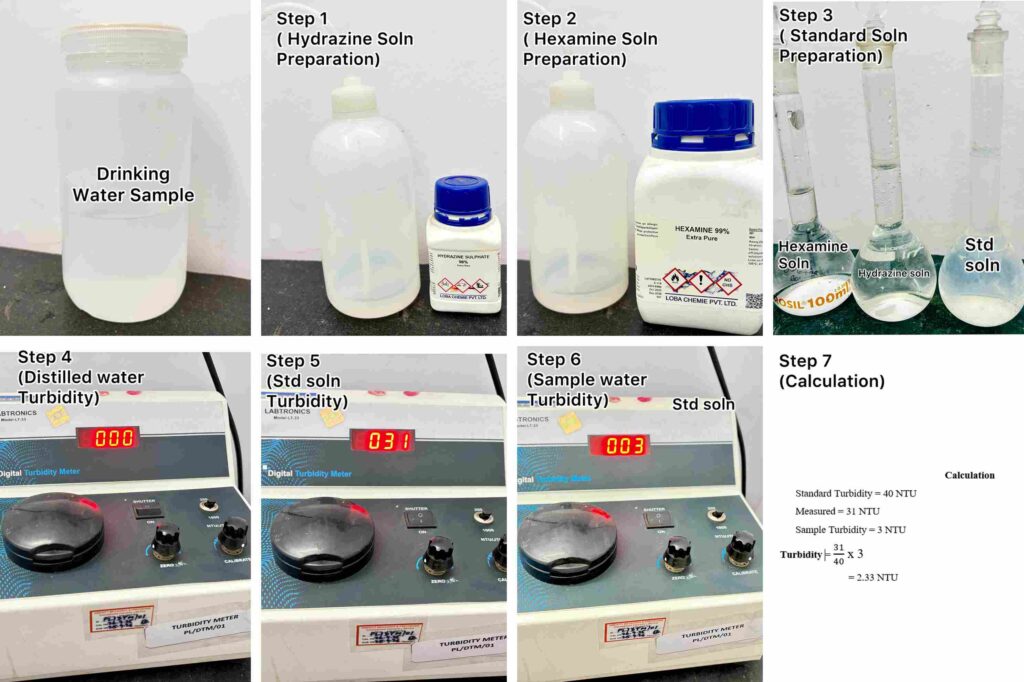
Here We have taken Drinking Water.
Chemicals, Instruments & Glasswares used in the Testing of Turbidity in Water sample:
Instruments & Glassware used
- Turbidity Meter – To measure turbidity.
- Volumetric Flasks (100 ml) –To make up volume to the mark.
Chemicals Used
- Hexamine Solution-Dissolve 10 g hexamine in demineralised water and dilute to 100 ml. It reacts with hydrazine to form a cloudy hazy formazine polymer which has a std turbidity interpretion.
- Hydrazine Sulphate Solution – Dissolve 1 g hydrazine sulphate in demineralised water and dilute to 100 ml.Hydrazine sulfate is used along with hexamine to produce a stable suspension of formazin.
- Turbidity Standard Suspension I ( Formazin) – Mix 5 ml hydrazine sulphate solution with 5 ml hexamine solution. After 24-hour standing dilute to 100 ml with demineralised water and mix well. Prepare fresh monthly.Formazin is used as a standard reference suspension to calibrate turbidity measurements in water (in NTU).
- Turbidity Standard Suspension II – Dilute 10 ml turbidity standard suspension 1 to 100ml with demineralised water, The turbidity of this suspension is defined as 40 Nephelometric Turbidity Units (NTU). Prepare fresh weekly.
- Distilled water-To make standard.The conductivity of distilled water should be <5 μS/cm to prevent contamination.
Analytical Procedure To Test Turbidity in Water:
- Switch on the instrument & allow to warm for 20 minutes at room temperature(22°C-25°C)
- Set the instrument to 0.000 with the distilled water
- Calibrate with standard turbidity Solution (40 NTU).Note the value.
- After the calibration measure the turbidity of the test sample.
Calculation:
Turbidity(NTU)= Sample reading X (standard reading/standard suspension)
Purpose of Turbidity Testing in Water Sample:
- To assess the clarity and quality of drinking water.
- To detect the presence of suspended particles and impurities.
- To monitor the efficiency of water treatment processes.
- To ensure water is safe and suitable for drinking.
Handling Mistakes should avoided during the test of Turbidity in Water Sample:
- Using dirty or scratched cuvettes – can scatter light and give false high readings.
- Touching the cuvette surface – fingerprints affect light transmission.
- Not mixing the sample properly – uneven distribution of particles.
- Incorrect instrument calibration – leads to inaccurate measurements.
- Improper placement of cuvette in the meter – misalignment affects light detection.
- Using contaminated sample containers & glasswares – introduces additional turbidity.Proper cleaning Process described previously.
Conclusion of the Turbidity testing in Water:
Turbidity testing is a vital step in assessing the quality and safety of drinking water. It provides a quick and reliable measure of the presence of suspended particles that can affect both the clarity and hygiene of water.By following these method, you can easily test the Turbidity of any water at laboratory & also manufacturing industry with availability of the equipments & chemicals. If you can’t understand the procedure you can check our real time photo attached with this writing or also you can reach to Pro Research & Testing Laboratory for the advance testing
FAQ on Water Turbidity Testing:
- What is turbidity?
Turbidity is the cloudiness or haziness of water caused by suspended particles like dirt, silt, and microorganisms.
- What unit is used to measure turbidity?
Turbidity is measured in NTU (Nephelometric Turbidity Units). - Why is turbidity testing important?
It helps assess water quality, detect contamination, and ensure safe drinking water. - Which instrument is used to measure turbidity?
A turbidity meter is commonly used. - Is turbidity testing only for drinking water?
No, it is also used in rivers, lakes, wastewater, and industrial water monitoring. - What is calibration in turbidity testing?
It is the process of adjusting the instrument using standard solutions to ensure accurate readings.
How We Verified This Testing/Research Procedure :
This testing is done under qualified analysts in our lab.Continually monitored by expertise.Repeatedly testing is always done to get accurate result.
Written by
Riya Ghosh (M.Sc. Food Technology, MAKAUT)
Designation – Chemist

Reviewed by
Anwesha Das (M.Sc Microbiology,BU)
Designation – Microbiologist
Verified By
Dr. Jyotirmoy Kumar Dey (Phd,Chemistry)
Designation – Senior/Chief Chemist
Experience – 25 Years +