
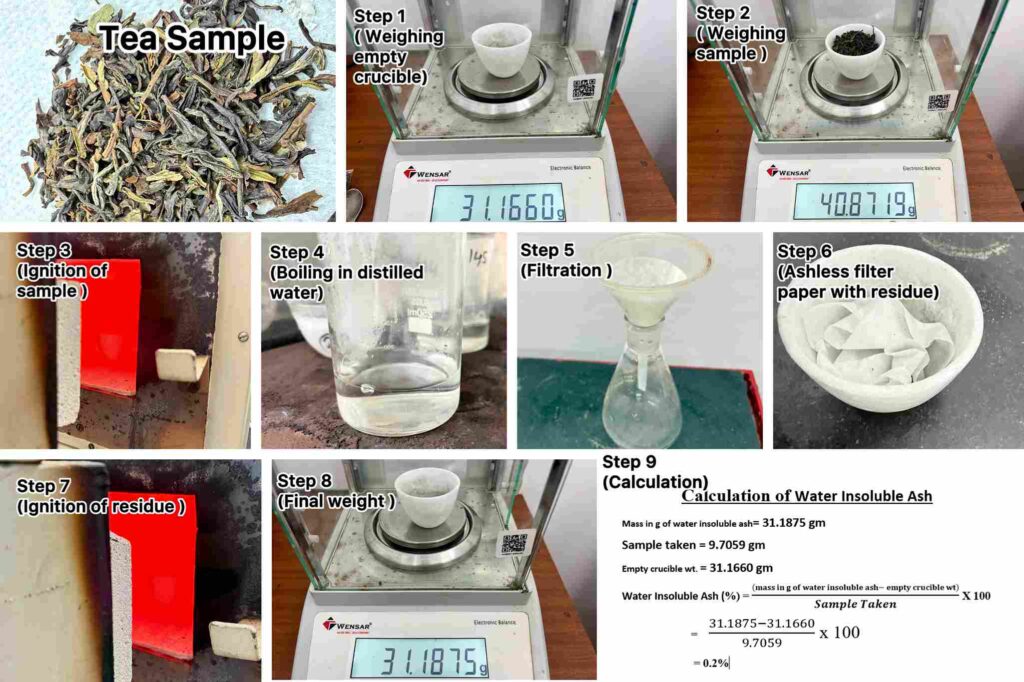
Water insoluble ash testing is an important quality control method used to determine the amount of inorganic impurities such as dirt, sand, and siliceous matter present in a sample. After obtaining the total ash, it is treated with water to separate the soluble and insoluble portions. The residue that remains undissolved represents the water insoluble ash, which indicates the purity and cleanliness of food products, spices, and herbal materials. Here we are testing water insoluble ash for Darjeeling tea leaves sample.
Equipments Required-
- Muffle furnace-Used to ash the organic matter in the food sample, leaving behind inorganic residue for analysis.
- Silica crucible-Holds the food sample during ashing in the muffle furnace; it resists high temperatures.
- Analytical balance(4-digit)-Accurately weighs the sample used in the test.
- Ashless Whatman 1 filter paper – To collect the residue by filtering the sample. this type of filter paper is used only to detect the contamination present in the food sample where the weight of the filter paper is negligible.
- Distilled Water – To dissolve the ash.The conductivity of distilled water should be <5 μS/cm to prevent contamination.
Procedure
| Sample Preparation | Take weight (about 10 g) of tea sample & make it ash.Procedure described previously |
| Boiling of distilled water | Add 50 ml of distilled water and boil for 5 minutes. |
| Filtration & Ignition | Filter the mixture through an ashless filter paper (whatman 1). Transfer the filter paper with residue to a pre-weighed silica crucible. Dry and ignite again in the muffle furnace at 550°C until constant weight is obtained. Cool in a desiccator and weigh. |
| Calculation | Water Insoluble Ash(%) = (mass in g of water insoluble ash- empty crucible wt) X 100/ sample taken |
Purpose of Testing
- To check the presence of dirt, sand, dust, and other inorganic contaminants in the food samples. e.g. If any spice is contaminated with sand, it can be easily detected by this method.
- To ensure the food materials are clean, safe, and hygienic for consumption.
- To detect adulteration, such as addition of mineral material in herbal powders.
- To assess the quality and purity of processed food samples.
- To evaluate good manufacturing and handling practices during plucking, drying, and packing.
Handling Mistakes
- Incomplete ignition of ash or filter paper leads to higher residue weight.
- Using a wet or warm crucible for weighing gives incorrect results.
- Contamination from dust, tongs falsely increases water insoluble ash.
- Spillage of ash during transfer or filtration causes lower values.
- Improper filtration (using damaged or folded filter paper) residue may pass through.
- Insufficient boiling time of ash with water incomplete dissolution of soluble salts.
- Weighing without cooling in a desiccator moisture affects final weight.
Conclusion
The water-insoluble ash test determines the amount of mineral matter in any food samples like spices (turmeric, black pepper, cumin etc), herbal food ingredients that does not dissolve in water, helping identify adulterants such as sand, soil, dust, or other insoluble impurities. A low value indicates good-quality, clean food, while a high value suggests contamination or poor processing. This test ensures the safety, purity, and authenticity of food for consumer use.By following these method, you can easily test the water-insoluble ash of any food products at laboratory & also manufacturing industry with availability of the equipments & chemicals. If you can’t understand the procedure you can check our real time photo attached with this writing or also you can reach to Pro Research & Testing Laboratory for the advance testing.
FAQ
1.Why measure water insoluble ash?
To check the amount of non-soluble inorganic impurities (mainly dirt/sand).
2. Is total ash and water insoluble ash same?
No. Water insoluble ash is a part of total ash representing only the water-insoluble.
3. Which types of tea can be tested by this method?
Any tea like CTC Tea,Assam Tea,Black Tea,Green Tea etc can be tested by this method.
4. Why it is important to wash the residue?
To remove water-soluble salts that would otherwise give a false high reading.
5. At what temperature is ignition done?
Typically 600–700°C until residue turns white/grey.
6. Does water insoluble ash affect tea taste?
Yes, impurities like sand or dirt can affect flavor and quality.
How We Verified This Testing/Research Procedure :
This testing is done under qualified analysts in our lab.Continually monitored by expertise.Repeatedly testing is always done to get accurate result.
Written by
Riya Ghosh (M.Sc. Food Technology, MAKAUT)
Designation – Chemist

Reviewed by
Anwesha Das (M.Sc Microbiology,BU)
Designation – Microbiologist
Verified By
Dr. Jyotirmoy Kumar Dey (Phd,Chemistry)
Designation – Senior/Chief Chemist
Experience – 25 Years +