
Copper is an essential trace element required for various physiological functions in the human body, but excessive intake can be toxic. Therefore, determining copper content in food is important to ensure nutritional adequacy and safety. The Sodium Diethyldithiocarbamate (NaDDC) spectrophotometric method is a widely used colorimetric technique for the estimation of copper in food samples.
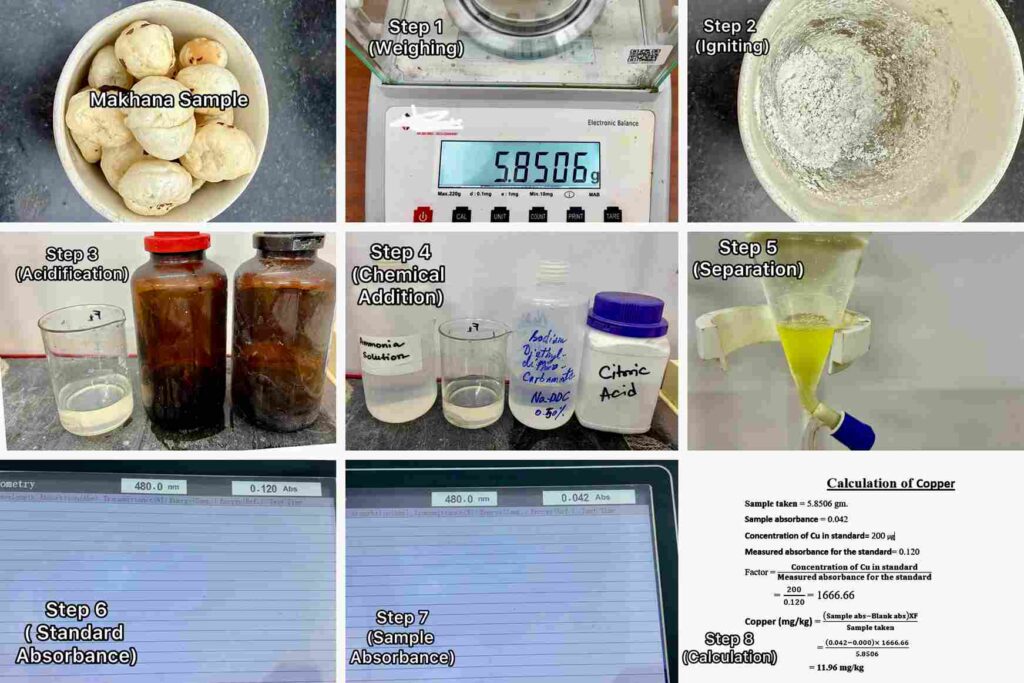
In this method, copper ions (Cu²⁺) present in the digested food sample react with sodium diethyldithiocarbamate to form a yellow-colored Cu–DDC complex. This complex is extracted into an organic solvent such as chloroform and its absorbance is measured using a spectrophotometer, typically at a wavelength of around 480 nm. The intensity of the color produced is directly proportional to the amount of copper present in the sample.
Cu2++2 NaDDC→ Cu(DDC)2+2Na2+
Apparatus & chemicals used
| Spectrophotometer | Measures the absorbance of the yellow-colored CuDDC complex at a specific wavelength to determine copper concentration. |
| Muffle furnace | Used to ash the organic matter in the food sample, leaving behind inorganic copper residue for analysis. |
| Silica crucible | Holds the food sample during ashing in the muffle furnace; it resists high temperatures. |
| Analytical balance(4-digit) | Accurately weighs the sample and reagents used in the test. |
| pH meter | To check the pH-7. |
| Tongs | Used to handle hot silica crucibles safely after ashing. |
| Desiccator | Cools the crucible and ash in a moisture-free environment to prevent absorption of moisture before weighing. |
| Hot plate | Heats and digests the sample with acids to dissolve copper residue before color development. |
| Separating funnel(250ml) | Used for extraction of the complex into an organic solvent (such as chloroform). |
| Beaker(250ml) | For mixing and transferring solutions during digestion and extraction steps. |
| Watch glass | Covers beakers during heating to prevent sample loss and contamination. |
| Pipette(5ml,1ml) | Measures and transfers precise volumes of reagents and solutions during testing. |
| Nitric acid | Used for digestion of the food sample to release copper ions from the organic matrix. |
| Hydrochloric acid | Maintains the required acidic medium and prevents precipitation of copper hydroxides, ensuring complete complex formation. |
| Sodium diethyldithiocarbamate | Reacts with Cu²⁺ ions to form a colored complex measurable by spectrophotometer. Dissolve 0.5 gm NaDDC in 100 ml distilled water.Here we have used all the following chemicals/reagents of Nice company. You can use the same company or any other companies |
| Ammonia | Used to adjust the pH-7 to the optimum range for complex formation; too low or too high pH prevents proper color development. |
| Standard copper solution | Dissolve 0·2 gm of copper sulphate with 6 ml of 1 : 1 nitric acid. Add 1 ml of concentrated sulphuric acid and evaporate the solution to dryness. Dilute the solution to 1 litre with distilled water. 1 ml =200µg of Copper |
| Chloroform | Serves as the organic solvent to extract the yellow copper–NaDDC complex. |
| Citric acid | Acts as a masking agent that prevents interference from other metal ions (like Fe, Zn) by forming stable complexes with them. Dissolve 0.5 gm citric acid in 100 ml distilled water. |
Procedure to test
| Weighing & Igniting | Take 5 gm sample & ignite in muffle furnace until it turns into ash. Process described previously. |
| Acidifying | Take the ash in a beaker. Add 5 ml HCL & 1 ml HNO₃. Add 50 ml distilled water. Boil gently at 80-90°c for 15 minutes. |
| Filtration | Filter in a 100 ml volumetric flask using filter paper. Adjust pH by using ammonia solution. Add 5 ml NaDDC into it. Volume make upto the mark. |
| Std solution | Pipette 1 mL of the copper std solution into a 100 mL volumetric flask. Prepare std as sample. Dilute with distilled water to mark. |
| Extraction | Take the solutions into separating funnel. Add 5 ml citric Acid & 10 ml Chloroform into it. Shake well & let the chloroform layer to be separated. |
| Measuring the Absorbance | Take the chloroform layer & measure the absorbance at 480 nm. Run a blank sample in the same way. Perform the test at least in 3 set to get accurate result. |
| Calculation of Copper | F=C/A C = Concentration of Cu in standard (mg/L) A = Measured absorbance for the standard F =Cu factor Copper(mg/kg)= (Sample abs-Blank abs) x F/Sample taken |
Purpose of Copper Testing in Food
- To check if copper in food is safe for eating.
- To find out how much copper is present.
- To detect any copper contamination from utensils or machines.
- To make sure the food follows safety rules and standards.
- To keep the food quality and nutrition correct.
Handling Mistakes While Doing Copper Testing
- Improper digestion of sample – Incomplete acid digestion leaves undissolved copper, giving low results.
- Wrong pH adjustment –Too acidic or too basic solution hampers proper color formation of the CuDDC complex.
- Contaminated glassware –Residual copper or chemicals can cause high readings.
- Improper extraction in separating funnel –Incomplete mixing or layer separation leads to loss of complex in aqueous layer.
- Using old or impure reagents –Especially NaDDC can decompose and affect color intensity.
- Delay in measurement –The yellow complex may fade with time; absorbance should be measured immediately.
- Air bubbles in pipette or spectrophotometer cuvette – Causes reading errors; remove bubbles before use.
- Incorrect wavelength setting –Wrong spectrophotometer wavelength gives inaccurate absorbance results.
- Not using blank properly –Skipping reagent blank correction gives wrong copper concentration.
Conclusion of Copper Testing in Food
Copper testing by the sodium diethyldithiocarbamate method helps accurately determine the amount of copper present in food samples. The yellow-colored Cu–NaDDC complex measured by spectrophotometer gives reliable results. This test ensures that the copper level is within safe and permissible limits, maintaining food safety, quality, and nutritional balance.To perform copper test at any manufacturing company or laboratory should ensure by following standard procedures mentioned above to accurately determine the copper and assess the quality of any food with availability of the apparatus & chemicals and also the above real-time photo attachment will help to understand the testing process completely. In addition, if expert guidance is needed ,please reach out to Pro Research & Testing Laboratory.
FAQ
Q1. What is the purpose of copper testing in food?
A:To check whether the copper content in food is within safe and acceptable limits for human consumption.
Q2. Which method is used for copper testing in food?
A:The Sodium Diethyldithiocarbamate (NaDDC) spectrophotometric method is commonly used.
Q3.Why is acid digestion done before testing?
A:Acid digestion (using nitric acid) breaks down organic matter and releases copper into a soluble form for accurate testing.
Q4. Why is chloroform used in this test?
A:Chloroform extracts the yellow CuDDC complex because it is soluble in organic solvent but not in water.
Q5. Why is pH control important during the test?
A:Proper pH ensures complete complex formation; wrong pH can prevent color development or cause interference.
Q6.What can cause errors in copper testing?
A:Contaminated glassware, improper extraction, wrong wavelength, or old reagents can give inaccurate results.
How We Verified This Testing/Research Procedure :
This testing is done under qualified analysts in our lab.Continually monitored by expertise.Repeatedly testing is always done to get accurate result.
Written by
Riya Ghosh (M.Sc. Food Technology, MAKAUT)
Designation – Chemist

Reviewed by
Anwesha Das (M.Sc Microbiology,BU)
Designation – Microbiologist
Verified By
Dr. Jyotirmoy Kumar Dey (Phd,Chemistry)
Designation – Senior/Chief Chemist
Experience – 25 Years +