
E. coli or Escherichia coli are gram negative bacteria of Enterobacteriaceae family. E. coli are commonly found human feces and feces of other animals. They comes under a wide group of bacteria called coliform group of bacteria. Consumption of food, contaminated with E. coli will cause food poisoning with serious adverse health effects in human. Thus it is recommended to check the food quality for presence or absence of Escherichia coli in food. Contamination of food or water samples with Escherichia coli usually indidcates that the food or water get contaminated with fecal matter or sewage waste.
Here we take soanpapri sample to isolate bacteria.
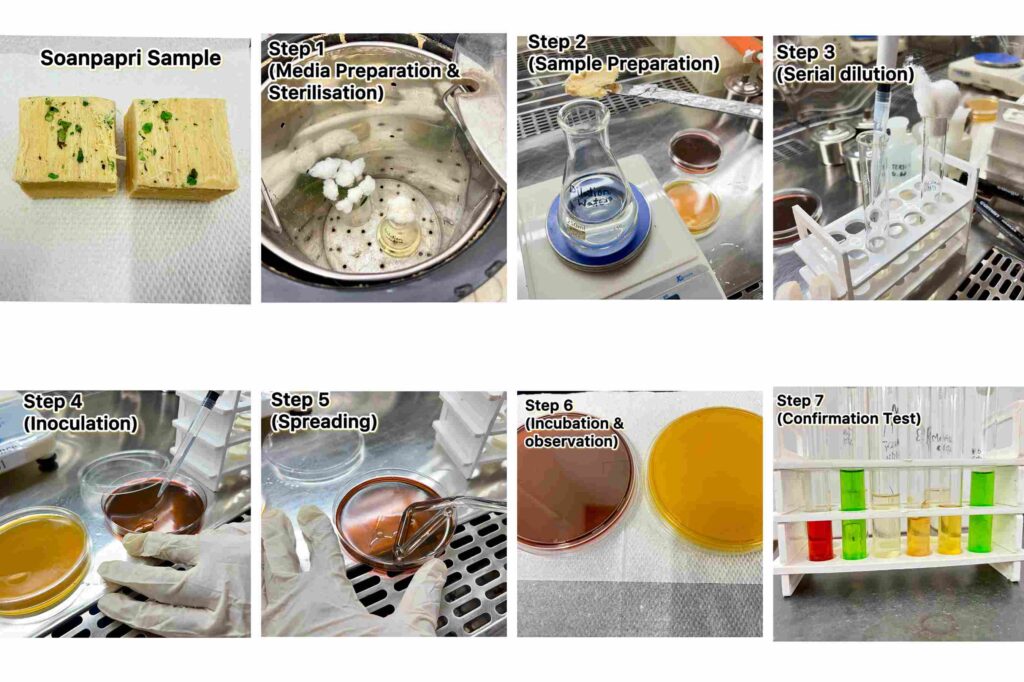
INSTRUMENT USED during isolation of E.coli from food :
- Weight Balance : To weigh the media that supports the growth of bacteria.
- pH meter: Used during media preparation.Proper pH ensure the expected microbial growth.
- Vortex : Used to proper mixing or homogenising the diluted sample.
- Autoclave : For sterilization of equipments at 121°C & 15 lbs pressure( it is the minimum & standard temperature which kill microorganism & its spore) and for disinfection of all equipments at same temperature & pressure after completion of testing.
- BioSafety Cabinet: Use to perform the whole testing in a sterilized environment.The testing should performed inside the biosafety cabinet only otherwise contamination can be occured which ultimately leading to the inaccurate result.
- Bunsen Burner or Spirit Lamp: Generate heat which is use to sterilize forcep for avoid contamination.
- Incubator(37°±2): Incubators are equipment used in biological laboratories to grow, maintain or revive bacteria. Incubators have specific temperature range optimum for growth .
CHEMICAL & GLASSWARE USED during isolation of E.coli from food:
- Sterile Petri Plates : Growth media is pour into this plates.
- Sterile Conical flask : To prepare media.Capacity of the flask will depend on the amount of media prepared. Here we use 250ml capacity for 100ml media.
- Sterile Tubes(12 ml): Used to perform biochemical test
- Micropipette(1 ml) & Spreader : Use to precisely measure the diluted sample & spreader used to spread the inoculumn on agar plates.
- Measuring Cylinder : To measure distilled water during media preparation.We use 10 ml & 100ml measuring cylinder for this test.
- Distilled Water : To prepare media. Distilled water should be autoclaved & contamination free.The conductivity of distilled water should be <5 μS/cm to prevent contamination
- 70% Isopropyl Alcohol or 70% IPA:Use as sanitizer to perform testing properly. Add 70 ml isopropyl alcohol in 30ml of distilled water.
- Gloves,Cap & Mask : To maintain proper sterility inside the biosafety cabinet.Bare hands can contaminate the equipments which affect the result accuracy. If you don’t wear gloves & masks can affects on analyzer’s body also.
MEDIA USED during isolation of E.coli from food & ITS WORKING PRINCIPLE:
| Dilution Water | Dilution water is a non-selective liquid medium to dilute the concentration of sample. We use commercially purchased dilution water to dilute the sample. 25 g of samples to be mixed with 225 ml of dilution water to make the concentration to 10-1. Any alteration in sample quantity will hamper the bacterial count.Preparation described previously |
| Mac Conkey Agar | Mac Conkey Agar is a differential and selective media that is used to isolate and differentiate Escherichia coli from food samples. Typical Escherichia coli colonies pink to red coloured colonies. Here we prepare 400 ml by adding 22.01gm Mac Conkey Agar in 400 ml distilled water |
| Tergitol 7 Agar | Tergitol 7 Agar is used to selectively isolate and count E. coli from a food sample. This agar selectively inhibit the growth of gram positive bacteria and allow the growth of E. coli. Typical E. coli will give distinguishable yellow colored colony with red centre. Here we prepare 400 ml by adding 13.25 gm Tergitol 7 Agar in 400 ml distilled water. |
| Gram Stain Kit | We use commercially purchased readymade gram stain kit. This is used to stain and differentiate between gram positive and gram negative bacteria. Gram positive bacteria appears as violet and gram negative bacteria appears as pink under microscope. E. coli is a gram negative bacteria and appears as pink under microscope. |
| Motility Medium | E. coli are motile bacteria. Suspected E. coli colonies will show motility when cultured in this media.Here we prepare 50 ml by adding 1.1 gm in 50 ml distilled water. |
| Kovac’s Reagent | This reagent is used to perform Indole test to detect E. coli. Suspected E. coli colonies are to be inoculated in tryptone water and incubated overnight. After addition of Kovac’s reagent to the medium, red rig will appear on top of the medium if the suspected colony is positive for E. coli. |
| Triple Sugar Iron(TSI) Agar | This media is used to identify E. coli. We use commercially available readymade TSI agar. E. coli will give red and yellow color in TSI media and produce gas.Here we prepare 50 ml by adding 3.226 gm in 50 ml distilled water |
| MR-VP Reagent | MR and VP are two different reagents i.e Methyle red and Voges Proskauer reagent.E. coli to be inoculated in tryptone water for overnight. MR reagent when added to the medium, a positive colony for E. coli will show red color formation on the top of the medium. Whereas, when VP Reagent added to the medium it will appear pink color of the medium. A suspected E. coli colony will give negative result for VP test.Here we prepare 50 ml by adding 0.85 gm in 50 ml distilled water |
| Citrate Agar | Citrate agar is used to check the citrate utilisation charecter of bacteria. A postive reaction will change the green color of the medium to blue.A suspected E. coli will give negative result (No color change of the medium).Here we prepare 50 ml by adding 1.214 gm 50 ml distilled water |
| Urea Agar | Urea agar is used to check the urea utilisation charecter of bacteria. A postive reaction will change the yellow or straw color of the medium to pink.A suspected E. coli will give negative result (No color change of the medium).Here we prepare 50 ml by adding 1.26 gm in 50 ml distilled water |
| Tryptone Water | Tryptone Water are non selective growth medium that support growth of any kind of bacteria. We use tryptone water to maintain the viability or purity of any selected bacteria. Here we prepare 50 ml by adding 0.75 gm in 50 ml distilled water |
| Sucrose & Salicin | Sucrose and salicin are sugars that E. coli has the ability to utilise carboghydrate sugars and product gas and acid. E. coli when inocultaed in tryptone water with added salicin and sucrose it will producse gas.Prepare both Sucrose & Salicin 1 % (1gm in 100 ml distilled water). |
SAMPLE STORAGE
| Storage | Escheriachia coli is a potent pathogen for human. Any food suspected of having E. coli must be handled and store with maximum care. Food samples suspected of E. coli must be preserved carefully under refrigerated condition (4°C-8°C) and with separation from other items. A close contact may initiate contamination. |
| Pre-Analytical Processing | Before conducting the analysis, food samples must be stored at room temperature for 15-20 minutes to bacteria become viable. If possible food samples must be homogenised and mixed for well and equal distribution of bacteria. |
METHOD FOLLOW TO TEST THE E.COLI IN FOOD SAMPLE
| Preparation of Dilution Water | Preparation described previously |
| Sample Preparation | 25 g of samples to be mixed with 225 ml of dilution water to make the concentration to 10-1. Mark it as 10-1 and mix it with a vortex machine. Hand vortex may be done as an alternative. Keep it for 5-10 minutes to suspend the food particles at the bottom of the flask to avoid contamination. Transfer 1 ml from this to a 9 ml tube and mark this dilution as 10-2. Make this serial dilution up to 10-6 or as required. |
| Plating | Pour 1 ml from each dilution to Mac Conkey Agar plates and Tergitol 7 agar plates. Spread the plates with a sterile spreader for uniform distribution of bacteria all along the plates. Perform the test in duplicate sets. |
| Incubation | Incubate the plates at 37°±2 for 24 hours. |
| Observation | After 24 hours of incubation observe the plates for identical colonies of Escherichia coli. E. coli colonies will appear red to pink colored colonies on Mac Conkey Agar and distinguishable yellow colored colony with red centre on Tergitol 7 Agar. Count the numbers of identical colonies on Tergitol 7 agar and proceed for biochemical confirmation tests. |
| Biochemical Identification | A series of biochemical tests are performed to identify Escherichia coli colonies. 1. GRAM STAIN TEST: Details described previously. 2. INDOLE TEST: Inoculate 1 selected colonies from tergitol 7 agar in tryptone water broth and incubate the tube at 37°±2 for 24 hours. After 24 hours add 1-2 drops of Kovac’s Regent on the top of the media. Red ring will appear on the top of the media if present for E. coli. 3. MOTILITY TEST: Stab and inoculate 1 suspected E. coli colony in motility media 37°±2 for 24 hours.. E. coli are motile bacteria. After 24 hours of leaf like appendages will appear along the line of stabbing suggestive of motility charecter. 4. METHYLE RED TEST: Inoculate 1 suspected E. coli colony in MR-VP medium and 37°±2 for 24 hours. After 24 hours add methyl red dropwise on top of the medium. A red color appear for the positive cases. E. coli are positive to MR test. 5. VOGES-PROSKAUER TEST: Inoculate 1 suspected E. coli colony in tryptone broth solution and incubate it at 37°±2 for 24 hours. After 24 hous add Barritt Reagent A & B dropwise on top of the medium. A red color will appear for the positive cases. E. coli are negative to VP test and no red color will appear. 6. CITRATE UTILISATION TEST: Inoculate 1 suspected E. coli colony on Citrate Agar and incubate it at 37°±2 for 7 days. A positive test will change the color of the medium from green to blue. E. coli is negative to this test and the color of medium will remain green. 7. TSI AGAR TEST: Inoculate 1 suspected E. coli colony on TSI Agar and incubate it at 37°±2 for maximum 3 days. E. coli will give yellow colour and produce gas in the media. 8. UREASE TEST: Inoculate 1 suspected E. coli colony on Urease Agar and incubate it at 37°±2 for 24 hours. Bacteria that utilise urease medium will give pink color to the media. E. coli is negative to this test and no color change will observe. 9. CARBOHYDRTAE UTILISATION TEST: Inoculate 1 suspected E. coli colony in tryptone broth containing sugars like salicin and Sucrose. E. coli ferment sugars in growth medium and produce Carbon Di-oxide gas, which can be observed under inverted Durham’s tube. Tube with suspected E. coli colonies will produce Carbon Di-Oxide gas under Durham’s Tube. |
| Calculation & Result | Calculate the total number of confirmed, identical E. coli colonies using the following formula when Total number of colonies counted is more than 15. N = ∑C/(2.2 x d x v) N= Total Escherichia coli count ∑C = Total number of identical E. coli colonies counted 2.2 = Dilution constant d = Dilution Factor v = Volume of Inoculum For Total number of colonies counted within 4-15 use this formula N= ∑C/vd N= Total Escherichia coli count ∑C = Total number of colonies counted d = Dilution Factor v = Volume of Inoculum For Total number of colonies counted within 1-4 express the result as <40 cfu/gm or Total number of colonies counted less than 1 express the result as <10 cfu/gm Here E.coli is absent in the food sample we take. |
PURPOSE OF E.Coli TESTING IN FOOD SAMPLE:
| Food Safety and Quality | E. coli is a potent pathogenic microorganism. It can cause a wide range of disease in human like food infection, colitis, diarrhoea etc. Any presence of E. coli in food may cause serious health effects. E. coli can found in food due to spoilage, poor processing like inadequate pasteurisation, under cooking of food, contact or contamination with spoiled food. |
| Regulatory Compliance | According to FSSAI guideline in India and guidelines of other regulatory authourity most of the food (raw and processed) must be absent or within very low limit from any pathogenic bacteria including E. coli. Testing food samples for E. coli establish the compliance with regulatory authorities. |
| Sewage Contamination | E. coli is a member of a coliform group of bacteria, especially fecal coliform group of bacteria. contamination of food from E. coli may indicate sewage contamination. |
| Detect Processing and Storage Failure | In raw or processed food industry food items are processed through a series of methods. Mishandling of foods during this processing may contaminate them with E. coli. For example, in dairy industry failed pasteurisation, improperly chilled milk or poorly maintained pipelines can introduce E. coli in milk samples. Handling foods in industry with unwashed contaminted hands, open space, proximity to open grounds or pond may increase the chances of food samples get contaminated with E. coli. |
| Evaluation of Food Safety | Presence of E. coli in food samples indicates that the food is not safe to consume. For some foods like raw meat, raw fish maximum 100 cfu/gm is acceptible as they are a subject of cooking. But any count more than that is not safe to consume. |
Avoid the following mistakes to get proper result in E.coli Testing of Food :
| Sample Size | For enumeration minimum 25 g of sample must be taken to get a high chance. Any more than that may alter the actual result. |
| Media Control and Process Control | For every test in biochemical confirmation a positive control (ATCC/ MTCC E. coli strain) and a blank sample must be done to correctly interpret the results. Media must be prepared with care to avoid any contamination in media. Any contaminated growth can mislead the results. |
| Media Preparation | This test requires preparation of media plates and media slunts. Slunts must be made carefully so that enough surface is available for streaking. Plates and slunts must be cooled properly at room temperature for solidification before working on them. if storage is needed, store the plates at refrigerated condition (4±2°C). |
| Temperature Control | To obtained accurate result, temperatures must be controlled and monitored throughout the process. Temperature of autoclave (121°C), temperature of incubators (37±2°C) must be maintained carefully to properly isolate and estimate E. coli from food samples. |
| Environmental Monitoring | E coli is a pathogenic microorganism and mishandling of this bacteria can cause serious community outbreak. To work with any pathogenic bacteria, laboratories shall maintain controlled environmental conditions like restricted entry inside the laboratory, separate and isolated microbiological workspace, an environment with minimum bioburden load, proper disposal of contaminated samples and a clean and sterile biosafety cabinet. |
| Glasswares Cleaning & Sterilization | Glasswares should be cleaned properly as mentioned earlier. |
What we can conclude from this testing?
Escherichia coli is a pathogenic microorganism that can cause severe diarrhoea and other enteric diseses in human. E. coli can get transmitted to human via contaminated food. This is a key parameter to determine the safety of a food sample. Foods with minimal load or absent from Escherichia coli are safe to consume, whereas foods with higher count of Escherichia coli are unfit to consume. By using the method mentioned above, you can easily identify and enumerate Escherichia coli in any lab or factory or in other places that has the right equipment and media. This testing process gives you accurate results, which are really important for quality control in many areas. Plus, if you find the procedure confusing, you can look at the real-time photo included with this text, which shows you each step and makes it easier to understand. Also, if you want professional help or need more advanced testing, you can contact Pro Research & Testing Laboratory for your testing needs.
FAQ– Frequently Asked Questions:
- Why it is important to check food samples for Escherichia coli?
Escherichia coli is a pathogenic microorganism, if consumed by human it can cause serious health effects. Also this bacteria spoils foods. - What is the usual sample quantity?
Generally, 25 g of food (or 25 mL for liquid samples) is analyzed unless specified otherwise by the test method or regulation. - Why is enrichment performed before testing?
Enrichment helps recover stressed bacteria that may not grow directly on selective media, increasing the likelihood of detection. - What is the incubation temperature for E. coli?
he temperature depends on the method used. Many ISO methods incubate at 37°C ± 2°C (or as specified in the method) to selectively grow E. coli. - What does a positive E. coli result indicate?
A positive result suggests possible fecal contamination and may indicate inadequate hygiene, improper processing, or post-processing contamination.
How We Verified This Testing/Research Procedure :
This testing procedure is done under qualified analyst .Continually monitored by expertise.Repeatedly testing is always done to get accurate result.

Written by
Anwesha Das (M.Sc Microbiology,BU)
Designation – Microbiologist
Reviewed by
Sramana Ghosh (M.Sc. Microbiology, MAKAUT)
Designation – Quality Manager
Verified By
Tathagata Talukdar (M.Sc,Microbiology) University of Calcutta
Designation – Senior/Chief Microbiologist
Experience – 12 Years + of experience including medical microbiology (NABL 15189) and general microbiology (NABL 17025)