Author name: Pro Research Team

Peroxide Value Testing Process in Oil & Fat Sample in Our Lab

Peroxide value(PV) testing is a crucial analytical method for determining the level of oxidation in oils and fats. It measures the amount of peroxide compounds, mostly hydroperoxides, that are created during the initial stages of lipid peroxidation when oils react with oxygen.The importance of peroxide value testing lies in its ability to detect early oxidative […]

Peroxide Value Testing Process in Oil & Fat Sample in Our Lab Read More »

Nitrite(NO₂⁻) Testing Process Of Water Sample in our lab

Nitrite (NO₂⁻) is an intermediate compound in the nitrogen cycle and is commonly found in wastewater due to agricultural runoff, sewage contamination, or incomplete nitrification. The NEDA method is a sensitive and widely used colorimetric method for nitrite determination in water.Nitrite reacts with sulphanilamide in acidic medium to form a diazonium salt. This salt further

Nitrite(NO₂⁻) Testing Process Of Water Sample in our lab Read More »

Added Urea detection Process in Milk Sample in our lab

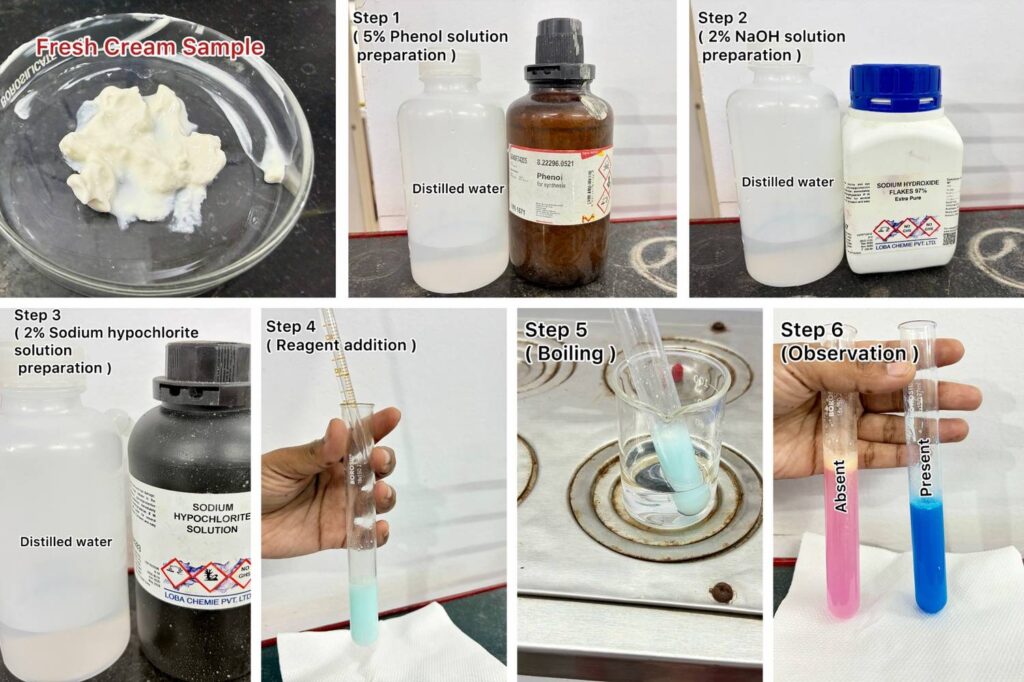
Milk is rich in proteins, fat, lactose, vitamins, and minerals. However, due to increasing demand, milk adulteration has become a significant problem. One typical adulterant is urea, unlawfully added to milk to raise its protein content by increasing viscosity also match with natural solids-not-fat (SNF) level.Very small levels of urea are naturally found in milk

Added Urea detection Process in Milk Sample in our lab Read More »

Cleaning & Sterilization Procedure of glasswares after work(Microbiological Testing) in our lab

The cleaning and sterilization of laboratory glassware is a multi-step process designed to ensure that equipment is properly clean. Proper protocols prevent cross-contamination, protect personnel from hazardous residues, and ensure the accuracy of experimental results.  Materials & Equipments needed in Cleaning & Sterilization Process of glasswares Washing method of glasswares after work(Microbiological Testing) Cleaning Procedure Empty all

Cleaning & Sterilization Procedure of glasswares after work(Microbiological Testing) in our lab Read More »

Cleaning Procedure of glasswares after work(Chemical Testing) in our lab

For Chemical Section Clean glasswares are essential to prevent cross-contamination and chemical interference, which can give false results. The process of glassware cleaning for chemical analysis is as follows. Chemicals used in cleaning process of glasswares after chemical testing Glasswares Washing Method The used glasswares are at first rinsed thoroughly with dilute HCL to remove any inorganic stains.(see

Cleaning Procedure of glasswares after work(Chemical Testing) in our lab Read More »

Instrument Operating Procedure in our lab

Microbiological Laboratory Section Instruments Name Water-Bath Incubator-01 Incubator-02 Incubator-03 Vortex Microscope Colony Counter WATER-BATH Lab ID -PL/DWB/02 Pour distilled water into the water path upto atleast 5 cm above the heating cell in immersed condition.│▼Switch on the hot water bath & set the temperature to 45 ± 1 ℃.│▼Constant temperature is reached with thermostat control.│▼After

Instrument Operating Procedure in our lab Read More »

Instrument Operating Procedure in our lab

Microbiology Laboratory Section Instruments Name Hot Air Oven Autoclave Laminar Air Flow Biosafety Cabinet Lab ID -PL/HAO/02 Switch on the equipment & set the desired temperature by thermostat key.│▼Keep the sample until desired test result.│▼After using switch off the equipment. Precaution Autoclave Model Name – Lab ID – PL/AC/DTC/01 Fill the autoclave (PL/AC/DTC/01) with distilled

Instrument Operating Procedure in our lab Read More »